RUTLAND — A new strategic plan for downtown Rutland, released Tuesday evening, sets ambitious goals for a city struck by Covid-19’s severe economic setbacks.
Hitting mid-swing through a promising revitalization effort, the pandemic’s impact on downtown Rutland has been as cruel as anywhere. Since March, the district has seen the permanent closure of five retail and restaurant businesses and the shutdown of a highly anticipated hotel project.
The city’s mainstay summer concert series, Friday Night Live — which brings in around 2,000 people each event, a dependable boost for downtown businesses — has been called off. And in March, GE Aviation told Rutland employees it would temporarily lay off 60% of its staff, affecting 840 workers.
While Rutland’s unemployment rate of 2.8% mirrored Vermont’s unemployment rate of 2.4% in February, Rutland County now has the third-highest unemployment rate in the state at 21.5%, according to economic data collected by the Federal Reserve Bank of St. Louis. The Northeast Kingdom’s Lamoille and Orleans counties currently have higher unemployment rates, at 25.4% and 24%, respectively.
But none of this has stopped Rutland — or its business owners — from strategizing for a big comeback.
In October, the Downtown Rutland Partnership (DRP) and the Rutland Redevelopment Authority (RRA) took a step toward updating the city’s downtown strategic plan, which hadn’t seen a revision since 2009.
They hired economic development consultant Camoin 310 of Saratoga Springs, New York, which analyzed existing reports and workforce data, led a community open house and walking tour, and assessed the downtown’s economic drivers to identify strengths and weaknesses.
At a Zoom event on Tuesday called “Reimagine Rutland: Downtown Rutland Strategic Plan,” the organizations released a 117-page, data-driven document that lays out, step-by-step, how to make downtown Rutland a more desirable place in which to live, work and to visit.
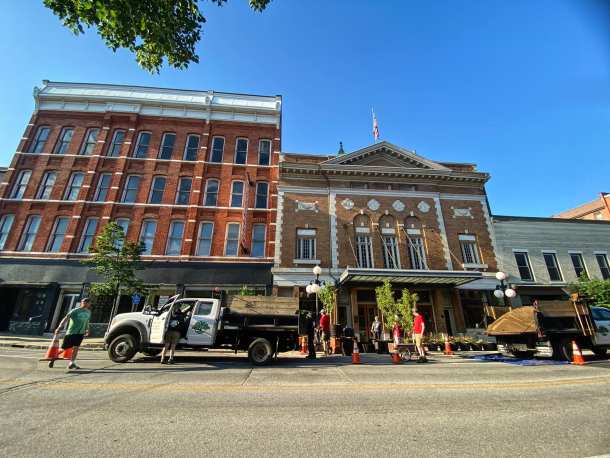
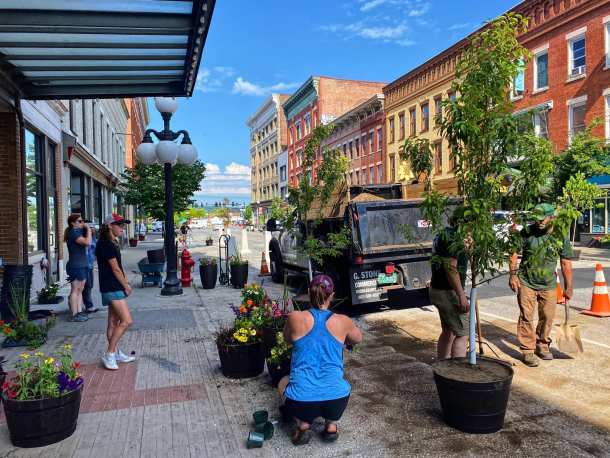
While many of the goals and processes outlined in the plan will take years to implement, downtown will see one immediate change this summer. The City approved a plan last week to transform Center Street, Rutland’s downtown nucleus, into a pedestrian and bike-friendly streetscape.
The makeover, expected to cost $17,820, comes complete with reduced road lane widths, five wooden “parklets” where restaurants can seat guests outdoors, “artistically enhanced” expanded sidewalks featuring local artwork, and streetscape planters that separate pedestrians from cars.
Center Street’s transformation is similar to other Covid-19-era changes to downtown areas around the state. In Brattleboro, for example, the town has reserved parking spaces to help restaurants increase their outdoor dining capacity, and local artists decorate the concrete barriers that separate diners from the roadway.
For Rutland, Center Street’s upcoming “pilot program,” which is currently in progress and has an estimated completion date of early July, is more than just a seasonal reaction to Covid-19. Changes to Center Street have been long-debated, and the success of the summer’s temporary implementation phase will inform more permanent changes in the future.
The trial phase is just one example of the way Rutland’s long-term strategies align with the immediate needs of a city coping with Covid-19.

When the DRP and the RRA began work on the strategic plan in October, they did so without considering the potential impact of a global pandemic. Organizers admit that Covid-19 has made some of the goals outlined in the plan more challenging, but they also say that their implementation could set Rutland up for improved success on the other side.
“We know that the world’s changed significantly since we’ve undertaken this research,” Dan Stevens, project manager with Camoin 310, told an audience of 36 listeners on Tuesday’s call. “But even with that being said, these opportunities the data are finding are very relevant for informing the path forward. Many of these strategies are not only relevant in a post-Covid world, many of them are actually more critical in planning for economic recovery from the crisis.”
That message resonates with Donald Billings, owner of Roots Restaurant and The Bakery in downtown Rutland, along with Mountain Merchant and Cru in Killington.
While none of Billings’ eateries are located on Center Street, he pitched the idea of creating outdoor dining “pods” to Rutland’s Board of Aldermen this spring with the hope that, if the streetscape was worth visiting, downtown Rutland could become a summer destination for state residents from other counties.
“We all go Burlington to walk around and sit outside,” he told Rutland’s Community and Economic Development Committee in May. “Same thing in Waterbury, same thing in Stowe. Every town has their own little thing. It creates such energy, and I feel that this — for a miniscule amount of money in the grand scheme of things — could really change how people view Rutland as a community. Here we are, bonding together to create a different synergy in downtown.”
But Billings got started to ensure his own businesses’ economic sustainability long before the city announced the summer changes to Center Street.
By offering innovative delivery and to-go packages, like adding options to purchase four-packs of Alchemist beer with burger meals, bringing hundreds of discounted lunches to Rutland Regional Medical Center for frontline workers, and installing a large tent on city-owned land adjacent to Roots for outdoor dining, Billings believes he has secured his restaurant’s fate, for now — not to mention the employment of his staff.
Demonstrating inside his restaurant, Billings gestured to lines of food and neatly arranged checks he’s had waiting for pick-up or delivery on recent nights before the state allowed outdoor dining. On one such night, he sold a whopping 148.7 pounds of prime rib, a feat that he called “insane.”

“I feel like we’re going to come out of this OK,” he said. “I mean, our revenue is way off. But this year is not about making money. It’s about controlling what you’re going to lose.”
Steve Peters, executive director of the DRP, says Covid-19 has been pointing some businesses toward more savvy ways of operating, including, for example, the creation of online stores and new offerings, like takeout and delivery.
“And now they’ve had some time, or a reason to do that,” he said. “I think there are some silver linings, sometimes, to having to change, because it allows us to think differently. My organization and other organizations have had some time to stop and say, ‘what can we do now that we wanted to do anyway?’”
Bridget Scott, owner of Center Street’s Speakeasy Cafe, has placed her coffee menus in the cafe windows and organized a one-at-a-time, in-person ordering system, along with online ordering to keep employees and customers safe. She’s also reduced cafe hours and thought deeply about which services will be essential for her to continue operations.
Scott says getting back to the way things used to be isn’t necessarily her goal. Instead, she’s appreciated the work-life balance required by the pandemic.
“The fact of the lockdown is, it’s the first time, kind of in my whole life, that I was forced to sit down, shut up, stop working, and think about what I wanted my life to look like,” Scott said. “And then I realized that I was working a lot. So I started to ask myself if there are ways I can enjoy the life part of the work-life balance a little bit more.”
Scott feels that her customer base, made up largely of regulars, will be game for whatever comes next for Speakeasy Cafe. Her new online store will stay, she said.
Though the pandemic has offered Scott a new perspective, thinking about its potential impact is stressful for her.
“I think too much,” she said. “Every night, I’m sort of half-dreaming about business and wondering if we’re doing everything that we can do, and I’m making plans to shave here, move this, fix that so that things get more and more efficient.”
A pillar of Rutland’s new downtown strategic plan depends on reversing the city’s “poor self image and regional perception limiting growth and opportunities” — a vague and daunting task that will depend partially on attracting a larger population of downtown residents.
Some business owners and downtown partners believe that this image reversal begins with the strength of the downtown business community. Billings drove this point home at the Community and Economic Development meeting.
“I guess I always look at challenges as an opportunity to show somebody what I’m made of,” he said. “I’m looking at this as an opportunity for Rutland to show — not only Rutland County, but the entire southern part of the state, ‘Oh, wow, look at what they’re doing, they’re really pushing the envelope a little bit. Good for them.’”