

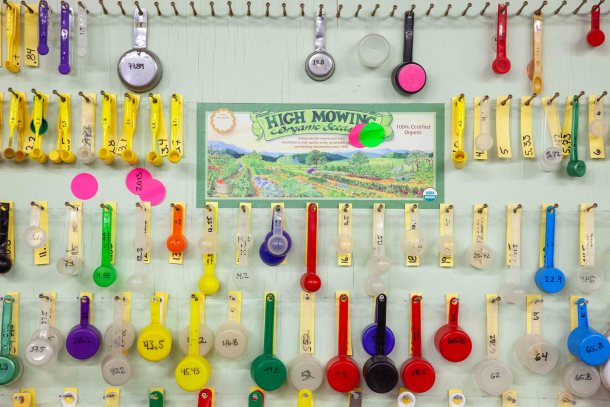
WOLCOTT — The first three months of the year are traditionally the busiest time at High Mowing Seeds, which takes in more than 100,000 pounds of organic seed each year and packages it for customers in every U.S. state and Canada.
But nothing prepared the company for the rush that happened after governors around the nation started shutting down commerce and other activity to suppress the spread of Covid-19.
High Mowing saw its largest-ever sales volume on the weekend after Gov. Phil Scott declared a state of emergency on March 13, said Andrea Tursini, the company’s director of sales and marketing. The orders poured in so rapidly in the following weeks that movement on the website slowed to a crawl, and the company ended up putting the website on hold for two weeks to stop new orders from coming in while it caught up with the ones already waiting to be fulfilled.
High Mowing usually sells $1.5 million worth of seeds between March and the end of the year. “Our sales were 200% and 300% higher for each of those two days” of the weekend after that March 13 announcement, Tursini said. “When we came in on Monday, it was the biggest number of orders we had ever seen in a single import from our website.”
The Covid-19 pandemic, and the emergency measures around it, turned off business altogether in some Vermont sectors and increased it exponentially at others. Companies that make items needed for testing — such as Chroma, which makes lenses for medical instruments in Bellows Falls, and First Light, which makes UV lamps used for sterilization — scrambled to hire as orders flooded in. Shoppers stocked up at grocery stores, causing shortages of some items. But restaurants, salons, lodging, and the many other small operations were ordered to halt all activity, and many are now wondering if they’ll survive another season of Covid-19 restrictions.
For High Mowing, the boost in sales — which hit 500% at some points — increased profits, but only slightly, said CEO Tom Furber.
“We were in the enviable position of having more business than we had anticipated, and we also had more expenses than we had anticipated because of hiring and distancing and the cost of shipping and supplies,” he said.

Of greater lasting impact are the lessons learned as company officials struggled to hire 15 new workers while Vermont was in a state of emergency, to come up with policies for handling social distancing, and to get seed out the door to commercial and residential customers in a timely manner. The company ran out of bulk seed in its most popular varieties, and nearly ran out of its seed packets, purchased from a manufacturer in New York.
Farmers were the first priority. The website, closed to orders, had a message on the home page directing commercial growers to place their orders by phone.
“Our intent was to make sure the people who are feeding our country were able to get the supplies they needed,” said Tursini.
Lessons learned
High Mowing made a sizeable investment last year in new software. That timing was lucky: it made it much easier for the company to switch half of its 50-person staff to remote work very quickly in March.
“Having the flexibility for people to work at home and have the phone systems and meetings and order processing and customer service still functioning, those were huge things,” said Tom Stearns, the company’s founder.
Stearns said he resolved this spring to make sure the website has the bandwidth in the future to handle big surges in traffic. Seventy percent of the company’s annual sales are in January through April.
“Going forward, we’re making sure we’re investing enough in those areas to make us resilient in the face of something like this,” he said.

Back to business as usual
High Mowing doesn’t grow seed; it contracts with about 100 farmers, including Stearns, as well as growers in Vermont, California, Washington, Oregon, Wisconsin, Montana, Idaho, Florida, Israel, and the European Union. It works very closely with growers, and all the seed is sent to Wolcott before being packaged and shipped out to stores, homes and growers in all 50 states and Canada.
Gardening was rising in popularity long before Covid-19 emergency measures put millions of people out of work and raised anxieties about the security of the food supply. The annual National Gardening Survey from the Florida-based Garden Research says young people have been taking up what is sometimes called the nation’s most popular hobby. Lawn and garden spending hit $47.8 billion in 2018, according to Garden Research, with average household expenditure of $503, up nearly $100 over the previous year, the group said.
But this year’s pandemic, and the empty supermarket shelves that resulted from panic buying, really pushed home gardening into high gear. Customers have told Tursini gardening is a perfect complement to the home schooling many parents are suddenly doing because the schools are closed.
And even though true food shortages haven’t materialized, empty supermarket shelves “scared a lot of people,” Tursini said. “To be able to plant their own food, to take some measure of control back at a time that felt very out of control, is something that is compelling.”
Other seed and gardening supply companies are also reporting a massive increase in sales and activity. MarketWatch reported in mid-April that Walmart, Lowe’s, the Burpee seed company, and Target had run out of nearly all fruit and vegetable seeds.
High Mowing is different from those companies, not only because of its scale but because all of its seeds — more than 700 varieties — are certified organic and verified non-GMO.
“You can’t just buy organic seeds; there’s no supply chain,” said Stearns. “We had to build our own.”
Stearns said High Mowing is also different because it works closely with growers in breeding, seed production, cleaning and quality control, and sales and distribution. In the conventional seed business, these functions are carried out by different companies, Stearns said.
“It’s hard to compare us to other seed companies because we’ve been doing everything soup to nuts as we have sort of worked on building a new industry,” said Stearns, who started the company in 1996.
The future
Most businesses and public entities are preparing for another Covid-19 outbreak as the warm weather departs, and High Mowing is as well. Furber is working with the company’s purchasing team to shore up supply where there were shortages this year.
“We’re also looking at hiring in a different way,” Tursini said. The company needed more customer service agents this spring, but didn’t have time to train them. “Those positions can be hard to hire for,” she said. “It’s helpful for those people to have a solid background in gardening or farming. We were a little lean this year even in normal times.”
High Mowing was approved for a Paycheck Protection Program loan of a little over $400,000. The company paid temporary workers this spring $13 an hour.

“The question I wrestled with most was, ‘Do you need the money?’” said Furber. “The conclusion I reached was we didn’t know what would happen, we didn’t know if we’d be shut down, we didn’t know every day whether or not we would have a breakout and would need to keep paying people.” He said he doesn’t yet know if the company will actually use the money.
High Mowing over the last few years has invested heavily in its facilities, IT, and for salaries and health insurance, said Stearns. He said he recently finished raising money for another round of growth and expansion, though he declined to give details.
He said most of the investment will go toward purchasing more seed, increasing quality control, and hiring additional sales and marketing staff.
Stearns thinks the crisis that started in March has taught the public some important lessons about the food supply.
“Seeds are essential,” he said. “We always knew they were essential; our customers knew. Tens of thousands of new people started to realize they were essential. Tens of thousands of new customers were coming to us with letters, emails and phone calls of appreciation and gratitude and anxiety about getting their seeds.”
Get the latest statistics and live updates on our coronavirus page.
Sign up for our coronavirus email list.
Tell us your story or give feedback at coronavirus@vtdigger.org.
Support our nonprofit journalism with a donation.

