

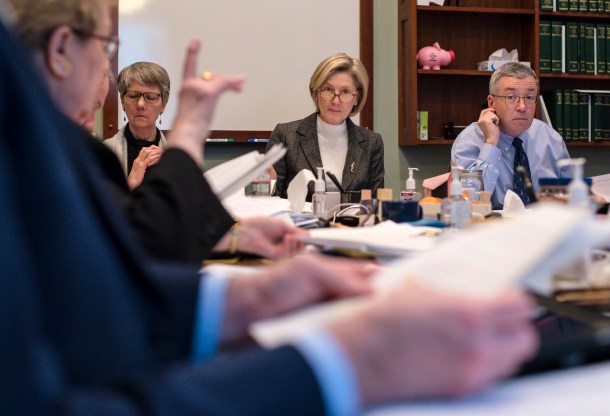
— House Appropriations has moved to reverse budget cuts proposed by Gov. Phil Scott in a partial spending bill for the first quarter of the next fiscal year.
On Wednesday, the committee unanimously passed a budget bill that would fund state government for the first three months of the next fiscal year, which begins on July 1, at about the same level that it did in the first quarter this year.
In anticipation of plummeting tax revenues from Covid-19, the Scott administration pitched a budget last month that would require most agencies to cut their budgets by 2% between July and September — a reduction that would amount to about 8% continued throughout the year.
Rep. Kitty Toll, D-Danville, the appropriations chair, said lawmakers are waiting until the summer to institute any cuts, so that they have time to weigh in on where reductions are made. “Who knows where the areas would be of reduction, because there were no proposed reductions by the governor,” Toll said. – Xander Landen
— the House approved H.716, a bill that would allow Abenaki tribe members to receive free fishing and hunting licenses, after a few failed attempts to amend the legislation and send it back to committee for more discussion.
Some advocates of the bill presented it as a form of reparations for Vermont’s indigenous people, who have suffered the loss of land and hunting rights to some areas. Other lawmakers were concerned that by giving away these free licenses, it would reduce revenue for the state at a time when it’s desperately needed.
Rep. Paul Lefebvre, R-Island Pond, said his committee received estimates from the Joint Fiscal Office that the change could result in about $20,000 in lost revenue. “We did not see this as being a terrible burden on the fish and wildlife department,” Lefebvre said. – Grace Elletson
— The Vermont Bar Association called on Senate Judiciary lawmakers in a new memo to scrap a new fee $5.25 imposed through the judiciary’s new electronic filing system. The Senate panel took no action on the request by the bar association during a Wednesday session.
Instead, Sen. Dick Sears, D-Bennington, the committee chair, said the panel would look for funding sources that could be tapped to cover the money that would be lost if the filing fees were suspended for several months, as it explores the issue. – Alan Keays
— In a Senate Econ committee meeting, Sen. Michael Sirotkin, D-Chittenden, said he’s begun hearing reports from employers that as businesses open up, employees who are receiving unemployment benefits are resistant to go back to work.
“Employers are frustrated,” Sirotkin said, “but a lot of them are gun shy about turning in their employees.”
Cameron Wood, director of the Unemployment Insurance Division, told lawmakers that his department will begin sending notices to both employers and employees that if a worker turns down an opportunity for employment, they might lose their benefit. – Grace Elletson
— Senate Health and Welfare lawmakers are taking up a House bill that would expand contraceptive access in highschools. Specifically, high schools would be required to make condoms available to all students.
When the bill was taken up by House committees earlier this year, concerns were raised that it might also require schools to make Plan B or other morning after pills available. The bill’s language was clarified to only require condoms, a change that got school officials on board.
“We certainly don’t think it’s the place of schools to be involved in that,” said Jay Nichols, executive director of the Vermont Principals’ Association. “We’re comfortable with making condoms available but I do not think schools should be distributing other types of birth control devices or certainly not subscription products.” – Grace Elletson
