


VTDigger posts regular coronavirus updates on this page. You can also subscribe here for daily coronavirus news. Please send your Covid-19 questions to coronavirus@vtdigger.org
SWANTON — When managers at Vermont Precision Tools started talking about Covid-19 safety measures to their partners in Kentucky, their counterparts there were surprised, said President Monica Greene.
“At the point where we started wearing masks internally, those employees (in Kentucky) said, ‘What’s going on? Why are you wearing masks?’” said Greene. “Nobody in that community had gotten to that point.”
Vermont Precision Tools shipped the company, Vermont Thread Gage, 100 masks on April 23.
“We had to communicate to them: ‘This is the scientific reason for wearing them,’” said Rob Green, operations director for the Swanton-based manufacturer, which owns Vermont Thread Gage. The company has 230 workers in Swanton and 120 in Kentucky. “We had started wearing masks even prior to the governor’s guidance.”
Working with its counterpart’s Covid-19 timeline was one of many new adjustments underway for Vermont Precision Tools, which serves as part of the supply chain for the medical device industry.
In the hectic aftermath of Covid-19’s arrival this winter, the initial focus for Vermont businesses was on whether or not they could continue to operate in the face of Gov. Phil Scott’s executive order that non-essential businesses stop their in-person operations.
That was never a question for Vermont Precision Tools, said Greene, who heard early on from customer General Motors.
“We didn’t realize that for the last couple of years, we had been making a part for a ventilator,” Greene said. “We had to scramble to make 100-piece orders into 1,000-piece orders for GM. We’re still working through the ventilator project process for them.”
Other big medical tool customers for Vermont Precision Tools are Medtronic, Stryker, and Johnson & Johnson.
In April, the Vermont Agency of Commerce and Community Development set up a committee called the RestartVT Action Team that developed guidelines behind the opening of every sector of business, including manufacturing, construction, retail and personal services like massage and salons. Green is on a task force of that committee looking at safety measures for manufacturing, fulfillment and distribution.

Vermont Precision had sent 145 workers home on March 26. In hindsight, that was too many, Greene said. They started calling people back to work nearly immediately, with more and more returning each week. The company is back to 90% staffing now.
“In the beginning there were so many unknowns; we were making judgment calls,” she said. “In trying to be on the conservative side, we probably went too deep too fast, and let too many people go too quickly.”
Not all companies have business continuity plans, and even fewer have plans that include the possibility of a flu pandemic, says Bob Zider, director of the Vermont Manufacturing Extension Center in Randolph, who is working closely with private businesses and state officials on business recovery. As it happens, Vermont Precision Tools is one of those few, because its medical customers require it. But the plan didn’t cover all of the needs that arose from the novel 2019 coronavirus, such as putting up physical barriers to separate work stations, and having cleaning and disinfecting supplies on hand.
“We wouldn’t have thought of social distancing,” said Greene. “In the future, in any sort of health crisis, we have the playbook much better defined and we can react quickly and completely.”
The ‘new abnormal’
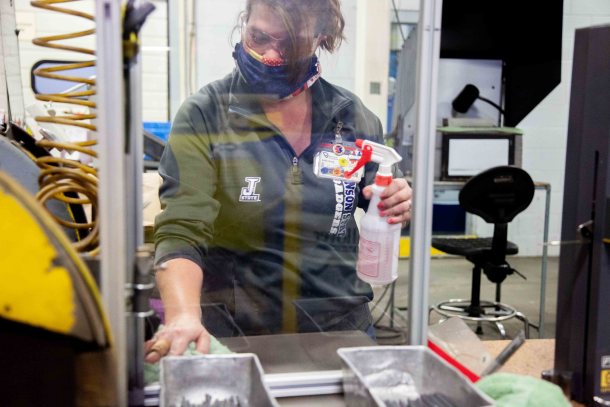
Vermont Precision Tools has always had three shifts, and that continues. Now, when workers arrive, they punch in and then stand in line, 6 feet apart, waiting to answer a brief questionnaire about how they are feeling. Then they have their temperature taken quickly with a forehead thermometer.
Once inside, most workers wear masks all day. In some jobs, they can’t, said Green.
“Having a mask on that could get saturated with oil presents a safety concern,” Green said. “We have air handling that takes the mist away.”
Meanwhile, Green and others who have been designated as official health and safety officers for the company — a state requirement — are constantly looking for other ways to minimize the chance of Covid-19 infection. They also make sure people are complying with the ones in place.
“Obviously this is the new abnormal,” said Green. “People aren’t accustomed to these things.”
The company was closed to all visitors until May 11, when a pair of VTDigger reporters were the first to visit and undergo screening, including questions about travel and a temperature check.
The Vermont and Kentucky plants operate under the same health and safety guidelines. In-person meetings are limited where possible, and when they do happen, participants stay at least 6 feet apart. The conference room now has a sign showing whether the room has been used at all and needs a cleaning.
Occupancy at each 10-foot-long table in the break room is limited to just one; break times have been extended so more people get a chance to use the room. But employees still gather together outside or in their cars to smoke or eat their meals, noted Green.
“That’s frustrating for us to navigate,” said Greene. “Whether it’s lunchtime, weekends, there is always that chance somebody might not be doing what they should.”


Plexiglass shields have gone up all over the company to separate people at places like machine workstations and restroom sinks. Procedures have changed. Instead of walking into someone’s office to drop off a file, Greene said, the company has set up a mail system for exchanging items.
Workers with a temperature of 100 degrees or higher have to stay away until they have been fever-free for at least 72 hours.
A dozen members of the administrative staff have been working remotely since March 25.
“They are feeling a little out of the loop,” said Greene.
A matter of compliance
Vermont residents seem to be ahead of Kentuckians when it comes to measures aimed at minimizing the spread of Covid-19. Gov. Phil Scott issued a “stay home” order on March 24, closing in-person operations for all non-essential businesses and asking all Vermonters to limit their activities outside of the home. As far back as March 11, Kentucky Gov. Andy Beshear was already recommending social distancing. He formally banned “mass gatherings” on March 19. But Greene and Green said that in practice, few of the company’s employees in Kentucky seemed to be taking the recommendations seriously.
“To this day, in the area of Kentucky we are at, it’s still less common to see people wearing masks,” Greene said. “People say 50% of people are wearing masks in Vermont. They (in Kentucky), on the other hand, would say 5 to 10% of people are.”
Two of the workers at the Kentucky plant tested positive for Covid-19. Nobody at the Swanton plant has, Greene said. While the Kentucky plant wasn’t shut down in the wake of those diagnoses, the company did testing and contact tracing and sent many workers home.
“That was frustrating because the testing wasn’t immediately available,” Greene said. The two Kentucky workers who tested positive on April 20 are Bosnian. “And then there is the communication barrier that makes it more difficult.”

An uncertain future
Greene hasn’t yet added up the costs, financial and otherwise, of the safety measures. The company was looking at nearly $40 million in sales this year before the crisis; she said that she expects a lower annual number now, but she’s not making any predictions. April’s profits were down about a third, she said. A federal Paycheck Protection Plan loan — Greene declined to say for how much — has helped.
While the manufacturing task force now has an array of guidelines in place, Zider said he knows that things are still evolving. Safety practices usually have to be tailored to fit each company, and many are still developing their response.
For example, Darn Tough Vermont, the Northfield-based sock-maker, is remotely training employees before they return to the manufacturing floor, said Brent Blevins, general manager of operations.
VMEC worked with the Centers for Disease Control, Vermont Occupational Safety and Health, the state Department of Health, and local and national manufacturers to develop guidelines. In the process, Zider has fielded an array of questions from Vermont manufacturers. He includes a few of his own in a VMEC webinar series.
One is about temperature checks and HIPAA compliance. The state Attorney General’s Office says in an emergency, companies can check employees’ temperatures, he said.
Another is from manufacturers with factory stores whose staff are worried about handling customers in the age of Covid-19.
“What if somebody comes in who won’t wear a mask, and what if they refuse to leave?” said Zider. “Those anxieties are very real.”
Vermont doesn’t require anyone to wear a mask in public, but stores can insist. VMEC’s webinars suggest good signage making that clear.
Employers who have remote workers, including the state of Vermont, are in no hurry to return those workers to the office. At Darn Tough, Blevins said there’s no immediate plan to call back the staff who have been working from home.
“They can do their jobs perfectly adequately remotely,” he said. That includes people who work in accounting and finance, customer and dealer service, and continuous improvement management.
“We can make do without that for now,” Blevins said. “If you’re not putting your hand on a sock, we would rather you stayed home for now.”
Get the latest statistics and live updates on our coronavirus page.
Sign up for our coronavirus email list.
Tell us your story or give feedback at coronavirus@vtdigger.org.
Support our nonprofit journalism with a donation.
