

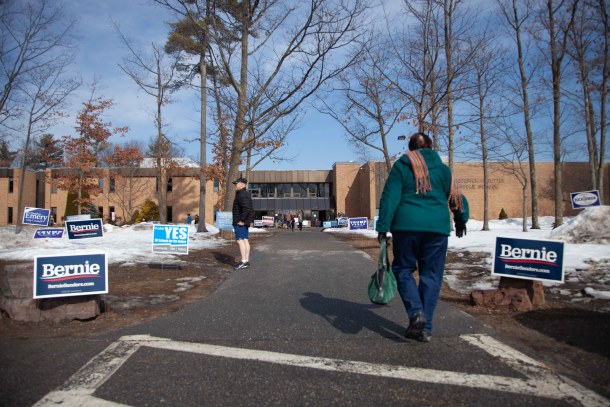
As health officials encourage Vermonters to continue social distancing in an effort to suppress the novel coronavirus, municipal leaders are grappling with how the measures could affect three rounds of elections slated to occur in the coming months.
In addition to the general election for state and federal offices on Nov. 3, Vermont has a primary for statewide offices scheduled on Aug. 11. Some cities and towns are also trying to vote on school budgets after initial proposals failed on Town Meeting Day in March.
A recent directive from Vermont Secretary of State Jim Condos offered municipalities leeway to customize their voting procedures, allowing them to conduct outdoor and “drive-up voting procedures.” The directive also loosened restrictions on counting ballots by hand, giving permission for towns to rely solely on tabulator machines, unless the town is electing officials.
Condos’s directive on local elections aligns with Gov. Phil Scott’s warning last month that social distancing and mask-wearing measures are “here to stay,” though the two have disagreed on when a decision should be made on expanded mail-in voting this fall.
A multi-layered problem
Given the advisories, Alburgh Town Clerk Donna Bohannon wonders if voting by mail is the best move for her town of less than 2,000 people, after their school board’s initial budget proposal was rejected by voters in March.
“At this point, it’s our safest bet and the least intrusive,” she said.
If Alburgh resorted to voting solely by mail, registered voters would still have to request a ballot from the town clerk, Bohannon said. Mailing ballots – which cost twice as much postage as regular mail – to all voters, only for many to end up in a recycling bin, would be costly, she explained.
If the town did attempt to vote in person, the process would look different from previous years. To ensure that no more than 10 people are gathered at once, only six people could vote at the same time, allowing four people to work the polling site. During a typical election, there are 32 voting stations available.
“It would be a lengthier process,” Bohannan said.
Regardless, Bohannan cannot determine how or when the vote will take place until Alburgh’s school board sets a date for the vote. The school board – which has been holding open meetings via video conference – is set to meet in person on May 18, three days after the current stay-at-home order expires, to discuss when the vote should be held.
School Board Chair Michael Savage said he hopes the town can vote in late June, but the decision will ultimately depend on how well the state is combating the pandemic.
If the school board delays the vote until August, the town could include the budget question with the state primary ballot, potentially easing logistical issues and giving more time for the state to control the virus’s spread.
But one thing on Savage’s mind, as distant as it may seem, are taxes. Alburgh residents pay taxes on a quarterly basis, with the first installment of the fiscal year coming at the end of August. If the distribution of tax bills occurred only weeks after the primary vote, it would leave a narrow window for the town to calculate a tax rate.
Plus, if the vote is ‘no’ and the school board lacks an approved budget, the town must delay collecting those funds. That means property owners will pay for two installments instead of one when the budget finally gets approved — a worrisome prospect given the country’s economic downturn.
“I wouldn’t want to hold a vote that late if we don’t have to,” Savage said of an Aug. 11 vote, “but definitely that could come into play.”
South Burlington weighs options
Leaders in South Burlington face a similar dilemma after their school budget was rejected in March. However, Vermont’s third largest city claims around 10 times the population of Alburgh, exacerbating the challenge to conduct a vote safely.
The city’s school board has decided to vote in person on May 28, but with numerous precautionary measures in place. While all four polling locations will be open, social distancing and a 10-person limit will be enforced at the sites, City Clerk Donna Kinville said.
The city has also ordered hand sanitizer and plastic glass to prevent the infection of workers, who will be wearing gloves and N95 masks. Since the city only has one question to vote on, tabulators will be used instead of a hand count to limit the number of workers handling ballots.
“We’re not handling these ballots any more than we have to,” Kinville said.
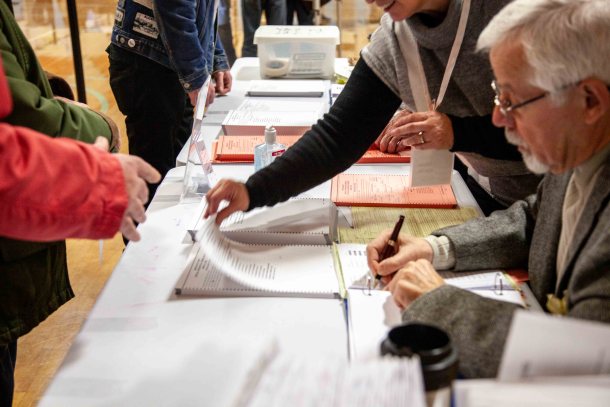
South Burlington officials can alter their decision until May 21 if there is a surge of infections. In that event, the city would hold drive-thru voting.
Kinville described the process: “Someone just pulls up in their car, they give us a name, we check them off, we hand them a ballot while they’re in the car, they drive to a central location within the parking area, within the controlled area, vote it, and drop it in a box as they were leaving.”
However, Kinville worries about the complications associated with the process.
“I mean, we’re in Vermont and it’s May. It’s rainy and the weather affects the paper quality, and if it’s windy how are you not dropping the ballots, and they’re flying all over the parking lot?” she said. “How do you make sure the tabulator’s going to read those ballots if they’ve been sitting outside in the damp weather all day?”
The city opted not to conduct the vote solely through mail-in ballots due to financial concerns. Kinville said the cost of an election by mail would be about $40,000, compared to roughly $3,000 for an in-person one.
South Burlington allocated $7,200 for election expenses in its budget for fiscal year 2020, which ends on June 30.
South Burlington will still encourage voters to fill out their ballots by mail before May 28 to limit contact as much as possible. However, Kinville noted that mailing out and receiving ballots will create more work for her staff, which is already strapped for labor because of a two-person cap on workers inside City Hall.
“We’re going to be asking for some leniency in that directive for the front end of the early voting, and really try to push people to vote at home by absentee ballot,” she said.
The Secretary of State’s office has already given South Burlington preliminary guidance on conducting an August primary, Kinville said, but she declined to comment further until Condos and Scott issue a joint directive on the matter.
For Bohannan – who said she is part of the population most vulnerable to symptoms of COVID-19 – the issue requires a balance of safety and preserving the most reliable methods of democratic government.
“There’s a bit of fear,” she said, “but we’re making the decisions based on fact.”

