

Editor’s note: Mark Bushnell is a Vermont journalist and historian. He is the author of “Hidden History of Vermont” and “It Happened in Vermont.”
John Whittemore’s new home gave him almost unimaginable joy. As his eyes flitted from the clean plaster walls to the wooden floors to the windows (real windows, with glass in them!), he could hardly believe his good fortune.
“I walked the floor with emotions of pleasure I was almost ashamed to acknowledge, yet could not suppress,” he later wrote. “I was pleased to see my mother contented, my grandmother comfortable, and my sisters with a home they were not ashamed of. I had now entered upon a new era. We had risen from abject want to competence and comfort.”
As a child in St. Albans at the start of the 1800s, Whittemore and his family had lived in a home so primitive that he recalled regularly watching squirrels running along the ceiling timbers. He also remembered bitterly cold winter mornings when the family had no wood for heat and he had no heavy clothes to stay warm.
Whittemore was hardly alone in feeling that his life prospects drastically changed in the years following the War of 1812. Peace brought new opportunities for people across Vermont as governments and private investors worked to improve the local transportation system and strengthen burgeoning industries.
Before the War of 1812, Vermonters, most of whom farmed, had generally contented themselves with a subsistence lifestyle. They sought to raise a mix of farm products to keep their families fed. Diversification protected a family from ruin in case some natural calamity claimed one of the crops.
A small barter economy existed within this subsistence way of life, however. If farmers ended the year with a surplus of a farm product, they could trade it with a local shopkeeper for finished goods, like nails, rum or cloth. But any bartering was limited to what shopkeepers had in stock. Merchant wouldn’t pay cash for goods since hard currency was in extremely short supply.
Taking the farm surplus to a more distant market was unrealistic. Goods traveled by wagon, meaning all but the most durable items, like wood and stone, wouldn’t survive long on the road. And those roads were just narrow tracks, prone to mud, that were cut through the forested landscape.
Vermonters had tried to improve the situation by building better roads. But these were still crude constructions, so-called corduroy roads, in which trees were felled, then logs were laid side by side and covered with dirt. Vermont developed something of a road-building frenzy starting in 1796, but more than two out of three of these privately funded ventures ended in failure when actual construction costs outstripped initial, optimistic projections.
Shipping costs were high, meaning that few goods could be profitably shipped beyond a 10- or 15-mile radius — not exactly a large market.
But government stepped in to change that, and in the process changed the lives of many Vermonters. Beginning in 1816, Congress enacted a series of programs commonly known as the American System. The legislation created tariffs — taxes on imported goods to keep American products competitive — and sold public lands at a premium. Revenues from the tariffs and land sales funded infrastructure projects that were designed to make transportation easier.
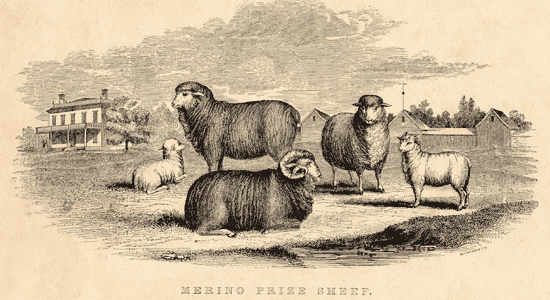
Congress slapped a protective tariff on British wool. The move allowed domestic producers not only to compete, but to raise their prices. Between 1827 and 1835, the price of wool rose more than 50%. Woolen mills sprang up around New England and bought all the wool that sheep farmers could produce.
Farmers went heavily into sheep farming during what for some became the most lucrative agricultural era Vermont has ever experienced. The booming wool market encouraged farmers to expand their flocks and buy more acreage, which drove up land prices. Less-successful farmers found themselves priced out, so they sold their land to farmers who were enlarging their operations. The farmers who sold left home in search of cheaper land. They usually found it farther north in Vermont or to the west, where many moved to start over.
In 1836, Vermont’s roughly 285,000 residents shared the state with 1.1 million sheep. By 1840, the sheep population would reach 1.7 million, or nearly six sheep per capita. No other state committed itself so strongly to sheep.
Of course, all this wool needed a way to get to distant markets. Expanded trade networks wouldn’t have been possible if no one had found a better way to transport goods.
The solution turned out to be shipping goods by water. Boats could carry far more than a wagon could and natural waterways already traveled hundreds of miles through the wilderness. The problem was that key waterways weren’t linked in any navigable way.
So it was with great interest that Vermonters watched as the state of New York paid for the construction of the Champlain Canal. The canal became the key to unlocking major markets for Vermont goods. The state’s merchants had previously only been able to trade north on the lake with Canada. Suddenly, with the completion in 1823 of the 64-mile-long canal, Lake Champlain was linked along the Hudson River to New York City.
Even with a canal in place, Lake Champlain was a dangerous place to navigate, because of rocks hidden below the surface and occasional storms. The federal government invested in more than a dozen lighthouses, numerous beacons and buoys and several breakwaters to make the lake safer to sail.
The canal’s impact was immense. The number of merchant ships on Lake Champlain increased fivefold in the first five years after the canal was opened. It made Vermont part of the national economy.
The sheep craze and the Champlain Canal disproportionately benefited the western part of the state. Other communities like Springfield, Windsor and Montpelier grew steadily as commercial centers of their respective regions during the early 1800s, but many people looked enviously at the Champlain Valley’s prosperity. They hoped to replicate that economic vitality by building their own game-changing canals. Engineers studied ways to connect Lake Memphremagog with the Connecticut River and the Connecticut with Lake Champlain. But the not-so-minor obstacle of the Green Mountains thwarted these efforts. These regions wouldn’t find their own speedy means to transport goods until the late 1840s, when the railroads arrived.
If many parts of Vermont were rapidly changing during the early 1800s, other sections were being left behind. Francis Parkman, who would go on to become one of America’s most famous historians, saw backwater Vermont in 1842 while hiking the woods of the Northeast Kingdom town of Canaan.
He stumbled upon subsistence farms: “Now and then there would be a clearing with its charred stumps, its boundary of frowning woods, and its log cabin; but, for the most part, the forest was in its original state.”
Having trudged along a path with mud a foot deep, Parkman and his traveling companion stopped at a farmhouse, where they were given a decent meal. While they ate, the young women worked at spinning wheels and the young men sat staring at them. “ ‘How far to the next clearing?’ we asked. ‘Eight mile!’ and a long eight miles it was to us—dismal slough of despond the whole way—mud to the knees.”

