


John Walters is a VTDigger political columnist.
A normal day in the Vermont Statehouse involves tightly packed committee rooms, crowded press conferences, constant traffic in narrow stairwells and passageways, casual conversations everywhere, and a lively cafeteria scene.
That all ended on March 13, the day Gov. Phil Scott declared a state of emergency due to the Covid-19 epidemic and the Legislature recessed indefinitely. Since then, all lawmaking has been via Zoom or other digital means.
“The day we left the Statehouse was crossover day,” recalled Paul Burns, executive director of the Vermont Public Interest Research Group. That’s the deadline for bills to move from the originating chamber to the other. It’s a frantic occasion. “I was literally sitting shoulder-to-shoulder in the Senate Health and Welfare Committee. Little did we know we’d never return to a process that was the same.”
That could be true, at least until there’s a proven vaccine for the virus. Even then, some measure of social distancing may become the new norm.
For now, it’s all speculation. But it’s something Statehouse denizens are thinking about. “Nobody knows for sure, but lobbying has changed forever and being a legislator has changed forever,” said Burns.
“We’ve certainly had internal conversations about what it might look like,” said Dylan Zwicky, a lobbyist for Leonine Public Affairs. “We’ll try to be innovative and adaptive within the guidelines put forward while still engaging with lawmakers.”
That means a heavy reliance on phone, text and email instead of the customary process of occupying strategic spots where key lawmakers are likely to pass by or trolling the cafeteria.
Same for the Statehouse press corps. We spend much of our time in strategic hangout mode, in committee hearings or in the cafeteria. Well, we used to. Now we spend our days making calls and watching committee hearings and caucus sessions on YouTube. We can’t grab a lawmaker for a quick word in the hallway, or get an informal sense of where things are going.
For legislative leadership, the immediate task is simply getting through the crisis. “If you have the luxury to think about what next year will look like, you have a privilege that I don’t,” said House Speaker Mitzi Johnson, D-South Hero. “We’re taking care of the ‘right now’ emergencies like unemployment insurance and the Vermont State Colleges.”
There’s also the task of making adjustments to the current fiscal year’s budget, with an expected $144 million loss of revenue between now and June 30. Then, lawmakers will have to craft what Johnson called a “skinny budget” to cover the first three months of fiscal year 2021 — July, August and September. Once that job is done, lawmaking will take a summer recess until August, when lawmakers will get to work on a budget for the rest of FY2021. They’ll be facing a host of calls for emergency funding — and a projected revenue shortfall of as much as $430 million. After that, legislative leaders hope to adjourn until the new year. But everything is subject to change.
It’s clear that “normal” isn’t coming back anytime soon. “We have to assume we’ll be remotely working for the rest of the legislative year,” said Senate President Pro Tempore Tim Ashe, D-Chittenden. “We’ll be operating with remote committee meetings and floor sessions indefinitely.” They would only return to the Statehouse, he added, under the guidance of state Health Commissioner Dr. Mark Levine.
There may be some sort of transitional mode. “There have been discussions of an ‘inside/outside’ option,” said Ashe. “We’d allow for the [committee] chair to be in the room with one witness at a time. Other members and spectators would join remotely.”
That may be necessary, Johnson said, for lawmakers who are at high risk for Covid-19, have high-risk family members or child care obligations. “They could still participate and vote remotely,” she said.
As for what happens in the new year, no one can say. “It’s a problem for others, to be honest,” said Ashe, who is giving up his Senate seat to run for lieutenant governor. “But there’s no scientific distinction between December and January.” Or February, or March, or April …
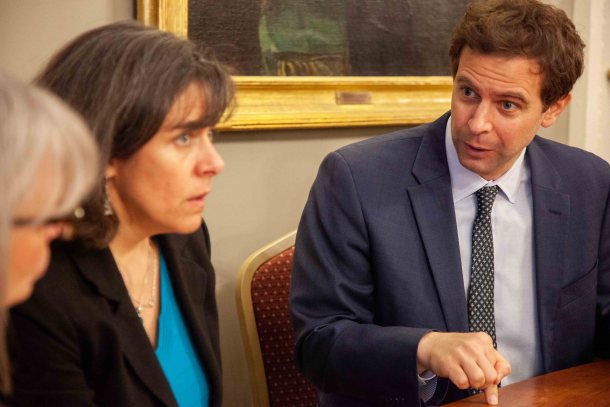
Even in the best of times, the Statehouse is a great place to get sick. And at the end of each week, lawmakers return home to every part of the state. It’s an ideal disease vector. Which may have been tolerable before coronavirus, but perhaps never again.
Resistance to change is commonplace under the Golden Dome. But some old barriers have already come crashing down. House and Senate sessions and committee hearings are carried live on video for the first time ever, and can be seen anytime after the fact on YouTube. “We’ll retain some of that transparency,” Burns said. “There will be more access, more cameras, maybe a digital voting process in the House.”
It does seem certain that the old argument “We’ve always done it this way” will never again carry the same weight. Ashe, the head of the tradition-bound Senate, says the pandemic “has democratized policymaking, to the benefit of the public.” For the first time ever, people don’t have to travel to the Statehouse to watch a committee hearing or floor debate.
Johnson agrees that the new regime “has increased access to Vermont’s democracy.” It could even entice more citizens to seek office. “Think about the kind of people for whom serving would be possible if they didn’t have to leave home for four days and three nights a week,” said Johnson.
The Statehouse has been shaken like a snow globe by Covid-19, even if we somehow avoided an outbreak in March — something Ashe attributes to “dumb luck” rather than foresight or planning. The memory of that close call should spur caution in future decision making. As with many other areas of life, we may be at the start of a complete rethinking about how Vermont conducts its legislative business.
