


VTDigger is posting regular updates on the coronavirus in Vermont on this page. You can also subscribe here for regular email updates on the coronavirus. If you have any questions, thoughts or updates on how Vermont is responding to COVID-19, contact us at coronavirus@vtdigger.org
Copley Hospital has rolled out a new test that can identify people who have developed Covid-19 antibodies.
If successful, the blood-based test could be used to determine who is immune and who can likely return to work without fear of being infected or passing the virus on to others.
The break-through serology test can detect whether an individual has antibodies to the virus and provide results in minutes.
Copley is the only health care facility in Vermont and one of a small number nationwide to start offering the tests, according to CEO Joe Woodin. The 25-bed hospital is first offering the tests to health care workers, and started a first round of voluntary testing for 535 employees early last week.
Woodin hailed the tests as a game-changer that will help protect health care workers, and ultimately allow people who had the virus without symptoms to get back to work without fearing for their safety or jeopardizing others.
“It’s really valuable to know you have been infected and you have antibodies,” Woodin said. “This is where the country’s going.”
The trial test hasn’t been approved by the U.S. Food and Drug Administration, but the federal government has not objected to the trial.
Anthony Fauci, director of the National Institute of Allergy and Infectious Disease and the Trump administration’s expert on Covid-19, says people who are exposed to the virus now are likely not to be susceptible to it in the near future.
“If we get infected in February and March and recover, next September, October, that person who’s infected — I believe — is going to be protected,” Fauci said in an interview with the Journal of the American Medical Association this week.
The state health commissioner says he is supportive of Copley’s program, but he is concerned about the accuracy of the new serology tests.
So far, the state has relied on the drive-up nasal swab tests, called polymerase chain reaction or PCR tests. More than 9,800 tests have been administered in Vermont, 727 of them with positive results. But the tests haven’t been consistently widely available, and officials have repeatedly expressed concerns about running out of testing materials.
The PCR test also has limitations. It’s inaccurate between 5% and 25% of the time, according to pathologist Catherine Antley, who’s on staff at Copley Hospital. It’s also only useful for those who are currently infected with Covid-19.
In comparison, the serology test is useful primarily for those who are asymptomatic.
The test itself is simple: The nurse takes a finger prick of blood, and sets it on a test strip. Within 10 minutes, the results appear as a colored stripe — red for positive, pink for inconclusive, and white for negative. The tests cost about $14 a piece, Woodin said, compared to about $50 for each PCR test.
The quick results and the ability to identify people who have the antibodies for the disease could transform the way the hospital combats Covid-19, Woodin said.
Those who have immunity can help jumpstart the economy by returning to work; health care workers could safely care for patients in the hospital. The tests will help Copley identify workers who are infected but asymptomatic, allowing them to self-isolate and avoid the unknowing spread of the disease to others.
“There’s a lot of fear and anxiety for people who don’t know whether they have it,” Woodin said.
The serology tests can also confirm results from the PCR tests, which sometimes yield false negatives. If the tests are deployed more broadly, they could help reveal the spread and scope of the disease, as well as present a more accurate picture of its fatality rate.
The hospital has completed tests on about 40 staff members, said chief medical officer Don Dupuis. One individual has tested positive; six more are uncertain. All seven of those individuals were referred to get a PCR test to see whether they currently carry the virus. The hospital will continue to test staff on a voluntary basis and depending on the supply, also offer tests to other health care workers in the community, said Dupuis.
The tests are very new, and are not yet fully tested or approved by the federal government. On April 1, the Food and Drug Administration offered emergency approval for the company Cellex to offer the tests, saying that the benefits outweigh the potential risks. Copley received a shipment of tests from Georgia company RayBiotech, which has been granted approval to distribute some tests while the government reviews its application.
Vermont Health Commissioner Mark Levine said he was supportive of Copley’s efforts, but advised caution in adopting the test more broadly. Even if the serology tests were widely available, Levine said public testing would be most useful after the number of new cases peaked.
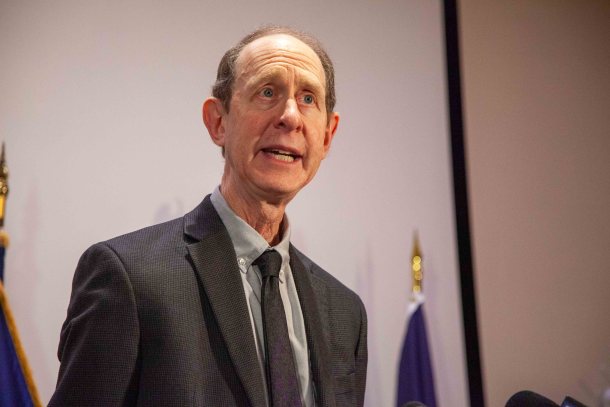
“This is an important strategy, and there will be a point during this unprecedented public health event when we will want to [know] if people interacted with the virus – whether they were aware of it or not,” he said in an email. “This would probably be in the deceleration phase of the virus in Vermont (which we have not yet reached).”
Levine said the state doesn’t yet have the testing materials to roll out serology testing for the population at large, nor does he have confidence in the accuracy of the tests. With serology tests, “there is a risk of false positives and false negatives which can lead to false reassurance or false alarming,” he argued.
Dupuis said he understood Levine’s perspective, but said the devastating toll of the virus called for health care workers to innovate and take risks.
“I guess we could wait nine months until we have everything figured out,” he said. “You really can’t harm anyone with this [test]. I don’t think we have the time to wait for things to take their normal course.”
The tests have been rolled out effectively in China and South Korea, according to Antley, the pathologist. Initial studies show the test has an accuracy of between 80% and 90%.
Two similar serology tests measure two types of antibodies, which the body produces to combat the virus, said Antley. About five days after infection, the body creates weaker IgM antibodies. After 10 to 14 days, depending on the person, the body produces stronger IgG antibodies. The IgM antibodies decline after about a month, but the IgG antibodies will remain in the body indefinitely.
Researchers hope that those antibodies will prevent the individual from contracting the coronavirus a second time. But it’s too early to know for sure if patients can become reinfected or contract a different strain of Covid-19, Antley said.
Antley helped secure two batches of the limited supply: Early this week, Copley started offering tests from its first shipment of 500 IgM tests. A second mailing containing 1,000 IgG tests also just arrived. The hospital will track its results and report the findings to RayBiotech and to the U.S. Food and Drug and Administration.
Those identified by serology tests as having Covid-19 antibodies could also donate blood plasma antibodies to help others stave off or fight the virus. That initiative, which the FDA has also approved for emergency use during the pandemic, could help fend off the disease while a vaccination is being created.
In Vermont, the Red Cross hasn’t started collecting plasma yet, but the FDA has asked the organization to start seeking donors. The University of Vermont Medical Center is also planning to participate in a national trial to provide Covid-19 patients with the plasma collected by the Red Cross, said Annie Mackin, a hospital spokesperson.
There are no plans currently to start using serology tests at the state’s largest hospital, in part because they aren’t commercially available, Mackin said. “We’re waiting to know more,” she said.
For now, Copley plans to test all asymptomatic health care workers.
There is a limited supply, but if more become available, Woodin said he’d “absolutely” offer it to the broader community.
The severity of the virus and its devastating impact worldwide should make people eager to try new approaches and methods, agreed Dupuis.
“Is this going to be fantastic? Is this going to be a flop? We don’t know,” he said. “We have the opportunity to try, and so you gotta try.”
After all, he added, “there’s only upside.”
