


VTDigger is posting regular updates on the coronavirus in Vermont on this page. You can also subscribe here for regular email updates on the coronavirus. If you have any questions, thoughts or updates on how Vermont is responding to COVID-19, contact us at coronavirus@vtdigger.org
On Tuesday, University of Vermont’s Patrick Gymnasium contained no stray pieces of popcorn or abandoned ticket stubs. There was no vestige at all of the college sporting events that filled the space a month ago.
The gym had been transformed for a more solemn purpose: a surge hospital for patients with the new coronavirus. Fifty fold-out cots were arranged in rows across the basketball court; the neatly folded blanket and pillow on each evoked a military hospital in a World War II drama.
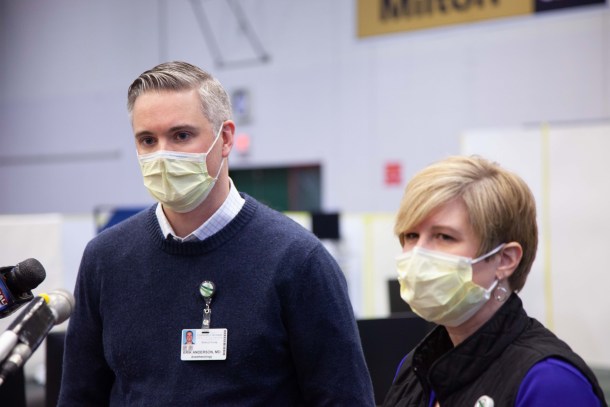
The space was empty of patients; ideally it would remain so, said Erik Anderson, an anesthesiologist assigned to be medical director of the site. The space would only be used if the University of Vermont Medical Center down the road was filled to overflowing. But as health care facilities in New York City and around the country have been inundated with Covid-19 patients, UVM Medical Center and other Vermont hospitals are preparing for the worst.
The hospital can easily accommodate its current level of 29 confirmed or suspected Covid-19 patients. But the state numbers continue to rise by the day. As of Wednesday, 605 people in Vermont had tested positive for the virus and 23 have died. Financial Regulation Commissioner Mike Pieciak predicted last week that the total number of cases would peak in mid-April to early May.
“We’ll be ready by the time the hospital needs us,” Anderson said.
If the UVM Medical Center exceeds its capacity for Covid-19 patients, it will send them to Patrick Gym, said Anderson. The “surge site” was built for those who require short-term medical care, he explained — patients with a high fever or shortness of breath who could be treated for 24 to 48 hours and then released back home. Those with more severe needs would be transported back to the medical center for more intensive care.
That would be days, if not weeks, in the future.
On Tuesday, masked doctors and nurses scurried around the building, adding the finishing touches to the myriad systems and amenities they had installed for medical care. It includes a row of cubicle areas for health care workers to remove their personal protective gear after a shift. A small flock of wheelchairs sat on one side of the room, along with several stretchers. A portable pharmacy with refrigerators holding medications stood on one side. Cords ran in serpentine masses along the floor. In the middle of the vacuous space, staff typed away at about two dozen computers, complete with antimicrobial keyboards.
Dawn LeBaron, vice president of hospital services, described the flurry of activity as the “tyranny of now.”
“Everybody drops what they’re doing, focuses on the one priority, on the one mission, and that is to respond to this event,” she said.


Around the state, members of the Vermont National Guard are simultaneously standing up similar facilities. They set up a 50-bed surge site at the Barre Civic Center associated with the Central Vermont Medical Center, and another one at the Collins Perley Sports and Fitness Center in St. Albans connected to Northwestern Medical Center, said Capt. Mike Arcovitch, spokesperson for the Guard.
Another 400-bed facility at the Champlain Valley Expo will be staffed primarily by the National Guard, and has been allocated for patients who do not have Covid-19. Gov. Phil Scott also announced that he had sent out medical surge trailers to various hospitals around the state and that an additional 150 beds would be set up in Rutland County.
At a press conference last week, Secretary of the Agency of Human Services Mike Smith said the statewide efforts were “critical” to mitigating a catastrophe. “If you look at history … you will find that where there have been failures in major events like this, they did not plan for the worst case scenario,” he said.
UVM Medical Center is picking up the tab for the project now, but LeBaron said hospital officials hope to be reimbursed. The price tag is unclear: “I would tell you a lot,” said LeBaron. But the state and federal government “have been absolutely reassuring to us that they will assist us,” she said. The price is not the ultimate focus, she added: “The charge in front of us is to get ready.”
At Patrick Gym, that means preparing for the most basic procedures in advance — including taking patients to the bathroom, or loading them onto a stretcher, said Marta Kokoszynska, a pulmonologist and critical care doctor, who worked at a computer in the gym. “Every step has to be planned out,” she said.
They had set up a “logistics and staging area” in the tennis courts down the hall. A row of shelves held folded linens, towels and scrubs for health care workers. IV infusion pumps and oxygen-measuring pulse oximeters sat next to boxes of chocolate flavored “snack packs.” Soccer and lacrosse goals had been pushed against a back wall. That space could hold an additional 50 beds, if necessary, Anderson said.
The planning process entails running through a multiplicity of “what if” scenarios and then preparing for each. They’ve set up a small negative pressure tent; in any other time it could be a concession tent selling candy bars. Now, it’s been installed with a ventilation system that also filters the air. Inside are two ventilators where patients can be intubated. Anderson would prefer to transfer patients to the hospital for such a procedure. “In the event we had to, we’re prepared,” he said, in what seems to have become his mantra.
Anderson and his colleagues are still working out staffing plans, he said, as well as transportation for patients to and from the medical center. They’d make it all work, he assured. Such flexibility “is the name of the game here,” he said.
A best case scenario with a small number of Covid-19 patients would mean that all the work is for naught, said Kevin Brochu, an advanced practice provider, who worked at a computer in the center of the room. In fact, that’s the goal. “Hopefully it’s just an exercise,” he said.
