

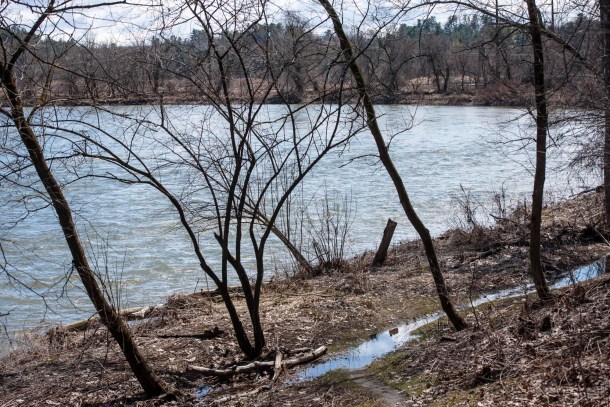
PFAS contamination has been found in groundwater and surface water — including a stretch of the Winooski River — near the Vermont Air National Guard base in South Burlington.
The findings come in a draft report released last week by the Guard on the extent of the contamination by the so-called “forever chemicals” — largely from now-banned firefighting foam — at the 281-acre base. State Department of Environmental Conservation staff need to review the report before it is finalized.
“This has been a very thorough process to determine potential impacts from the use of PFAS on our base and I am encouraged that we can now move toward the next phase of this critically important work,” said Col. Adam Rice, 158th Fighter Wing vice commander, in a prepared statement. He added that elevated PFAS levels were not found in drinking water on or off-base.
The state and the federal Environmental Protection Agency tested a groundwater collection trench by a firefighting training area following the discovery of widespread PFAS contamination in Bennington in 2016.
Initial sampling that year showed the trench had PFOS and PFOA levels in the tens of thousands of parts per trillion — significantly higher than the state’s groundwater enforcement standard. After finding elevated PFAS levels in an agricultural well northwest of the base, the state installed a charcoal treatment system.
The initial round of sampling detected six “areas of concern” on the base with significant PFAS contamination, leading the DEC to ask the Guard in 2018 to conduct an expanded site investigation. Richard Spiese, hazardous site manager for the Department of Environmental Conservation, said that DEC knew from previous sampling that there was PFAS contamination in some sites surrounding the base, including nearby streams.
“But now with this work, I would say it’s pretty clear that you can connect the dots,” he said. “So we know that the impacts to those (sites) are coming from … things that occurred on the base.”
The Guard contracted Utah-based engineering firm Parsons Corp. to do the expanded investigation. Parsons took samples from last May to August.
The areas of concern on the base with the highest levels of PFAS in groundwater are a former firefighting training area, former and current fire stations, and an equipment testing area. Two former crash sites have less significant PFAS contamination.
Aqueous film forming foam, or “AFFF,” blankets flammable liquids like petroleum and natural gas, preventing the spread of oxygen and smothering the fire. But the same compounds — PFOA and PFOS — that made AFFF such an effective fire suppressant are now also known to be toxic, and manufacturing AFFF with those compounds became illegal in the U.S. in the early 2000s. As PFAS, the class of man-made chemicals that PFOA and PFOS belong to, accumulate in soil, water and the human body as they take a long time to break down.
Use of AFFF by the military has been linked to PFAS contamination near bases around the country.
State environmental regulators learned from the new inspection report that PFAS levels in the Winooski just downstream of where contaminated water feeds in are not much higher than the background amounts. The river is about a quarter mile from the base.
Spiese said that contamination from the base adds around one or two parts per trillion for the five PFAS compounds regulated by the state — roughly doubling the background levels of PFAS in the state’s largest river.
While the state Agency of Natural Resources is moving ahead with a drinking water standard for PFAS of a combined 20 ppt, Vermont is still working with New Hampshire to come up with a surface water standard based on fish impacts. But Spiese said he now knows that levels in the Winooski are below the range being discussed for that standard.
“My fear originally was it might be high enough that … I’d have to do a ‘Do not fish order’ or something like that,” said Spiese.
Samples taken on the base in and around the former firefighting training area again showed PFAS contamination in the tens of thousands of parts per trillion — hundreds of times higher than the 20 ppt enforcement standard in Vermont. (One groundwater well from a previous round of sampling in 2018 had PFAS levels of 179,000.)
And many of the stormwater and surface water samples off the base were also above that threshold, with samples ranging from two to over 2,000 ppt.

Because the Air National Guard is a federal program, the site investigation and remediation have to comply with federal environmental law — a “multi-year process,” said Spiese. Once the DEC signs off on the inspection report, the Guard will further investigate specific contamination sources and come up with potential options to remediate the site.
While stressing that VTANG, not the state, would come up with the remediation options, Spiese said that cleaning up contaminated soils is often the focus of remediation work.
“They haven’t added any PFOS probably for over a decade, and yet we still see it in groundwater under the entire site on base and off base,” he said. “And why is that? It’s because this big (soil) sponge is slowly giving off PFOS at elevated levels.”
