

[T]he Vermont Air National Guard will be moving ahead with sampling to better understand the extent of PFAS contamination at the South Burlington base, where elevated levels of the toxins have been found at six sites.
Guard officials announced in a press release Thursday that a contractor would start an “expanded site investigation” at the base this month, with full results expected early next year.
“The objective of this phase of the inspection process is to fully delineate the extent of on and off-base contamination,” Lt. Chelsea Clark, public affairs officer with the Vermont Air National Guard, said. “Final results of this inspection will guide the next step.”
After the discovery of widespread PFAS contamination in Bennington in 2016, the state and the Environmental Protection Agency tested a groundwater collection trench by a firefighting training area, said Richard Spiese, hazardous site manager for the Vermont Department of Environmental Conservation.
Initial sampling in May 2016 showed the trench had PFOS and PFOA levels in the thousands of parts per trillion — significantly higher than the state’s groundwater enforcement standard of 20 ppt combined. Additional testing identified six potential areas of PFAS contamination at the base — all stemming from use of aqueous film-forming foam, or AFFF, to fight fires, said Spiese.
“It’s certainly at a level of concern, hence we’ve been asking the Air Guard to continue with their investigation,” he said of the contamination.
Spiese said that the highest levels of PFAS — the manmade class of chemicals to which PFOA and PFOS belong — were found unsurprisingly at an area where the Guard used to train firefighters.
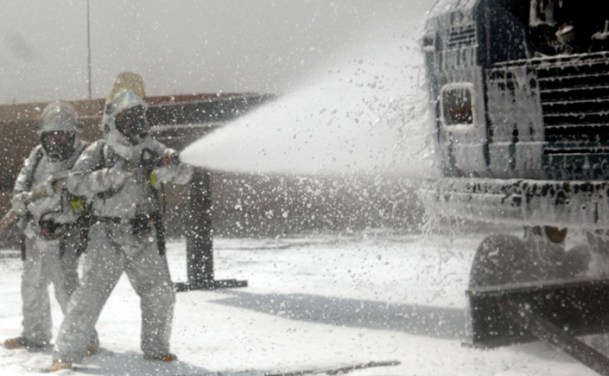
“For a number of years, they would light fires with jet fuel and other solvents and then they would put them out with AFFF, so they were practicing to do a good job,” he said.
The other sites at the Air National Guard base with elevated PFAS levels are two fire stations, an equipment testing area and — to a much lesser extent — “a couple of plane crashes where they did a one-time application,” said Spiese.
Champlain Water District, which supplies water to the base and neighboring areas, has not detected PFAS compounds, according to the press release.
At present, the only drinking water source showing signs of PFAS contamination from the base was an agricultural well, which now has a treatment system installed. A charcoal treatment system was also installed to filter PFAS in the groundwater recovery trench, said Spiese.
Because the Air National Guard is a federal program, the site investigation and remediation have to comply with federal environmental law — meaning this will be a multi-year effort, said Spiese. The Guard has also been working closely with the state DEC as Vermont has stricter PFAS regulations than the federal government.
The sampling this summer and fall will allow the Air National Guard and regulators to better understand the extent of contamination at the base, he said. Parsons Corp. — the engineering firm contracted to do the testing — will sample surface water, groundwater and soils at the base, according to a letter from DEC. Parson will also sample surface water around the base to determine if there is any off-site PFAS contamination.
Once the site investigation is complete, the Guard and regulators will look into options for remediating the contamination, said Spiese. He added the state would be encouraging the Guard to focus on evaluating — and remediating — contaminated soils, which are generally the source of contamination at hazardous waste sites.
AFFF, first produced in the 1960s, blankets flammable liquids like petroleum and natural gas, preventing the spread of oxygen and smothering the fire. But the same compounds — PFOA and PFOS — that made AFFF such an effective fire suppressant are now also known to be toxic.
Manufacturing AFFF with PFOA and PFOS became illegal in the U.S. in the early 2000s. Following Air Force protocol, the Guard replaced so-called “legacy foams” with newer foams, said Lt. Chelsea Clark, public affairs officer for the Vermont Guard. Spiese said the Guard now only uses PFAS-based foams in actual emergencies, not for training.
The expanded sampling at the base comes at a time when Vermont is launching a widespread PFAS sampling effort by all public drinking water supplies, car washes, landfills and other sites.
