

Editor’s note: Mark Bushnell is a Vermont journalist and historian. He is the author of “Hidden History of Vermont” and “It Happened in Vermont.”
On April 10, 1815, one of the greatest cataclysms in human history occurred. And was largely overlooked. Mount Tambora, a volcano on the Indonesian island of Sumbawa, exploded in the largest eruption since prehistoric times. Lava flows quickly killed more than 10,000 people on the island. At least another 80,000 more died in the aftermath of diseases, famine and tsunami that erupted after the volcano did.
Sumbawa, however, was a remote island in the Pacific and high-speed communication was nonexistent, so word of the catastrophe moved slowly and was quickly forgotten in much of the world. The impact of the eruption, however, would be widespread and enduring.
It was even felt in a corner of Franklin County, Vermont, that would come to be known as Egypt, after the biblical land of plenty, because of a local farmer’s response to the disaster.
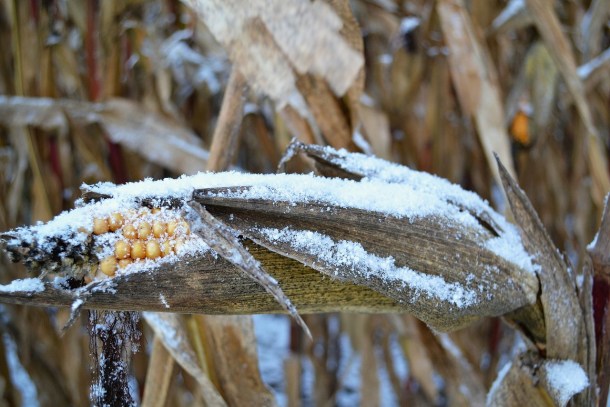
A year after the eruption and half a world away, Nathaniel Foster was planting corn in a field he had just cleared — well, partially cleared. The land was still spotted with tree stumps. Foster, a 29-year-old veteran of the War of 1812, was a Massachusetts native who had recently settled in Vermont, where he married Sarah Leach. Together they worked to establish a farm in Fairfield.
Like many farmers, Foster decided that pulling out the tree stumps was so labor intensive and time consuming that it made more sense just to leave them to rot. But rotting was a slow process, so, like many farmers, Foster planted his corn among the stumps. The stumps would prove to be just what the Fosters needed to survive the misery to come. Fortunately for many of his neighbors and others farther away, Foster had an ingenious mind paired with a generous heart.
Years without a summer
Little could have prepared Vermonters for the freakish and devastating year to come. Looking back, New Englanders would call 1816 “the year without a summer,” “the poverty year,” “the famine year” or “eighteen hundred and froze to death.”
Despite the frigid temperatures that would characterize it, the year started with mild weather. January and February saw high temperatures of 46 degrees. And March saw a high of 52. That was nothing compared with April, when a heat wave pushed the temperature to 82.
The first sign of trouble came in mid-May. The nights of May 15-17 saw hard frosts. Vermonters might have forgotten those frosts by June, however, when on the fifth the temperature rose well into the 80s. But the winds shifted at night, and a Canadian cold front drove the temperature down 40 to 50 degrees. Two days later, as an anonymous diarist in Brookfield succinctly put it, “Froze all day. Ground covered with snow all day. … All the trees on the high land turned black.”
Vermont, and much of the Northern Hemisphere, was experiencing the effects of Mount Tambora’s eruption. The blast had blown an estimated 100 cubic miles of debris into the atmosphere. One researcher calculated that that was enough dust to cover the island of Manhattan a mile and a half deep.
The high-altitude dust partially blocked out the sun, which to make matters worse was experiencing a period of particularly low solar activity. In some parts of the Northern Hemisphere, the dust cloud darkened the sky and made it glow oddly. English painter J.M.W. Turner famously captured these fantastical skies. The unseasonably cold weather 18-year-old Mary Wollstonecraft Shelley experienced while vacationing in Switzerland that June inspired her to pen her gothic classic, “Frankenstein.”
The airborne debris caused global cooling, particularly in New England. Years later, Vermonter James Winchester, who had been 14 at the time, remembered the summer of 1816 as the time “when people froze to death in the month of roses–suicides through fear that the sun was cooling off.”
There is scant evidence to support Winchester’s dire claims, but people did despair. And they didn’t understand that a volcano halfway around the world could be the culprit.
Foster takes to the stump
As the cold weather continued, Nathaniel Foster realized that if he did nothing, his crops were doomed. But what could he do? Foster thought of those stumps in the field. Maybe they were the answer. He decided to burn them in hopes of keeping the green shoots of his corn crop alive. The stumps didn’t burst into flames, but smoldered. During the worst of the weather, Foster worked day and night lighting and relighting the fires, according to a Fairfield town history.
At the time, Vermonters’ welfare was linked directly to the local harvest, particularly of corn, a staple crop. In those days, most people farmed, whether in large fields or in small yards. Congregations paid their ministers partly in tillable land. Even tradespeople relied on the harvest, as farmers often bartered for their goods.
While people across the state lost their crops, Foster’s corn crop, shielded by the warmth from the burning stumps, thrived. He not only had enough corn for the winter, he had more than he could use as seed corn in the year to come. At the same time, many other Vermonters were afraid they wouldn’t have seed corn to plant in 1817.
Foster’s unexpected bounty could have made him a rich man. The price of corn had skyrocketed. Before 1816, corn generally brought anywhere from 75 cents to $1.12 a bushel in the New York marketplace, according to one study. Because of the early summer frosts, the price rose to $1.35 in August and hit $1.78 early in 1817. Prices were dramatically higher in Vermont. In the fall of 1816, a bushel of corn had reached $2.50 in Newbury and $3 in Peacham. By spring 1817, a bushel cost $5 in Barnard.
Some saw the crisis as a chance to get rich. A Newbury man took a boatload of corn up the Connecticut River and sold it for five times the normal rate.
When word of Foster’s bounty got out, he received generous offers for his corn. Bankers traveled from St. Albans to visit Foster on his farm. They offered him $5 a bushel for his corn. They must have thought they could turn around and sell the corn for still more to desperate Vermonters.
Foster rejected the offer. He wasn’t holding out for a higher price. He wanted to sell for less, and not to speculators. Instead he sold it the next spring to neighbors, and people from throughout northwestern Vermont and Canada — anyone who made it to his doorway. The cost? One dollar a bushel. Foster limited how much each person could buy in order to make the seed corn go as far as possible, and perhaps to deter speculators.
People began referring to Foster’s corner of Fairfield as Egypt, after the Bible story in which, during a famine, Jacob sends his sons to Egypt to buy corn.
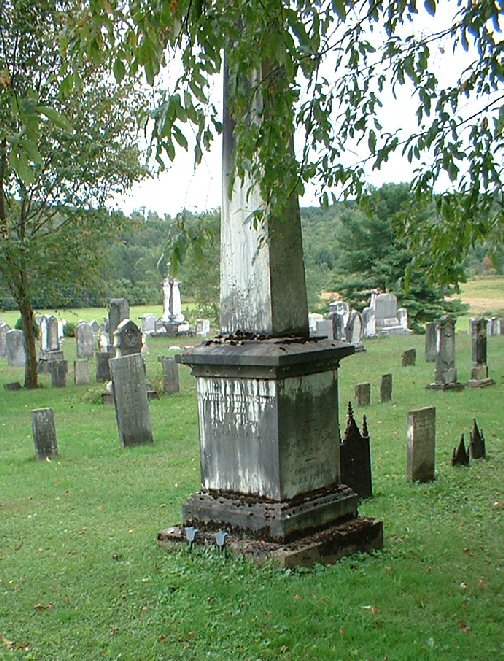
The story of Nathaniel Foster is largely forgotten today, even in Fairfield. But in the town you can still find Egypt Road and Egypt Cemetery, where Foster is buried under a sizable obelisk near the field where he grew his corn.

