

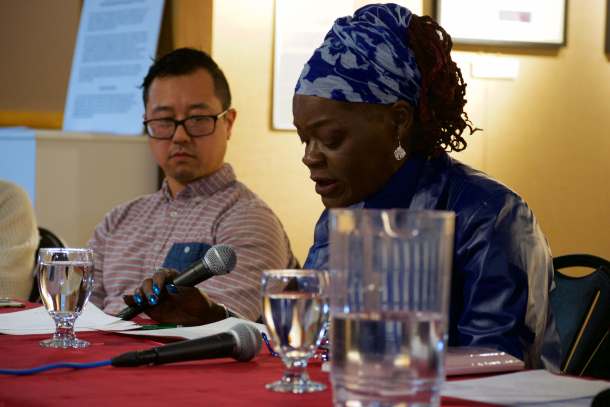
ST. JOHNSBURY — Gladys Chambers sought peace when she moved from New York City to the Northeast Kingdom after the Sept. 11, 2001, attacks.
“I just wanted a place where my son would be safe, a place where he could run on the grass and be a child,” the Orleans County resident said Wednesday.
But over the years her hope turned to fear, she said, and she and her now 19-year-old son have isolated themselves for fear of racial discrimination.
“The ostracism and trauma I experienced just trying to wade my way through the heartbreaking implicit racial tension that exists in the Northeast Kingdom was too much for me to cognitively bear,” said Chambers, who is black.
She and four other people of color described racial hostilities — subtle and overt — they’ve experienced in the Kingdom and elsewhere at a forum in St. Johnsbury Wednesday.
The event, “Visible in Vermont: Our Stories, Our Voices,” was part of a series from the Root Social Justice Center that highlights the stories of nonwhite residents in majority-white communities throughout the state.
The series has featured speakers and photo exhibits at its stops across Vermont, and on Wednesday it drew a few dozen attendees to the St. Johnsbury Athenaeum library, where they listened to stories from panelists of black, Fillipino and Japanese backgrounds.
Several of the speakers focused on slights and assumptions made by white people that caused them to feel othered — viewed as alien or exotic and treated differently as a result.
“Joy is really, really important in life, and I like to seek joy, and I know everyone else does as well,” said Sahra Ali, who moved to the United States from Somalia at a young age. “And it’s really difficult to … seek joy when you feel like you’re being othered.”
Ali, a freelance writer for the North Star Monthly and Hardwick Gazette who works in St. Johnsbury, said things have mostly been good in the months she’s been in Vermont.
But she described how when she tells people where she was born, they often project onto her their own “African story” — they had a child serving in the Peace Corps in the continent, for example.
“It’s a little off-putting,” Ali said. “I never know what to say to that.”
George Sales, owner of the Filipino restaurant Pica-Pica in St. Johnsbury, moved to the area in 2013. He had lived in the Washington, D.C., area, after moving to the United States from the Philippines, before he relocated to Vermont, where his husband is from.
Early on in Vermont, he said, he too faced different expectations. He originally worked as a project manager and felt he had to show people he was capable of more than, say, taking notes.
Peacham resident Geoffrey Sewake, who comes from a Japanese background and has been living in the Kingdom since 2014, said he’s been asked many times about where he’s originally from.
People assume he wasn’t born in the United States, he said, when in reality he, his parents and his grandparents all were.
“I have a long history of being born here,” he said, laughing, adding that he doesn’t speak, and has never known, a language other than English.
But he detailed how, growing up in a majority-white neighborhood on the West Coast, he struggled.
“For a long time, I was self hating,” Sewake said. “I didn’t want to be Japanese. I didn’t want to be ‘the other.’ I pushed away everything that belonged to me that was Japanese.”
Sewake, who is opening a brewery in St. Johnsbury, said he has two multiracial children who haven’t been in school long enough to experience the things he has. But he’s sure one day he’ll need to help them navigate those trials.
That’s what Marjorie Ste. Marie, a Danville chiropractor of Fillipino descent, has been grappling with. She said her school-aged son has come home crying from incidents related to his identity.
“There’s a part of me that just wants to tell my son, ‘Well, why can’t you just take it?’” she said.
She continued: “But that’s not an answer. I had to take that back and say, ‘No, I can’t tell him that.’”
The story of Chambers, the woman from Orleans County, and her teenage son drew the most visible emotional response from the room.
Chambers said she worked for nine years in the Kingdom to earn a college degree, but when she tried to apply for required internships, she was constantly turned away “because I wasn’t a good fit.”
Chambers said that one employer told her that her presence in the office would throw clientele off.
She said she was later fired without just cause from a recovery center, and that because of all her negative experiences, she relapsed after nearly two decades of sobriety from alcohol.
“The racism I experienced in the Northeast Kingdom was very hard for me because it was so slight,” she said.
She feels guilty for keeping her son in the area, she said, when he experienced racism in school. She is afraid to let him drive alone as a black man. They trust few people.
“It’s been hell here in Vermont for me and him,” she said, “because of the color of our skin.”
Chambers said they will likely have to move to have a better life. She feels afraid to try to use her degree in the Kingdom.

Promotional materials for the event series say it partly aims to help white people reflect on unintended behaviors that make people of color uncomfortable — sometimes called microaggressions.
Toward the end of the night in St. Johnsbury, a white audience member asked the panelists what could be done to end racism children in school are experiencing.
“I thank you for your question — we’re not here to answer that question,” organizer Sha’an Mouliert said in response.
Mouliert explained how white audience members at these events often seem to assume panelists of color have an answer to the problem of racism.
“We would love to charge you a consultation fee,” Mouliert said.
The audience member wished Mouliert good luck.
