

Starting next week, Final Reading will only be available by (free) subscription. Sign up here and get it hot off the press by email at 6:30 p.m., Tuesday-Friday.

IN JAN. 31’s FINAL READING …
The governor vetoes paid leave, free college tuition in Vermont is shaken down by its fiscal reality, and tensions rise over teacher benefit funding.
THE TOP TAKE
It was one of those moments when a nice concept meets the hard facts of fiscal reality. On Friday afternoon, the Senate Education Committee received cost estimates on S.271, a bill that would provide free tuition for qualifying students at Vermont community colleges. As written, the bill would apply to those with family or individual incomes under $100,000.
Stephanie Barrett of the Legislature’s Joint Fiscal Office reported that the bill would cost $5.9 million in its first year and $6.8 million in subsequent years. Those numbers, she said, don’t account for inflation.
“In higher education, costs are going up,” noted committee chair Sen. Philip Baruth, D/P-Chittenden. “We have to assume whatever we enact will have rising costs in future years.”
In any case, $6 million is likely a pill too large to swallow this year. Baruth talked of the bill as “wishing on the moon.”
S.271’s chief sponsor, Sen. Ruth Hardy, D-Addison, also serves on the Education Committee. She hopes to allow more Vermonters to pursue post-secondary degrees. She set the $100,000 ceiling, she said, “to capture all students who might face fiscal constraints.”
Baruth raised the concern that offering free tuition at community colleges might draw students away from Vermont’s four-year institutions, which are already hurting. Hardy argued that S.271 could benefit the four-year campuses because more students could achieve a two-year degree debt-free, thus easing their path to further education.
Action on S.271 isn’t off the table. The committee will seek more information about setting the income ceiling at a lower figure, which would reduce the benefit’s cost. It will also consider extending the benefit to the Vermont State Colleges system, which would raise the cost.
Baruth floated the idea of using revenue from a marijuana tax-and-regulate system for the program. There are, he acknowledged, a lot of competing calls for that hypothetical pot of gold. “They’re both unicorns,” he said of S.271 and the use of cannabis money. “We’ll have to decide which unicorn is more feasible.” – John Walters

WHAT YOU NEED TO KNOW
— Gov. Phil Scott vetoed the paid leave bill. His reasoning, laid out in a press release, was that he didn’t support a program reliant on a mandatory payroll tax. Instead, he’ll pursue his paid leave plan for state employees, which would rely on a private insurance model.
“The good news for Vermonters is that the Legislature will have an opportunity to stand with them and override this misguided veto,” House Speaker Mitzi Johnson, D-South Hero, said in a statement. “This debate is not over and the House will take prompt action next week.” – Grace Elletson
— Officials clashed in House Appropriations over how teacher benefits should be funded in fiscal 2021. The Scott administration has proposed putting an additional $2.4 million into teacher “OPEBs” (other post-employee benefits). Treasurer Beth Pearce wants about $8.5 million.
Brad Ferland, deputy secretary of administration, said there needs to be a larger conversation about the “four buckets” of public benefits — state employees pension and OPEBs, and teacher pensions and OPEBs — before major funding decisions are made. – Grace Elletson
— Interim Corrections Commissioner James Baker met with Women’s Caucus members about alleged abuse of female inmates at the Chittenden Regional Correctional Facility, saying that creating a cultural shift in the facility is his top priority.
“There are certain people in corrections who, when I ask them what the mission is and they stare at me and can’t tell me the vision, that’s a little bit of clue there’s a culture problem,” Baker said. – Grace Elletson
— The University of Vermont Board of Trustees approved new guidelines that emphasize diversity in recruiting new members to the board, a topic which has garnered the attention of the Legislature. S.248 was introduced to mandate the board has 12 or 13 members who identify as women or nonbinary by 2025. Only six of the current 25 board members are women.
Ron Lumbra, vice chair of the board, said he believes quotas are “dangerous.” “One of the challenges with affirmative kind of quotas is that it can harm the image and brand of a diverse candidate coming onto the board,” he said. – Aidan Quigley
— Sen. Dick Sears, D-Bennington, said he’s frustrated that “misinformation” is traveling the Statehouse about the justice reinvestment bill his Senate Judiciary committee is taking on to reduce recidivism rates when inmates are let out of jail on furlough.
He said there’s an impression in the Statehouse, and repeated by those who have testified, that those let out on furlough commit crimes that force them back into jail. In reality, many are taken back to jail while on furlough due to technical violations. – Grace Elletson
— The title of bill S.181, “An act relating to access to employee restrooms for individuals living with an inflammatory bowel disease” may prompt some odd reactions at first, but Sears says it has serious implications.
As someone who has Crohn’s disease himself, he wants to ensure that others can’t be denied a restroom in a store that may only have an employee bathroom when in serious need due to a medical cause. He was inspired by a similar bill in Massachusetts. – Grace Elletson
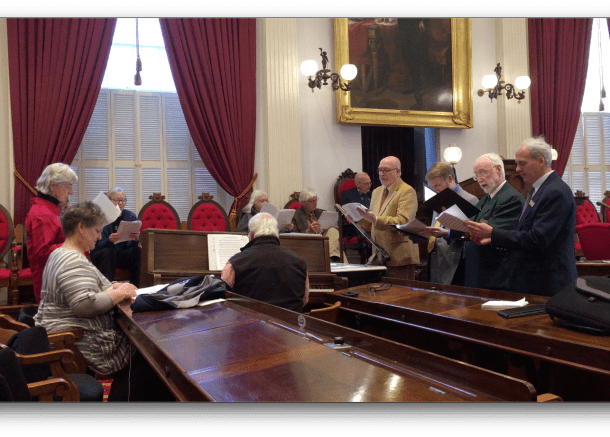
— As part of the Farmers Night series, the Statehouse Singers will be performing choral settings next Wednesday night of the Bill of Rights and the 19th Amendment. Participating legislators include: House Speaker Mitzi Johnson, D-South Hero, Rep. Mari Cordes, D-Lincoln (“my best soprano,” said choirmaster Arthur Zorn) and Sen. Alison Clarkson, D-Windsor.
The now-retired Zorn, who was the longtime head of Spaulding High School’s fine arts department, was highly complimentary of his charges. “This is impressive,” he said after a Friday rehearsal. “These are very talented people.” – John Walters
REPORTER’S NOTEBOOK
House Government Operations passed the bill that would create a legal marketplace for marijuana. Grace Elletson caught up with VTDigger’s Xander Landen to learn more about how committee members changed it before it moves forward.
GE: What stood out to you in this bill?
XL: So the major changes related to how land use and agricultural regulations would apply to marijuana growers. The biggest thing is that the committee decided that marijuana cannot be considered an agricultural product.
GE: Why not?
That’s interesting, because if it was an agricultural product, growers would be able to take advantage of additional tax exemptions and would have more flexibility to grow the crop on existing farmland.
GE: How did committee members come to this decision?
XL: They want to make sure that marijuana businesses are treated like any commercial or industrial business and comply with land use and environmental regulations. This is the first time the bill is moving this session, after the speaker has signaled she’s really not interested in a legal marijuana market. She’s not standing in the way of the bill, but it’s not a priority and leaving it to other House members to work out the kinks.


