

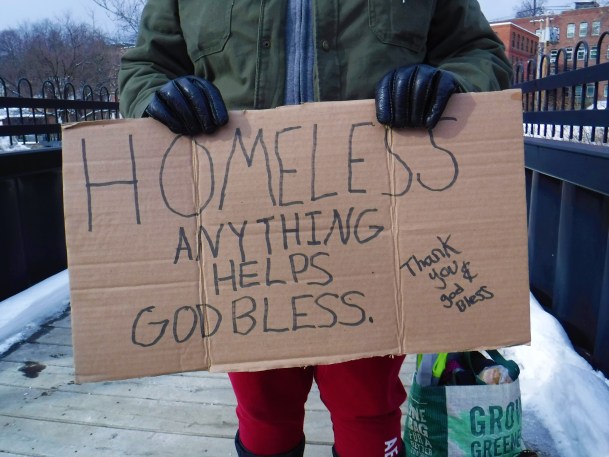
As cities and states nationwide conduct an annual census of people who are homeless this month, many are supporting their efforts with considerable sums of money.
But in Vermont, the count, required by the U.S. Department of Housing and Urban Development, is being run entirely on donated manpower.
The state doesn’t allocate funds to carry out the Point-in-Time survey of residents without permanent shelter, so it must rely on a network of social service workers and volunteers. Yet despite the lack of dedicated resources, surveyors are confident in the accuracy of their work.
The country’s largest cities employ thousands of people to canvass streets. California’s greater Los Angeles area is spending more than $1 million on the count. In 2018, New York City paid some 200 decoys to act as if they’re homeless as a way to test the exercise’s accuracy.
In comparison, Vermont, which counted 1,089 homeless individuals last year, doesn’t budget any money for the census. Surveyors therefore focus their resources less on searching for people outdoors and more on seeking them inside shelters, soup kitchens and social service providers where they’re most apt to congregate.
“It’s all based on volunteers and organizations that already are seeing these folks,” says Andrea Hurley of the Vermont Coalition to End Homelessness, which takes the lead on implementing the survey, along with the Chittenden Homeless Alliance.
The coalition is distributing information about the count to a dozen regional “continuum of care” partnerships of service providers and agencies, which in turn are soliciting support from hundreds of local organizations.
In Brattleboro, the Groundworks Collaborative that operates the local shelter and food shelf coordinates the count by communicating with public health officers, police, schools, the hospital and “non-service service providers” such as the library.
“We spread the word widely,” says Karli Schrade, Groundworks’ Point-in-Time point person.
Any homeless individual who stayed in Brattleboro’s winter shelter or local lodging paid for by a state program this past Wednesday was counted automatically. Schrade and volunteers then traveled to soup kitchens and public warming spaces Thursday in search of people who weren’t reported the night before.
The survey doesn’t ask for a person’s name, but survey-takers do collect information like age, gender, race and ethnicity, physical and mental health, substance use and HIV status and whether someone is a veteran or fleeing domestic violence. Those answers are sent to the state coalition, which releases an annual report each spring.
Vermont’s 2019 Point-in-Time census found that nearly a quarter of the state’s reported homeless population were children up to age 18, 12% were fleeing domestic violence and 12% were black or Hispanic — the latter figure disproportionately larger than the percentage of the state’s population who are of color.
Counters are required only to find people who meet the federal definition of “literal homelessness,” which means they don’t have to count those who are staying with family or friends, paying for their own motel room or in jail, foster care or a mental health facility. Organizers are aiming to record more homeless Vermonters, especially those in rural areas, by encouraging them to phone 211 this week.
Organizers don’t see the lack of financial support hampering the survey. The people conducting the census most often are social service workers with a history of tracking the homeless population year-round.
“It’s amazing we’re able to do it,” Hurley says. “We’d love to have some funding, but more to be able to give out resources to those who don’t have shelter.”
Vermont isn’t alone in its challenge. Neighboring New Hampshire is one of many smaller states that rely on a network of social service providers and volunteers to conduct the count, which helps determine housing gaps and government spending priorities.
“So much of our funding is based on this, so it’s important to count everybody,” Schrade says in Brattleboro. “We have more than one tool that shows homelessness, but the Point-in-Time count is unique because it’s representative of the entire state and a great way to raise awareness.”
Correction: This article was updated to clarify that the Point-in-Time survey only requires the counting of those who meet the federal definition of “literal homelessness.” It also was updated to clarify that the survey is organized by the Vermont Coalition to End Homelessness and Champlain Homeless Alliance, not the state.
