

Jon Margolis is a political columnist for VTDigger.
Steady as she goes.
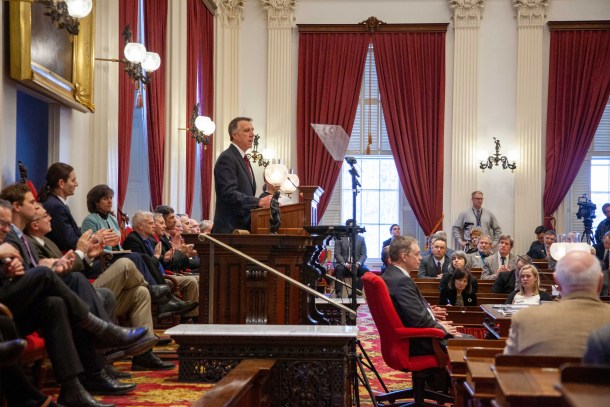
Gov. Phil Scott made clear in his budget message this week that he’s planning to steer the ship of his state straight ahead. Very little zigging or zagging.
Not much innovation, either.
With Capt. Scott at the wheel, the ship will by no means sail full speed ahead. More like half or even quarter-speed, slow enough so the budget “does not raise taxes or service fees paid by Vermonters.”
That doesn’t mean dead in the water. Capt. Scott would make some improvements, at least $11 million in new spending: $1.5 million to fix that unsightly hole in the ground in downtown Newport; $2.8 million to finish the Lamoille Valley Rail Trail; more money for housing and child care.
But the governor was sending word that the course he has been following for the last three years is the right one, so not much change is needed either in speed or direction in order to sail safely into port.
Meaning his reelection this November.
Scott has not yet announced whether he’s running for a third term. But like his State of the State messages earlier this month, the budget speech was politically shrewd. He presented a spending proposal that was prudent but not stubborn, and a picture of himself as a moderate: a conservative when it comes to taxes, a middle-of-the-roader on government programs, a liberal on immigration who got his one standing ovation when he said of refugees and New Americans, “as long as I’m governor, they’ll be welcome right here in Vermont.”
A very effective picture to paint of yourself if you’re running for office, especially if you’re a Republican.
Very effective does not mean trouble-free, either for approval of the budget or Scott’s reelection. To begin with, some of his proposals are going to face opposition and possibly rejection from the Legislature, which is controlled by Democrats.
Start with the one proposal that might be considered a major innovation: an additional $3 million for “child care assistance.”
And where will that $3 million come from? “Expand the lottery,” is all Scott said in his speech. Even the summary in the official budget document is short on detail. “Revenue will come, in part, from increased lottery sales due to the introduction of keno.”
And in part from allowing betting on sports.
The word “sports” is nowhere in the governor’s message, and though his administration officials candidly disclosed it during their budget briefing for the press, they were short on details. Presumably the bets would work through the lottery system.
But the lottery money now goes into the education fund, thereby holding down property taxes. House Speaker Mitzi Johnson, D-South Hero, said the proposal seemed like “stealing from the education fund,” to her, meaning it could lead to higher property taxes. Legislators don’t like anything that might raise property taxes. Some of them might not like the idea of more gambling in general. Rep. Brian Cina, P/D-Burlington, said financing child care through more gambling “exploits weaker low-income people.”
That’s likely to be a view shared by other lawmakers, some of whom noted what they considered an irony in Scott’s speech. He reiterated his opposition to “a new $29 million payroll tax,” leaving little doubt that he would veto the mandatory family and medical leave bill now working its way through the Legislature.
But he wants that $3 million for more child care, some of which might not be needed if parents were guaranteed partial pay for a few weeks after they had a baby.
Perhaps not the only irony here. To Scott, Vermont faces only one “crisis.” It is not, as Senate President Pro Tem Tim Ashe, D-Chittenden, pointed out, a crisis in the Department of Corrections (despite reports of abusing women prisoners at the Chittenden Regional Correctional Facility) or the mental health system (despite threatened closing of the Brattleboro Retreat), neither mentioned in Scott’s speech.
There is only “the demographic crisis,” which Scott called “without question, the greatest challenge we face as a state.”
Quite possibly. But to meet this challenge, the governor’s budget offers small-bore proposals: make it easier for nurses to get licenses, eliminate the state income tax on military pensions, more apprenticeships.
All of which might or might not keep Vermonters from moving out or entice outsiders to move in. State officials noted that they don’t have anything resembling data or accounts from what other states have done to show how effective these steps might be.
One of Scott’s plans to attract newcomers is to exempt companies that create “energy innovation jobs” from the state’s corporate income tax.
Forget for a moment the complication that this would be a tax cut for the affluent (that’s who run corporations) and a tough sell with this Legislature. For the governor, it’s a twofer: possibly attracting newcomers while helping to fight climate change. Just like his plan to expand electric car ownership and … and … well, not much else when it comes to climate change.
A potential problem for the governor both in this legislative session and in his reelection campaign. His steadfast opposition to higher gasoline prices may be popular, but it seems clear that a majority of Vermonters accept the scientific consensus that the world is getting hotter (as does Scott) and want their state to do something about it. Maybe do something more than just encourage more of them to buy electric cars.
If any issue threatens to complicate Scott’s campaign, it is probably this one. He starts off as the early front-runner, threatened only by the huge majority of voters who will reject the Republican at the top of the ticket. It is interesting, though, that professor Larry Sabato’s usually perceptive “crystal ball” of the University of Virginia Center for Politics moved its assessment of the Vermont governor’s race race from “likely Republican” to “leans Republican” after Lt. Gov. David Zuckerman announced he was running.
“Zuckerman may be better situated to convert Democratic presidential voters into votes for himself,” it said.
However steady the course, ships of state can always run into turbulence.

