


IN JAN. 21’S FINAL READING…
An inside look into reporters’ preparation for the governor’s budget address, minimum wage negotiations continue and an amendment to clarify slavery language in the Constitution passes both chambers.
THE TOP TAKE
It’s an annual tradition at the Statehouse. A couple of hours before the governor delivers the budget address, top administration officials gather to brief reporters on the contents of the budget. Everything is on the record — but is strictly embargoed until after the speech. It’s a useful way for journalists to get instant clarification on the details of a multi-billion-dollar spending plan.
The event is 45 minutes of mental pandemonium. The officials tout new initiatives, reporters furiously take notes, frantically skim the numbers-heavy budget book and spit out questions, and officials deflect the inconvenient queries. (TIL: WPTZ-TV’s Stewart Ledbetter is an incredibly aggressive typist. I weep for his keyboard.)
As for substance … well, there wasn’t much. Past briefings have gone by in a flash, with insufficient time for all the questions. Tuesday’s event was kind of a slog, as reporters poked away at details and flipped back and forth through the budget book in search of anything newsworthy.
Administration Secretary Susanne Young began things by saying the budget “is packed with new policy,” and then unspooled a series of small-dollar incremental ideas, none costing more than about $3 million apiece — and only a handful at that price point.
Young and Finance Commissioner Adam Greshin boasted of efforts to streamline state government, citing $13 million in annual savings. But when asked how much money was spent on programs designed to save money, Young responded, “We don’t have that broken out.”
Many answers were similarly unresponsive. VTDigger columnist Jon Margolis repeatedly asked if there was any actual evidence for various economic-development initiatives such as employer tax credits grants for workers. Every time, the answer boiled down to “We’d have to get back to you on that,” followed by a quick pivot to the unquantifiable benefits of the plan.
At the end of the session, reporters filed out of the governor’s conference room. The question on everyone’s lips: “Was there anything new in there?” The answer, “Not much.” – John Walters

WHAT YOU NEED TO KNOW
— Minimum wage conference committee negotiations kicked off Tuesday and are expected to finish up tomorrow afternoon. The proposal on the table from the Senate is an increase to $12.55 over two years, from the current $10.96. Representatives wanted time to look over the proposal. – Grace Elletson
— During Tuesday’s Democrat House caucus, Rep. Tom Stevens, D-Waterbury, gave an overview of the finalized paid leave plan, hashed out in conference committee and passed by the Senate.
In response, Rep. Cynthia Browning, D-Arlington, called the plan “irrational and inappropriate” for not including mandatory temporary disability insurance — a concern also voiced by Progressive lawmakers who are rallying support to block a veto override of the legislation. – Grace Elletson
— In an update to the Democrat Caucus, Rep. Alice Emmons, D-Springfield, said her Corrections committee is discussing strengthening the qualifications of corrections officer applicants and the abuse reporting process at the state’s prison for women. “DOC is in turmoil and losing people,” Emmons said. “We need to provide some stability.” – Grace Elletson
— Senate Education heard testimony for the first time today about a bill that would require the University of Vermont to achieve gender parity on its board of trustees.
Bill sponsor Sen. Chris Pearson, D-Chittenden, admitted that a fix will be “clunky” because trustees are elected in various ways. But, he said, the benefit of having diverse viewpoints is more important. – Grace Elletson
— The Senate Committee on Health and Welfare will be taking testimony every day this week on a bill that would ban flavored tobacco and e-cigarette products. Jennifer Costa of the American Cancer Society Cancer Action Network testified Tuesday.
She told senators that children and teens are most attracted to these flavored products, and that companies should be held responsible for their addictive qualities. “The sooner we can get these off the market … the better for public health,” she said. – Grace Elletson
— Statehouse security during the governor’s address included a tactical unit — the National Guard’s Weapons of Mass Destruction Civil Support Team — that protects against “chemical, biological, radiological and nuclear high-yield explosives.”
Matt Romei, chief of the Capitol Police, said, “We bring a lot of tools to bear at the Statehouse to protect the public. … Some of those tools are seen, some of them are not so easily seen.” – Grace Elletson
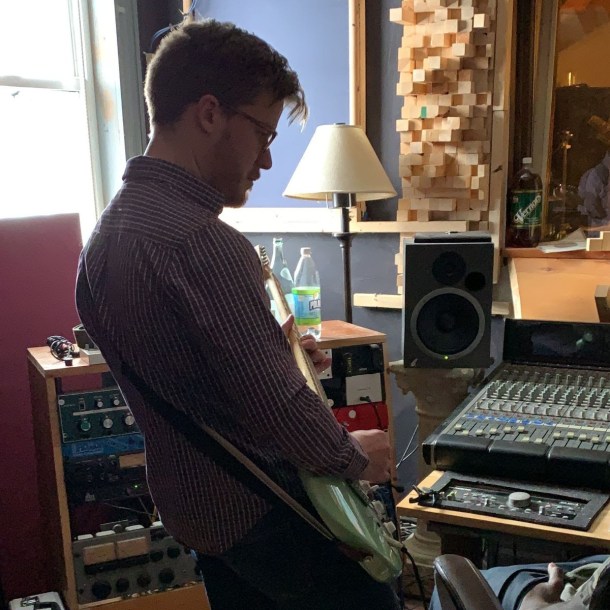
— Rep. Dylan Giambatista, D-Essex Junction, spent the weekend cutting some tunes in support of his campaign for state Senate in Chittenden County. Giambatista is a former member of the iconic band Rough Francis.
“We’re recording two songs to emphasize the importance of running for office and voting,” said Giambatista. He hopes to release a record in late spring or early summer, as the primary campaign is kicking into high gear. – John Walters
REPORTER’S NOTEBOOK
Last January, a group of lawmakers introduced a proposal to amend the Vermont Constitution. They wanted to clarify certain language in it that in order to make clear that slavery of any form was prohibited in the state.
In April, the proposal passed the Senate. Today, it passed the House unanimously. VTDigger’s Grace Elletson caught up with Sen. Debbie Ingram, D-Williston, who was a main sponsor of the proposal, to learn more about the significance of its passage.
GE: For starters, why did you want to introduce this proposal?
DI: Vermont has always prided itself on being the first state to outlaw slavery, but the way I read the language, it’s not really completely clear. And if we’re not clear then we are communicating to people of color, especially black people, that we’re not sure about our history … or unwilling to grapple with racial bias and the way it manifests itself in our society today.
GE: Were there any arguments about why this amendment should not be adopted that surprised you?
DI: Sen. [Dick] McCormack voted against it in the Senate chamber. He’s an articulate spokesperson of his view, which is an outlier, that some people voted even in the committee want to preserve this historical language and they’re proud of Vermont’s reputation of being forward thinking. Obviously the vast majority of people did not agree with that point of view.
It did surprise me, it definitely surprised me, that in this day and age that it was so important for some people to preserve that history when we can teach it to our children in our history books. We can preserve the history without preserving that language in the Constitution.

