

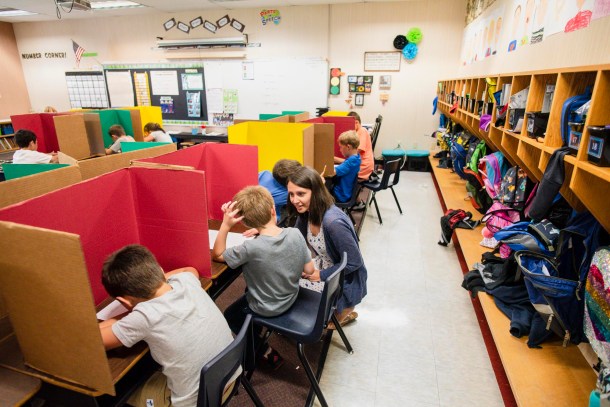
Vermont spends more than almost any other state to educate each student in our primary and secondary schools. According to the U.S. Department of Education, in school year 2015-16, the latest year for which we have data, Vermont’s $1.7 billion in education spending amounted to $19,000 per student.
To put that number in perspective, it’s 61% more than the U.S. average of $11,800 per student. Only New York, Connecticut, and New Jersey — all much wealthier states than Vermont — spent more.
In 2015 the Vermont Legislature passed Act 46, a law that pressured towns to consolidate school districts. Its goal was to reduce costs, and therefore property taxes, by consolidating duplicative administrative functions in the state’s many school districts.
While administrative costs in Vermont are higher than the national average, they only account for 8.5% of all costs and are only slightly above the national average of 7.6%. Even if Act 46 is successful at paring Vermont’s administrative school costs down to the national level, it would save less than $20 million out of an overall expenditure level of $1.7 billion.
Administrative costs may be higher in Vermont than elsewhere, but that can’t explain a spending level 61% above the national average. We need to look elsewhere for the source.
Three-quarters of education spending is for teacher and staff salaries and benefits. That’s where the money is. So it must be that we either pay teachers a lot or we have a lot of teachers.
Our high spending is not due to higher-than-average salaries. Vermont teachers’ salaries average $57,300; a few thousand less than the U.S. average. Lower-than-average teacher salaries should translate into lower-than-average spending, just the opposite of what the numbers show.
We do have a lot more teachers, given the number of students in our schools, than one would expect given national norms.
In the 50 states as a whole, the ratio of students per teacher is 16-to-1: On average each teacher teaches 16 students. In Vermont, the ratio is 10.5-to-1. That’s the smallest ratio in the United States. A school with 200 students in the U.S. would average 13 teachers. In Vermont a school of that size would employ 19 teachers.
A similar pattern holds for non-teaching staff. Vermont also has the lowest ratio of students to staff of any state in the nation.
Vermont’s high per-pupil spending, then, is entirely due to the large number of teachers and non-teaching staff.
If Vermont’s high level of education spending led to commensurately better outcomes, I, for one, would not object. Spending an extra $7,000 per student — which translates into $659 million — might be a price other taxpayers would be willing to pay as well for an 18-year-old who was well-prepared for life after high school.
But my analysis of state test scores shows that, once we adjust for Vermont’s unique demographic features, our students don’t perform better than their peers in other states. In fact, in many dimensions they significantly underperform their peers.
Could we reduce our education spending without sacrificing quality? Nearly all states spend less than Vermont and many have better student performance than Vermont.
We don’t even have to get down to the U.S. average spending to free up lots of money which could be used for all sorts of competing priorities. We could spend more on the environment, reform our correctional system, clean up Lake Champlain, train underemployed adults, shore up our underfunded state pension system, provide more assistance to the most vulnerable Vermonters, and provide tax relief to Vermonters.
If we spent the same amount per student as our neighbors in New Hampshire, we would free up $365 million. If you don’t like the idea of emulating the “live free or die” state, how about using Massachusetts as a model? If we spent the same amount as they do, that would free up $238 million.
That’s not chump change.
