



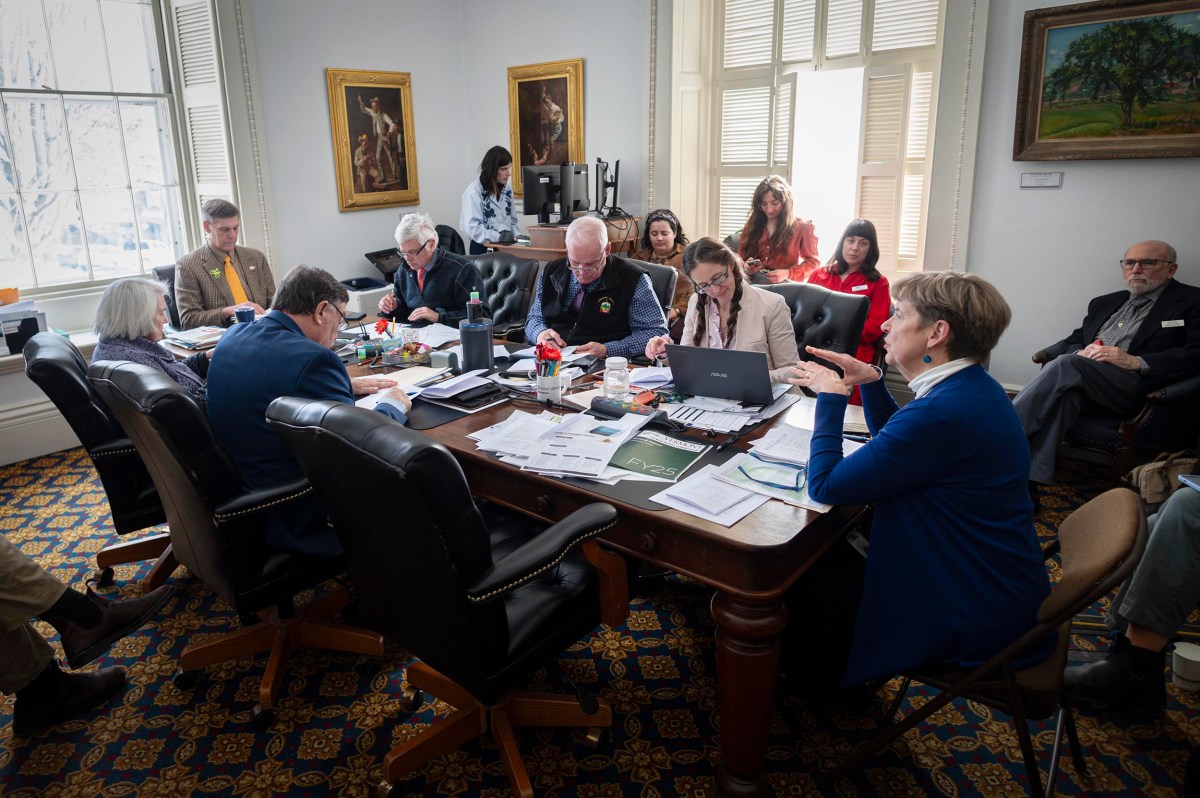
When Vermont lawmakers set aside $50 million in this year’s budget to help plug feared future federal funding cuts made by the Trump administration, they weren’t sure exactly what that pot of money would be used for, or when. Now, a year into Trump’s second term, they’ve started drawing on some of the money — and are continuing to debate when to draw on the rest.
In the wake of Trump’s deadly immigration crackdown in Minneapolis in recent weeks, Senate President Pro Tempore Phil Baruth, D/P-Chittenden Central, is proposing a new potential use for those funds. He wants to make at least some of the cash available to reimburse the state or municipalities for public safety costs they could incur if a similar operation took place here.
Baruth told his colleagues on the Senate Appropriations Committee Tuesday that the proposal stemmed from discussions with leaders in Burlington and Winooski, which are among the state’s most diverse communities. If federal immigration agents targeted those cities, he said, many members of the public would turn out to protest. And judging by recent events, he said, a “greatly increased” state or local police presence would be needed “to make sure that nothing spirals out of control.”
The pro tem wants his idea included in this year’s midcycle budget tune-up legislation, which modifies state spending through June. Senate Approps started taking testimony on the “budget adjustment” bill, H.790, on Tuesday. The House approved its version of the bill Friday.
Baruth’s proposal comes as state lawmakers have already spent, or proposed spending, about a quarter of that $50 million for other uses.
Last fall, they used some $6 million to fund food assistance for tens of thousands of Vermonters in the first half of November as federal funding lapsed during the government shutdown. They also sent $250,000 to the Vermont Foodbank to help address the temporary surge in need.
More recently, the House’s version of the 2026 budget adjustment bill proposes taking another $5 million from that pot. That money would be used to slow the loss of vouchers that help thousands of Vermonters cover rent amid federal funding cuts to the Section 8 program.
It’s difficult to say how much it would cost the state or municipalities to police a major protest against an immigration enforcement surge. According to the City of Minneapolis, local police have worked thousands of hours of combined overtime during Trump’s crackdown there. The estimated cost of overtime between Jan. 8 and 11, the city said, was more than $2 million.
No members of the Appropriations Committee expressed immediate disapproval of Baruth’s idea Tuesday. The pro tem said he expects there will be more discussion of it in the coming days, when the details could be tweaked. Sen. Andrew Perchlik, D/P-Washington, the committee’s chair, said he hopes the panel will finish its work on the budget adjustment by early next week.
— Shaun Robinson
In the know
Lawmakers narrowly confirmed Michael Drescher’s seat on the Vermont Supreme Court after Republican Lt. Gov. John Rodgers cast a rare tie-breaking vote in the divided chamber Tuesday.
The contentious vote on Drescher came after senators weighed their ethical questions in considering his nomination. Many feared Drescher would not uphold the rights of Vermonters because he spent the last year serving as Vermont’s top federal prosecutor under the Trump administration. In that role, he represented the federal government in cases involving the detentions of students Mohsen Mahdawi and Rümeysa Öztürk.
Read the full story here.
— Charlotte Oliver
It was a busy day for Rodgers, who also formally announced Tuesday that he’s running for a second term. The Glover Republican and former state legislator — who won his current post in 2024 amid a wave of GOP gains across the state — said he wants to stay in the job to continue pushing to make Vermont more affordable to live in and enticing for young people to stick around as adults.
“No matter where I go, the high cost of living is on people’s mind,” Rodgers said at a campaign launch outside the Statehouse, flanked by about 50 legislators, family members and supporters. Thom Lauzon, the mayor of Barre, opened the event.
Rodgers’ announcement came less than an hour after he cast what is likely to be one of the most significant votes of his tenure — confirming Drescher’s nomination to the state’s Supreme Court.
Rodgers said in response to a reporter’s question that he does not think it is important for the lieutenant governor to use the office to speak out against the sweeping changes enacted by the Trump administration. That’s a clear distinction from the three Democrats — Molly Gray, Ryan McLaren and Esther Charlestin — who have announced they’re challenging him this year.
No other Republican has so far announced a primary challenge to Rodgers this year.
— Shaun Robinson
On the move
The House granted preliminary approval on Tuesday to a bill that would create a new criminal penalty for “intentionally or recklessly” intimidating voters and officials who run elections. The measure, H.541, mirrors similar protections already in federal law that apply when candidates for federal office are on the ballot, said Rep. Ian Goodnow, D-Brattleboro, presenting it on the House floor. The bill would effectively extend those protections to state and local contests, including those on Town Meeting Day.
Violators would face up to a $2,000 fine or two years in prison. The bill, for which Goodnow is the lead sponsor, is slated for third reading on Wednesday.
— Shaun Robinson
Family affair
Rep. Topper McFaun, R-Barre Town, recognized the nurses and nurse practitioners gathered in Montpelier for their professional advocacy day on Tuesday. Among the more than 100 nurses in the gallery: Kate McFaun Williams, an emergency room nurse and leader in the Vermont chapter of the American Nurses Association — also, Rep. McFaun’s daughter.
McFaun Williams opened her testimony to the House Health Care Committee this afternoon by raising some issues with H.585, a bill Rep. McFaun introduced.
— Olivia Gieger
ICYMI
From health care to immigration, the economy to social services and education to climate, VTDigger reporters have closely followed Trump’s time back in office and the defining ways it has affected the Green Mountain State.
One year in, we looked back on what’s changed — and looked ahead to the changes still to come. Read our newsroom’s roundup of Trump 2.0, which we published over the weekend, here.
— VTD staff
Notable quotable
Reporters gathered in Lt. Gov. Rodgers’ office to ask him about his tie-breaking vote on Tuesday afternoon.
He opened with: “You want to see my dead animals?” Classic Rodgers.
— Charlotte Oliver
