


Lt. Gov. David Zuckerman is officially running for governor.
The Progressive/Democrat announced Monday he is mounting a challenge against incumbent Republican Phil Scott, about a week after the news of his candidacy broke on VTDigger.
During his announcement speech in Montpelier, Zuckerman stressed the importance of raising the minimum wage and addressing climate change. He added the state should be working to make higher education, housing and health care more affordable.
“These last three years we have not seen the vision or action that Vermonters need,” Zuckerman said of Scott’s time in office.
“There’s going to be a huge wave — I think — of energy,” Zuckerman told reporters Monday.
“Folks are frustrated with government as usual and they’d rather there be folks looking out for them — really fighting for them — in the executive office,” he added.
For months, Zuckerman said he had been undecided on whether he would run for governor, as he weighed family responsibility and the future of his Hinesburg business, Full Moon Farm.

He now formally joins former education secretary Rebecca Holcombe, who announced she was running for governor in July, as the only two candidates in the Democratic field.
Ahead of Zuckerman’s announcement Monday, the Holcombe campaign released a list of 15 endorsements, including 13 current legislators. Those now supporting Holcombe also include a former Vermont Democratic Party chair, Dottie Deans, and former vice chair, Tim Jerman, currently a Democratic National Committee delegate.
Zuckerman responded by rolling out seven endorsements of his own, including former Burlington mayor Peter Clavellle along with Crea and Phil Lintilhac — deep-pocketed supporters of progressive candidates (Crea Lintilhac also serves on VTDigger’s board).
Although Zuckerman is getting into the race later than Holcombe, whose campaign reports it has raised nearly $300,000 since the summer, he already enjoys strong name recognition throughout the state, after serving for nearly two decades in the Vermont Legislature and two terms as lieutenant governor.
In July of 2018, four months ahead of the election, 72% of Vermonters had heard of Zuckerman, according a VPR-Vermont PBS poll.
Zuckerman’s long career in Vermont politics will likely give him an edge over Holcombe, said Eric Davis, an emeritus political science professor at Middlebury College.
“You’d have to say that Zuckerman would be favored over Holcombe, having name recognition and having won other statewide elections,” Davis said. (Holcombe’s campaign argues there’s no evidence her name recognition numbers “aren’t competitive” with the lieutenant governor’s.)
Holcombe was not available for an interview Monday. But in a statement, she touted her executive experience and work with school board officials and educators in every community in the state.
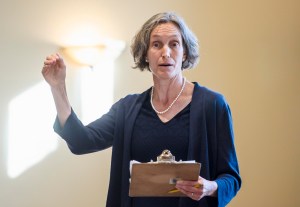
“Phil Scott and David Zuckerman have been talking about our challenges for the last two decades,” she said. “I am hearing from Vermonters that they need action and solutions—that’s why I’m running for governor.”
Throughout his time in Montpelier, Zuckerman has fashioned himself in the image of the popular U.S. Sen. Bernie Sanders. In the 1990s Zuckerman was a volunteer for Sanders and has been a strong ally of the progressive Vermont senator for years.
Mirroring Sanders, Zuckerman has championed a $15 minimum wage, instituting a wealth tax on Vermont’s richest residents, legalizing marijuana, and taking strong action on climate change.
While in the Legislature, he spearheaded legislation that made Vermont the first state in the nation to require food manufacturers to label products containing genetically modified ingredients.
Davis said he sees a possible path to victory for Zuckerman against the governor, even though “conventional wisdom would say Scott would be favored as the incumbent.”
In 2020, Democrats are expected to turn out in high numbers to vote against President Donald Trump. If Sanders also makes it on the ballot as the Democratic nominee for president, Zuckerman would likely see an additional boost.
Davis said that Zuckerman will make a strong effort to turn out young people, and that both he and Holcombe will argue that Scott hasn’t gone far enough to address issues like climate change and rising health care costs.
“Both Democrats would say that what Scott has demonstrated in the last four years…is passive leadership rather than active leadership,” he said.
In the last two months, Zuckerman has been able to analyze Vermont Democratic Party polling, gauging his head-to-head favorability against Scott, as well as what issues are most important to Vermonters. Those results have been closely guarded by the party.
On Monday, Zuckerman would not go into specifics of the poll but said the results were “certainly encouraging.”
“Win or lose, it’s important that we get out there, we talk about these issues, and we put them on the front-burner,” Zuckerman said.

Scott will be a formidable challenge for whichever Democrat wins the primary nomination in August. The incumbent governor maintains a 64% approval rating, with strong support among Democrats, Republicans and Independents.
Scott has said he will not say whether he is seeking reelection until May, after the 2020 legislative session. But he has already started fundraising for his campaign. He sent a letter to top donors in November, asking for financial support and touting his accomplishments in office.
Sen. Randy Brock, R-Franklin, who lost against Zuckerman in the 2016 lieutenant governor’s race, said he believes Scott will win reelection in 2020 thanks to his moderate approach to addressing issues like taxation and the state’s demographic crisis.
“I think that Phil has the advantage of a position of moderation which i think is part of the long tradition we have,” Brock said. “I think that that’s what we need: to steer a middle course between the extremes.”
Former Republican House minority leader Don Turner, who ran for lieutenant against Zuckerman in 2018, said that his former opponent could make Scott’s reelection bid a “very challenging race.”
Turner pointed to 2018, when Sanders, running for re-election to his U.S. Senate seat, endorsed Zuckerman and campaigned with him around the state. If Sanders was back on the ballot in 2020, Zuckerman could see a big boost from left-leaning Democrats.
“It was definitely an advantage to have Bernie on his side,” Turner said.
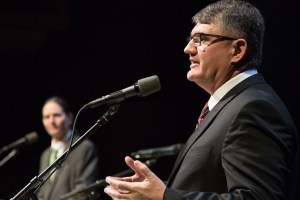
Turner was complimentary of Zuckerman as a political candidate. “He’s very polished in his ideology and beliefs and his message. I think in debating him he was very strong debater. He’s a very intelligent gentlemen,” he said.
But he cautioned that Zuckerman’s progressive policies would lead to heightened cost of living in the state.
“[Vermont’s] already a very expensive place to live and do business,” he said. “And if you elect a David Zuckerman it’s not going to get less expensive.”
Sen. Anthony Pollina, P/D Chittenden, the chair of Vermont’s Progressive Party, said that Zuckerman will present a strong challenge against Scott.
“I see the ability for David to refocus the debate around the economics of working and middle class families,” Pollina said.
Zuckerman will be able to successfully point out Scott’s “weaknesses” on the campaign trail, according to Pollina, including how the governor has stood in the way of minimum wage and paid family leave legislation, and has shown “no urgency” when it comes to addressing climate change.
“When it comes to issues that are important to Vermonters, he’s been pretty weak when it comes down to it,” Pollina said of the governor.
Rich Clark, a professor of political science at Castleton University, who has conducted polling throughout the state, said that whoever challenges Scott this fall will face an uphill battle, given that Vermonters historically reelect incumbent governors.
And there’s nothing that’s happened under Scott’s watch so far that— in and of itself—would turn his supporters away from him, Clark said.
“There’s nothing that surfaces in my mind now that would indicate a real disgruntlement with the Scott administration,” he said.
Zuckerman’s progressive politics may contrast against Scott’s moderate positions. But a challenge from a popular far-left candidate, even in 2020, may not be enough to best the governor.
“You have to recognize the voters have decided again and again to send Bernie Sanders back to the Senate and yet in that time have supported Jim Douglas and Phil Scott as governors,” Clark said.
“I don’t think the problem with Hallquist or with Minter has been that they were too moderate and didn’t rally the other side,” Clark said, referring to Sue Minter, the Democrat opponent to Scott in 2016, and Christine Hallquist, his challenger in 2018.
“I really think it was the case that it was the strength of Scott.”
