

This story was updated at 3:15 p.m. and 6:15 a.m.
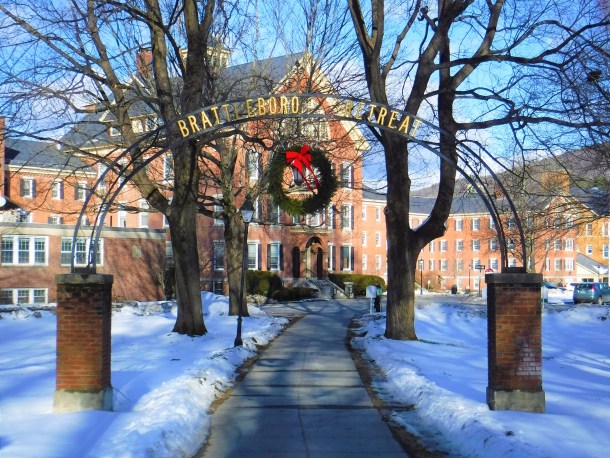
The secretary of the Agency of Human Services has balked at a request from the Brattleboro Retreat for additional monies to make up for a “reoccurring financial crisis.”
In response to the state’s refusal to give the Retreat an additional $2 million in funding, the board of trustees alerted the state it is considering its options, including selling or closing the psychiatric facility.
The Retreat, which is Windham County’s largest employer with more than 800 workers, serves more than 4,000 patients a year from Vermont and the region. It has the only treatment program for LGTBQ patients in the country and offers the only specialized treatment for children in the state.
Since Tropical Storm Irene led to the shutdown of the Vermont State Hospital in Waterbury, the Retreat has played a critical role in the state mental health system. Fifty percent of all of Vermont’s inpatient psychiatric treatment beds are provided by the Retreat. And the facility provides suboxone treatment through the state’s hub and spoke system to 150 patients, according to the Windham County delegation.
Brattleboro Retreat CEO Louis Josephson said the board instructed him on Thursday to alert the Agency of Human Services and the governor that they are considering the options for the facility without additional funding from the state. That could include looking at ways to continue operating, selling or closing.
The facility recently saw a significant, unexpected decrease in patients.
“This is all worst-case scenario planning here,” Josephson said Sunday.
In a press release issued after VTDigger requested information about the decision, Secretary Mike Smith said that last year the agency gave the Retreat an annual rate increase of $3.5 million on top of an investment of $16 million for 12 new beds at the psychiatric facility.
Last week the Retreat asked for another $2 million because fewer patients are utilizing the facility than anticipated, Smith said.
Smith said he rejected the Retreat’s request because “their financial strategy appears to be built on a flawed premise — that continued financial bailouts from taxpayers is an effective long-term solution or is expected when Retreat management makes a financial miscalculation (budgeting a higher patient count).”
In addition, Smith chided the Retreat for failing “to make significant management or strategic operational changes,” and currently is offering “little clarity on where they stand financially and the prospects of better financial conditions in the future.”
The Retreat has also failed to provide a plan for paying more than $1 million in state taxes owed, Smith said.
“I want to be clear: just asking taxpayers to put up more money, in order to avoid necessary change, is not an option I can support, or an option I believe the Governor or Legislature would want me to bring forward,” Smith said.
About 50% of the Retreat’s revenues are from the Medicaid program.
Josephson said Sunday that the board’s decision is not a strategy in negotiations with the state.
“It’s not a negotiating tactic,” he said. “It’s just a fact.”
He said that the board felt it was important to tell state officials about the options they are considering.
“Nobody likes surprises, and this would be a really terrible thing for the state of Vermont,” he said. “I’m really worried, frankly, that the state of Vermont is not understanding the impact if we’re not able to keep providing the type of services we have.”
However, Josephson said he is optimistic the Retreat can avoid closure.
“We think even if the state said we won’t give you another penny, we think there’s ways we can keep the Retreat functioning to some extent,” Josephson said.
Josephson said there isn’t a clear timeline for moving forward with options for the psychiatric facility.
“We are going to keep negotiating with the state see if there’s any room for extra support, but if there isn’t, you know, there isn’t,” he said.
Sen. Jeanette White, D-Windham, said in an interview Saturday night that the Retreat was paid $1,000 less per day for Medicaid patients than the Vermont Psychiatric Care Hospital in Berlin and the underpayment, which totals $5 million a year, had exacerbated the Retreat’s financial situation.
“They simply can’t lose an employer with over 800 people,” White said. “It would have a huge impact on Windham County.”
The Retreat provides services to private patients that aren’t anywhere else, White said and the state is in “desperate need of residential beds for adolescents, and we are in desperate need for a step down facility,” she said.
“There is no way UVM Medical Center can take all those people,” White said.
In a statement released by the Windham County delegation, White and her colleagues in the House and Senate said they support “the decisions the Retreat has made to answer the Agency of Human Services repeated requests to expand its state beds and services in order to help the State of Vermont provide mental healthcare to Vermonters in the most acute need.”
“To say we are disappointed by Secretary Smith’s public statement issued today is an understatement,” the delegation wrote. “We have no doubt that the State of Vermont will continue to work, responsibly, in partnership with the Retreat to continue to provide care for all patients. We will work diligently with the Scott Administration and the Retreat to ensure that is the case.”
Rep. Emilie Kornheiser, D-Brattleboro, said the community mental health agencies don’t have the capacity to pick up the slack, “that’s why we have these places.
“Incredibly vulnerable people’s lives is not what you want to play politics with,” Kornheiser said in an interview Saturday.
The Retreat lost $2.5 million in fiscal year 2017, and $439,000 in 2016, according to the latest 990 tax reports submitted to the IRS. Expenditures at the facility in 2017 were nearly $70 million. The budget for 2019 was $75 million, according to a state filing. Last year, the Retreat had 54 days of cash on hand.
Rep. Anne Donahue, R-Northfield, who is an advocate for mental health parity, says the closing of the Retreat would have “a more devastating impact than the closing of the Vermont State Hospital because of the number of individuals who would be immediately affected.”
In 2011, the state moved 54 patients from Waterbury. The Retreat took many of the patients, others ended up in emergency rooms at hospitals around the state. It took two years for the state to build a 25-bed facility to replace the state hospital with the Vermont Psychiatric Care Hospital.
The number of people on a daily basis who use the Retreat and would lose access to inpatient care would be 60-70 adults and 25-30 children, Donahue said.
A significant additional investment would need to be made to fill the void, Donahue said. If the proposed UVM Medical Center project in Berlin moves forward that could address the need long term, she added.
“It recalls to mind how desperately we needed to get something in place after the Vermont State Hospital was flooded by Tropical Storm Irene,” Donahue said.
“The Retreat is an archaic model of care that has been trying to achieve its own sustainability, and it’s done that through growing state funded care,” she added.
There have also been recent issues at the Brattleboro Retreat with staff.
The union that represents Retreat nurses filed unfair labor practices charges against the facility over allegations of discrimination against union leaders, violation of due process rights, and refusing to share information.
Last week, according to the union, the National Labor Relations Board forwarded their charges to litigation.
Correction: A previous version of this article incorrectly characterized the timeline of the $3.5 million rate increase for the Brattleboro Retreat.
Elizabeth Hewitt contributed to this report.
