


The Deeper Dig is a weekly podcast from the VTDigger newsroom. Listen below, and subscribe on Apple Podcasts, Google Play, Spotify or anywhere you listen to podcasts.
In Franklin County, Dr. Joe Nasca used to be one of many independent pediatricians — now, he’s the only one left. His is one of many independent practices that might get left by the wayside as major hospital systems take over a growing share of the state’s patients.
Vermont, like the rest of the country, is trending away from the “country doctor” model that Nasca and his peers grew up with, and towards a system where medical care is consolidated under systems like UVM Medical Center and Northwestern Medical Center in St. Albans.
Nationally, about 31% of doctors say that they’re an owner or partner in their own medical practice — down from 57% in 2000. That’s close to a 50% drop over 18 years.
In Vermont, the trends are similar — independent doctors have dropped from 47% in 2011 to 31% in 2017. And the data shows that’s exacerbated in the most rural areas.
On this week’s Deeper Dig, health care reporter Katie Jickling talks to Nasca about what makes his practice different, and what this trend is going to mean for the future of medicine in rural Vermont.
**Podcast transcript**
This week: Independent doctors across Vermont are closing their practices, while major hospital systems take over a growing share of the state’s patients. What does that mean for Vermonters seeking care?
Dr. Joe Nasca: I’ll be right with you.
Last week, our health care reporter Katie Jickling visited an independent doctor in Georgia, Vermont to learn more.
Jickling: Right above the patients table, there’s this Norman Rockwell painting called “Country Doctor” that’s very prominent, he can see it from his big wooden desk.
Nasca: As I’ve looked at it over the years, he’s really telling a story in that picture I think.
Jickling: It’s sort of been his North Star ever since he was in medical school in Buffalo, he said it was above the desk of his dean. For him, it really embodied this image of the kind of doctor that he wanted to be.
Nasca: This child doesn’t look very ill, but these people are very focused on what’s going on. He’s still dressed in his work clothes, very patient, and this little guy, I think he says, you know we’ve had a long relationship. That’s probably their son, and he probably took care of that little guy.
Jickling: It shows an older doctor caring for a young boy, and the boy’s parents are looking concerned, and there’s an older sibling sitting in a corner, it’s sort of evening, and there’s a dog sleeping by the fire, it’s clearly in this doctor’s house, and he’s caring for these people that he’s probably known for a really long time. And for Dr. Joe, it epitomized this in-person, very personalized encounter and relationship and working hard for this community that you love and are a part of and I think that that’s something he sort of looks at, he talks to his teenage patients, he says, and says this is self fulfilling prophecies are really true, and look at me, and this is what I have envisioned and have followed.
Nasca: I tell them that’s my self-fulfilling prophecy right there.
What’s the vibe of this office? How’s it different from where some other folks may go see a pediatrician?
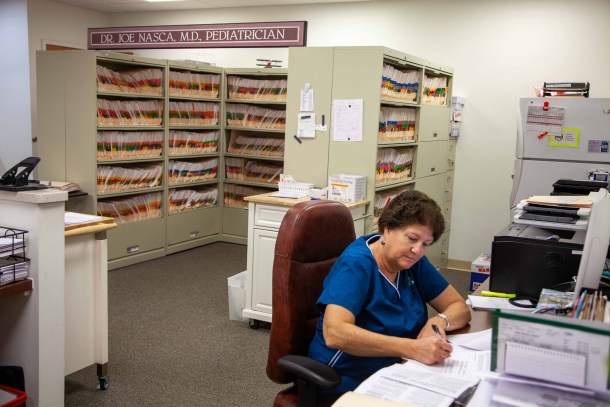
Jickling: You go in, and behind the desk, there are just shelves and shelves of medical records, he clearly has not moved to electronic medical records, and he’s quite proud of that. He sees that as really focusing on, rather than looking at a computer screen, he’s talking to his patients.
Nasca: A good analogy is we’re doing vinyl here, we’re doing the real thing. We’re not digital.
Jickling: And he’s crafted this office in a way that is personal to him. The waiting room is set up like a beach with a floor tiled with the ocean and swimming fish, and different plants around, and there are drawings from little kids, and his patients on all the walls.
How did Dr. Joe get into this? How did he end up as an independent practitioner out there?
Jickling: He came to Vermont in 1991 by way of upstate New York after medical school, and he started at a small practice in St. Albans called MouseTrap Pediatrics. He was there for about until 2006, about 15 years. It was independently owned, but he felt like it was getting too big.
Nasca: Eight doctors, five offices, 30 nurses, so it was a big operation, and it was the time of big office, lots of stuff going on, phone tree…
Jickling: He talked about a phone tree where people call and there’s the press 1 if you want to talk to Dr. Joe, press 2 if you want to talk to Dr. So-and-so, and that was too much for him.
Nasca: That just didn’t work for me anymore, so I went off into private practice in 2006.
Jickling: He’s been there ever since, and he sees this as the chance to be a doctor in his own way, in a very personalized one-on-one sort of setting.
Nasca: When I was with the big group, I had chest pain for five years, until I finally left I realized the source of the chest pain is this irresolvable anxiety about not being able to practice medicine in a comfortable way, and 13 years ago, going off on your own was crazy, nobody hangs up a shingle anymore, you must be out of your mind. And I was scared, is this going to work? But there were people like Paul that I knew, the interns that were here in town that had done it, I spoke with them, if these guys could do it I could do it.
What about in terms of the way he works with his patients? How does he see that as different from the way a doctor might interact with their patients in a larger setting?
Jickling: He says that he wants to practice medicine not health care. And for him, that means that he’s not interested in the business of health care, the billing and the politics of care as much, and all the factors that are really administrative in nature.
Nasca: The whole thing that we call health care: drugs, drug costs, surgery… I mean there’s all of that, and then there’s what I do, which is the smaller part of that whole thing. I think this is that picture that you’re looking at that’s the Norman Rockwell, you know. I’m your doctor, it’s what we did today.
Jickling: He wants to see his patients, he wants to get to know them on a very personal level, and he wants to talk about their health and the things that they care about, even if that doesn’t fit neatly into the block that they’ve signed up for in their appointment.
Nasca: This job gets better the longer you do it, so after 20 years you’ve done a generation now, so we saw a patient this morning, a young woman that was here with her 3-year-old, and I’ve taken care of her since she was 4. I’m what some people think of when they think of my doctor.
Jickling: He talked about providing really seamless care to patients. He saw a young patient who was burned on his hands, he came in, he treated the burns, and then the parents came back every day for the rest of the week just making sure they were doing the right thing, that they were changing the bandages properly.
Nasca: One of the great things about this kind of practice is that you have me here and you’re stuck with me. You get that linear look, OK you saw this wound yesterday, now you’re looking at it today, it’s very hard to describe it, I guess you could photograph it.
And that’s something he can do because… it’s him? He sees those same people over and over?
Jickling: That’s something he could do because he was willing to push around other appointments when these concerned parents showed up at different times of the day. It’s something he could do because he knew the patient, he knew what had happened to this child, and he was willing to put in the time for the family..
Nasca: Thursday I had a boy come it with very complicated problems who was scheduled to have surgery on Monday, and he worried about having an infection prior to the surgery, so we were able to do some tests, and on Saturday, we were able to confirm those tests and start him on the proper treatment prior to his surgery, so Friday night I was on the phone with his mother and his surgeon. Saturday morning, I got a call from the lab, I was in Montreal, but I was able to communicate with the mother about the results of the tests, and the antibiotics he needed to be on, and Monday morning, when I walked in, I called the surgeon to update him on what had happened over the weekend, so that seamless care from Thursday day to Monday morning would have involved many changeovers in health care. All good people, but you know the game of telephone you played when you’re a kid, and everybody whispers in the ear of the next person. It was harder for me to be on call once every eight nights for eight doctors than for me to be on call every night for my patients because I know the story,
Jickling: That’s something I also heard from a family whose been going to him, to Dr. Joe, for several years. They have two boys, and when one of them has an appointment, Dr. Joe is happy to look at the other one as well, even though it’s not a billable hour and he’s not getting paid for it. They also said that Dr. Joe invited the family over to pick apples this fall, which is decidedly not in the realm of typical doctor duties.
Yeah, I can’t think of the last time that happened to me. What made you decide to seek out this doctor? What made you interested in looking at how someone like Dr. Joe operates his practice?
Jickling: There used to be 10 pediatricians in Franklin County, one practice has closed entirely, the second practice that formerly employed seven or eight doctors that has merged with Northwestern and a couple of those doctors have left, now there are five, and so he’s the only independent pediatrician left in the county, and it’s indicative of this larger trend, where particularly rural families are traveling farther and farther distances to see a pediatrician, and more and more doctors want to join hospitals because of a heavy administrative burden. It’s difficult to have electronic health records, and do the billing and administration in addition to seeing patients, and so often doctors want to be able to have the administrative structure that a hospital offers.
Nasca: I think there’s really, really talented smart good physicians that work in big systems, and they’re able to do that, and I think the magic is when you’re in the room with the patient and the door’s closed and you’re focused on why are you here today? What’s troubling you? And I think that’s what motivates people to go to medicine. I think there’s some doctors that are very interested in analytics and developing the new health record, and that’s great, that’s a good skill set to have, but I think most people that go to medicine really want this connection that we feel when we’re in the room.
I’m curious why this trend, why are there so many fewer independent pediatricians in Franklin County now than there were, you know, 10 years ago?
Jickling: This is something that is happening all over the country — it’s increasingly difficult for doctors to make it on their own for a variety of reasons. There has been a trend toward consolidation that started in the late ‘80s and early ‘90s. When the Affordable Care Act passed in 2010, that’s Obama’s health care law, it basically incentivized outpatient care rather than inpatient care. And so hospitals started buying up independent practices and small doctors offices because they wanted to reap the benefits offered by those incentives. And so that also helped accelerate the trend.
Is that what’s happened in Vermont?
Jickling : Nationally, about 31% of doctors say that they’re an owner or partner in their own medical practice, but that’s down from about 57% in 2000. That’s close to a 50% drop over 18 years. In Vermont, the trends are similar — independent doctors have dropped from 47% in 2011 to 31% in 2017, which is the most recent numbers we have. That’s a really significant drop. And that’s exacerbated in the most rural areas.
I wonder, are there other political factors either in-state or nationally that have contributed to this? Are there other forces that are kind of fighting against practices like Dr. Joe’s?
Jickling: Often, the doctors in rural areas in particular see a lot more poor patients, they’re on Medicaid, and the Medicaid reimbursement rates for doctors are pretty low. And so when you’re seeing a high percentage of these patients, it makes it harder and harder to remain financially feasible.
Nasca: One of the first years I started, I had a child who stuck a pitchfork in their foot. And because the family didn’t have health insurance, you know, going to the doctor was not something that they were going to do until things got very bad and then by the time I saw the child, he had a bad infection need to be hospitalized, have a surgery and you know, clean out the infection. So, especially in the northern reaches of Franklin County, you know, Appalachia extends up to the Canadian border, and the poverty in the northern section of the county is significant. And, you know, probably on the order of 60 or 70% of the kids in Richford up through St. Johnsbury are covered on state insurance because of their parents’ money situation. And there was a 21% drop in reimbursement in 2016 for Medicaid. And that’s what led to the demise of the pediatric practices in Franklin County.
Jickling: So 21% drop in reimbursement rates for kids?
Nasca: For Medicaid. But if more than half of the kids you’re taking care of now suddenly have this huge drop, and the good thing is everybody now has insurance so they’re not getting the pitchfork in the foot anymore, they’re coming to get care. But, you know, you’d have to talk to somebody from the old MouseTrap Group to ask exactly what happened, but my sense was that they just went out of business. They just couldn’t. They couldn’t make payroll.
Jickling: I talked to a doctor named Paul Rodgers up in Johnson, Vermont, and he closed his practice earlier this year. He’s been practicing there for decades. And he tried to give away his practice, but he couldn’t find anybody to take it. So he ended up just closing it down. But he said, you know, it’s understandable with young doctors and tens of thousands of dollars of medical school debt. It’s difficult to make a go of it, especially with the financial challenges and just the challenges of being a young person living in a very rural area.
Yeah, I’m curious who else you’ve talked to about this trend that we’re seeing of hospitals consolidating and independent doctors kind of falling by the wayside. What else have you been hearing about the big picture outlook here?
Jickling: Right now the big elephant in the room, so to speak is UVM Medical Center, which has six hospitals in New York and Vermont, and also has about 49 medical practices, including 37 in Vermont. And so they’re buying up practices at a relatively rapid rate. And they often pay doctors a little bit more to work for them and it’s sort of a consistent schedule and consistent employment. They’re sort of the trend and often that consolidation is increasing costs for patients overall so that’s a concern for some people.
I’m curious what does this all mean for Vermonters. How does that really manifest itself in their
care to be seeing an independent doctor like Dr. Joe versus going to a larger hospital or hospital-owned practice?
Jickling: I think that depends who you ask. If you asked folks at UVM Medical Center, they focus a lot on data analysis and looking at care through these sort of data lenses. They have very sophisticated technology and equipment. And they’re often providing very good care. But, according to Dr. Joe and and these other independent doctors, it’s maybe not as personal, so you’re not getting to know your doctor, you’re not seeing the same person again and again, for years and sometimes even for generations. Dr. Joe is now on a second generation of patients, so he’s seeing the children of the people he saw since they were babies. It’s a different kind of care and different priorities in how you practice medicine. And depending on who you are, that may or may not be important to you. It’s also an issue in terms of access. There are a lot of doctors and a lot of pediatricians in Chittenden County. But once you go out further to the Northeast Kingdom toward some of the communities, rural communities on the Canadian border, there just aren’t doctors up there. And so if you’re a family and both parents are working, or you maybe don’t have transportation, it can be very difficult to get to a doctor in a reasonable amount of time. And so I think it’s a reasonable assumption to think that some of those families just aren’t going for their annual checkups or doing some of this preventative medicine that might save Vermonters money in the long term. So if this trend continues, and it becomes less and less viable for independent doctors to run their own practices.
Where does that leave folks like Dr. Joe and his community?
Jickling: Well, Dr. Joe wants to retire in the next several years. And he said he met a UVM med school student who grew up in the area, had a couple kids and really wants it to come back and practice in his community. And I think in an ideal world, he would sell or give away his practice to somebody like that. Those people are getting harder and harder to find. And I think you see that with Paul Rodgers, who had to close his practice.
Nasca: I think when you own the practice, or you become very invested in this way of life — I mean, I’m here because I enjoy what I do, and I want to continue to do what I’m doing. So like my neighbor, who’s an organic dairy farmer, you know, I asked him, how do you keep farming? He said hope. I hope that things change. I hope that this is a cyclical sort of thing, there’s an up and down.
Jickling: I think that in the future, a lot of these practices may well be owned by bigger hospitals. And hopefully, they’ll think that it’s lucrative enough to send doctors to more rural areas, but it may not be, and it may also just mean that families will drive further for their care. And it may mean that you’re not seeing the same doctor every year for your checkup, it may mean that you schedule an appointment with whoever’s available at a bigger institution like UVM Medical Center and Northwestern, and that does change the dynamic. It seems like overall that maybe results in less choice for people and they get care. Yeah, I think choice is an issue. I think they’re two different facets of that. One is that some people worry that less competition will result in higher prices because a lot of the practices may be owned by the same small group of hospitals, that prices will ultimately go up doctors or practices will be less efficient and innovative and how they provide care. And ultimately, the care will suffer, patients will suffer. And there’s also just the fact that we want to be able to choose where we see a doctor and what kind of care we get and where we bring our kids when they have a fever in the middle of the night. And that’s important to people to even though it’s much harder to measure.
Thanks for the rundown, Katie.
Jickling: You’re welcome.


