


When Dr. Joe Nasca sees teenage patients, he points their attention to a Norman Rockwell print hung prominently in his Georgia office.
In it, a “country doctor” examines a young boy in a rustic home office as anxious parents look on and a sleeping dog fills out the scene.
There are such things as self-fulfilling prophecies, the 61-year-old tells them. They “have a vision of where they’re going.”
He’s proof. The print has been Nasca’s North Star since he saw a copy hanging on the wall of the dean’s office at medical school in Buffalo, New York. It helped him envision the kind of practice he wanted in northwestern Vermont. These days, it keeps him there.
Nasca clings tightly to the Rockwellian vision of rural health care, even as his fellow adherents dwindle.
As hospitals snatch up independent practices and rural medicine becomes less lucrative, doctors like Nasca have become something of an endangered species. Between 2011 and 2017, the number of independent doctors in Vermont fell from 47% to 31%. The percentage of independently employed specialists dropped nearly in half over that same period.
As of 2017, there were 582 primary care doctors across the state, according to a report by the regulatory Green Mountain Care Board from the same year.
As recently as five years ago, Franklin County had 11 independent pediatricians at three different practices. Now, Nasca is the only one who remains independently owned.
The decline in the state’s independent practices reflects a national trend, but it offers a greater threat to rural, low-income patients.
“We all care deeply about access to care in the state,” said Jessica Holmes, a member of the Green Mountain Care Board, which regulates health care in Vermont. “The decline in providers, whether independent or [hospital]-employed, is certainly a growing concern, especially in rural communities.”
The increase in consolidation reflects a recent uptick on a decades-long trend. In the late 1980s and early 1990s, hospital consolidation took off as for-profit hospitals snatched up smaller institutions as a way to find efficiencies and gain more leverage with insurance companies.
In 2010, President Barack Obama’s Affordable Care Act led to another wave. The law incentivized moving patients from inpatient to outpatient care; hospitals responded by subsuming outpatient clinics to reap those benefits.
Those trends have become even more explicit in rural areas, where the jobs are fewer and less lucrative. A recent NPR poll reported that a quarter of Americans living in rural areas couldn’t access the health care they need.
Nasca came to Franklin County in 1991, and joined Mousetrap Pediatrics, a group of independent doctors who worked in St. Albans.
By the mid-2000s, there were at least 11 pediatricians in the county — eight at Mousetrap, in offices in Enosburg Falls, Swanton, St. Albans, and Milton (in Chittenden County), and two at Franklin County Pediatrics in St. Albans. That’s in addition to the Northwestern Medical Center, and a handful of other family doctors.
Eventually, Nasca felt the atmosphere even at Mousetrap had become impersonal. Patients couldn’t directly call their doctor without being funneled through an operator, he said. He suffered ongoing chest pain because of the stress.
Deeper Dig podcast: VTDigger’s health care reporter Katie Jickling visits Dr. Joe Nasca’s practice in Georgia.
In 2006, Nasca left to set up shop just off Exit 18 in Georgia. He aimed to distill medicine down to its simple core element: the relationship between patient and doctor — complete with sugar-free lollipops afterwards for the kids.
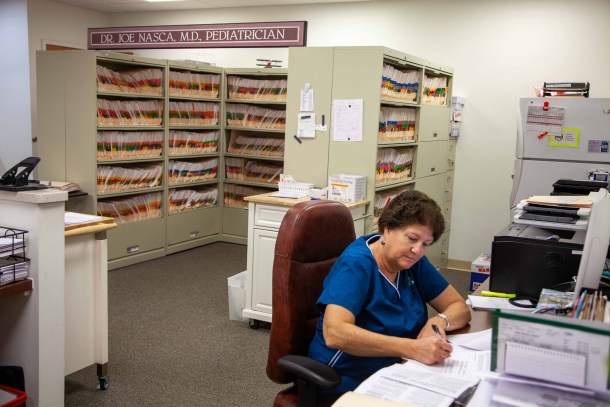
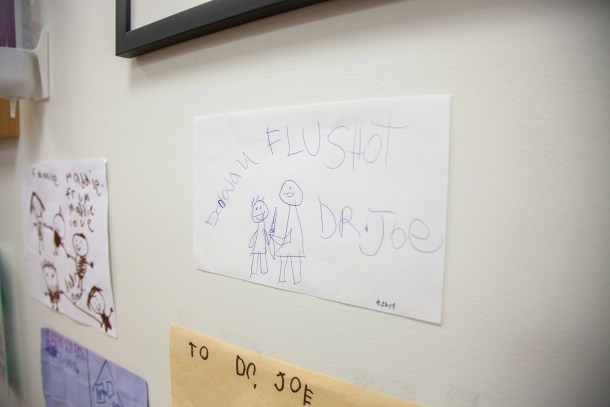
The waiting room floor is tiled like a beach, complete with swimming fish and a sand shovel. Misspelled messages from grateful patients decorate the walls. Shelves of paper medical records loom behind the check-in desk; Nasca eschews technology and has not moved to electronic medical records.
He distinguishes his work from the bureaucratic oversight and implementation of health care: the billing, data, analytics. “I do medicine, not health care,” he likes to say.
The local, down-home vibe keeps some patients coming back.
Valerie Brosseau, of St. Albans, has been taking her two young sons to see Nasca since they were born.
Her oldest, now 3, knew how to sign Nasca’s name before he could talk; Brosseau said she can count on Nasca to pick up the phone “at all hours.” When one of their boys has an appointment, Nasca is happy to take a look at the other — and even her nephew, when he got hurt on a Saturday.
Last fall, Nasca had them over to pick apples. “He’s like family,” Brosseau said.
Such relationships keep Nasca in the business as well. After he treated a boy’s severe burns on his hands, the parents returned every day to make sure they were changing the bandages correctly.
He fit them in — even though it occasionally leaves him an hour and a half behind schedule. “They’re young first-time parents,” he said, with a shrug.
Patients come from as far afield as upstate New York and the Canadian border to see “Dr. Joe.” He has more than 2,000 patients, a full slate.
But Nasca’s vision, of minimizing the bureaucracy that he sees as a distraction, is increasingly antithetical to the medical zeitgeist.
The state is implementing the all-payer system, which is driven by tracking health and patient data. Nasca has not joined OneCare Vermont, the state’s accountable care organization charged with implementing those reforms. The federal government has mandated that doctors adopt expensive electronic health records system to receive full Medicaid and Medicare reimbursements.
Insurers and the government have implemented “extremely complex systems of care and administration,” said Paul Reiss, an independent doctor at Evergreen Family Health in Williston. Those complexities, including billing, staffing, and tracking state quality measures, he said, “are what drives these practices into not being able to succeed.”
The financial pressures don’t play in favor of doctors like Nasca either.
The federal insurers, Medicare and Medicaid, reimburse doctors at lower rates than private insurance companies. In rural communities where independent doctors often operate, the poverty rates, and thus the Medicaid rates, are higher. That’s especially true for rural pediatricians, said Holmes.
Nasca said more than 40% of his patients have insurance through Medicaid or Dr. Dynasaur, the state’s insurance for low-income children. He declined to provide an exact percentage.
In 2015, Franklin County Pediatrics closed. Kristen Connolly, one of the two doctors, wrote a letter to the regulatory Green Mountain Care Board, citing a high proportion of Medicaid patients and a low reimbursement rate.
That same year, the remaining five doctors at Mousetrap Pediatrics merged with Northwestern Medical Center. Representatives from Northwestern didn’t respond to multiple requests for comment.
A 2017 study by the Green Mountain Care Board showed that insurance companies pay doctors at academic medical centers such as University of Vermont Medical Center more than other providers. UVM negotiates to receive an average of $168 per patient, compared to about $100 for the same service from an independent doctor or even a smaller hospital.
Closing practices
Less lucrative professions make it more difficult to entice the next generation of doctors to take up the mantel.
Paul Rogers practiced medicine in Johnson for 31 years. When he wanted to cut back on his hours, he tried to give away his practice. In 2018, after three years of looking for someone to succeed him, he closed his practice.
For a young doctor graduating with medical debt, setting up shop in Johnson is a tough sell, he acknowledged. He couldn’t offer a 401k or loan forgiveness or even a steady salary for a young physician.
He wasn’t interested in selling his practice to a large hospital or a larger health center. “It just wouldn’t feel right,” he said.
Now he works a day and a half a week at the Cambridge Health Center.
Realistically, unless UVM Medical Center or another facility funds a new practice, “There will never be another doctor there again,” he said.
Rogers represents the reality for small rural doctors, according to Reiss. “His business failed,” he said. “Even though his patients were very well cared for, his practice wasn’t worth anything.”
Holmes, of the Green Mountain Care Board, said the board would look to mitigate the closure of practices. It’s held meetings on workforce retention and reducing administrative burden. The board also required UVM Medical Center to reduce its fees as a way to make insurance reimbursement more consistent between hospital and other practices.
Their rural health care task force will come out with recommendations on the subject next month, Holmes said.
UVM Medical Center owns 49 practices, including 37 in Vermont.
According to UVM Medical Center CEO John Brumsted, the hospital doesn’t go out seeking practices to buy up; the doctors come to the medical center looking to partner.
Brumsted said he sees the medical center’s role as helping their smaller counterparts afloat. Ultimately it’s helping people in rural places get medical care, he said.

Trends toward consolidation have continued — though less frequently with UVM Medical Center, according to Susan Ridzon, executive director of Health First, an organization that includes about 90% of the state’s independent doctors. Between 2015 and 2017, Health First lost 23 members, resulting in the closure of eight practices. Two of those practices closed because they weren’t financially viable, according to Ridzon.
“We’ve lost an unprecedented number of practices and members over the last two years,” she said.
A handful of new independent practices have partly offset those losses. Eight doctors created five new practices — three specialist and two primary care. Three of those left larger hospitals to start their own practices, Ridzon said.
Nasca’s own future remains tenuous. He’s nearing retirement age. Ideally, he’d like to have a young doctor take over the work, he said. He met someone who was interested recently, a young man who grew up in Franklin County, is raising two kids in the area and is in med school at UVM.
“I would like to think that five years from now, when he finishes medical school and residency, he could come in and do that,” Nasca said.
That is up in the air. Until then, Nasca’s not going anywhere.
“I like this practice,” he said. “And I probably would not be able to do this the way I do it if I work for somebody else.”

