


The Generator maker space in Burlington has been home to a number of successful start-ups but nothing quite as groundbreaking as OVR Technology, a two-year-old company that’s adding the sense of smell to virtual reality headsets.
Now, the company is readying the commercial launch of their product, a candy bar size device that attaches to virtual reality headsets so it sits just above the nose. VR software for gaming, education or training can be programmed to trigger minuscule bursts of scent at precise moments.
The company is completing its first 200 systems, which can be used in trauma therapy treatment, education and more.
Four of the company’s five principals met through an accident of maker space real estate at Generator’s first home, the basement of Memorial Hall Auditorium on Main Street.
Matt Flego and Erik Cooper, former New York City residents who started an industrial design and prototyping business in Vermont called M/E Design, were making wood and steel stools at Generator, across from a cubicle where Aaron Wisniewski and his brother Sam launched a fragrance and flavor company called Alice & the Magician.
Flego tried a VR system at Generator that a UVM Health Network technology expert brought in, which he described it as “a beast of a machine.” The system later lived at ALTernator for a month where Aaron Wisniewski, who had never tried VR before, gave it a spin.
“I put that headset on not really having any expectations and it blew my mind,” Wisniewski said. “About a week later, the next conversation that Matt and I had was, like, ‘This needs scent.’”
In 2017, Flego, Cooper and the Wisniewski brothers, all in their mid-30’s, raised enough seed money from an angel investor to launch OVR, which stands for “olfactory virtual reality.” The four of them, a fifth partner and a small team that includes a software engineer comprise the start-up today, which is based in a refurbished industrial warehouse in Burlington’s South End.
A demo of the technology involving two hand-held controllers with buttons allowed users to pick up basil and garlic in a virtual pizza kitchen and bring the virtual herbs to the user’s nose and smell them. In another virtual environment, a rose is pulled from soil and users can smell both the flower’s petals and the soil on its roots.
The battery powered add-on to VR systems, referred to as the OX1 on OVR’s website, contains a custom-made cartridge with a total of nine different scents in tiny cylinders and patented scent actuators.
“It might be firing one, two, three micro-droplets that are only a micron in size or less,” said Aaron Wisniewski. A micron is a millionth of a meter. The tiny droplets are dispersed for a very brief amount of time: a fraction of a millisecond.

The cartridges are coated with a special liquid the company regards as a trade secret. OVR would not allow its cartridges or some of the machinery in its office to be photographed. The nine mini-cylinders collectively hold a total of two milliliters of custom-made liquid scent. (A thin hypodermic syringe holds one milliliter of liquid.) Beta testing underway indicates that each cartridge is good for two weeks to a month of regular use.
Aaron Wisniewski, who is the mastermind of the scent formulations, directed a colleague working on the scent of burning autumn leaves one day this fall.
Flego and Cooper are industrial designers and fabricators who have mastered everything from woodworking and metal work to electronics and computer programming. Wisniewski recalled the constant parade of Generator members asking Flego for advice at the maker space, describing Flego’s cubicle as an “industrial engineering help desk.”
For the olfactory VR project they used a phenomenon known as piezo electrics, which involves an electric charge that accumulates when mechanical stress is applied to materials such as ceramics or crystals. This is employed in the OX1 unit to control the size and volume of the scent droplets.
OVR Technology is in the process of making 200 developer kits, which will include the OX1, software and the water-based liquid scent, which Wisniewski refers to as “scentware.” VR content developers can use the software to program the firing of scent at precise times. A dozen units are out now being tested and many of the remaining 180 or so kits to be made are spoken for, according to Wisniewski.
One of the first units went to Albert “Skip” Rizzo, a University of Southern California psychologist who’s been using VR to treat military veterans suffering from post traumatic stress disorder (PTSD). Rizzo’s VR systems run his Bravemind program to conduct exposure therapy at VA centers around the country. Exposure therapy involves a process in which patients re-visit the traumas that caused their psychological scarring.
Since 2004, clinicians using Bravemind have employed a scent machine that Rizzo, who has been recognized by the American Psychological Association for his work on trauma, describes as cumbersome and expensive.
After learning of Rizzo’s work, four of the OVR Technology principals went to Los Angeles in April 2018 to demonstrate their device. A part had become detached during the cross-country flight, necessitating a quick repair job en route to the initial meeting with Rizzo. Flego started soldering the broken part in a cafe but was thrown out when on-lookers noticed the fumes coming from his table. He continued the repair in a restroom on USC’s campus, finishing just before security arrived.
“It was pretty shady,” Flego said, then burst into laughter. “It looked like we were working on a bomb.”
Rizzo was impressed with the Vermont contingent’s device, pronouncing it “a remarkable piece of technology.” He praised it for being smaller, cheaper and more usable than the scent system he’s been using.
“This is a dream come true for us to have people that have the technical expertise to build the actual equipment but also had the knowledge to create different smells,” Rizzo told VTDigger. “So, it was the perfect team for us to partner with and I think [Bravemind] is an ideal application to really put their system through its paces. It’s a leap forward for us and I think it’s going to make the therapy much better for the wider masses that this it’s applied to.”
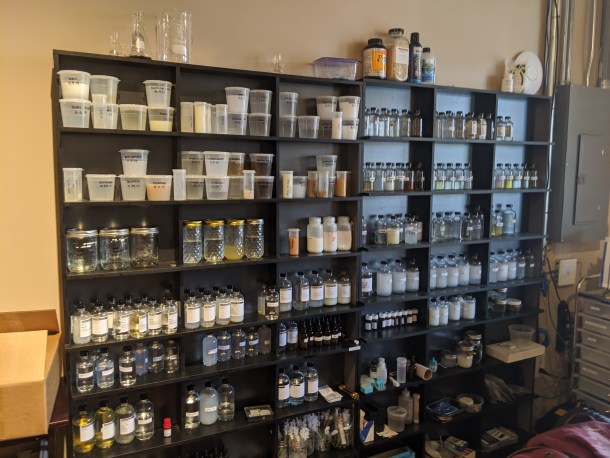
Wisniewski said that OVR could make most of the scents Rizzo requested. These included the smell of diesel, sweat, cordite, burning rubber, gunpowder and a Middle Eastern market. The smell of burning flesh and burning hair are still in the development phase, he said.
Rizzo said that OVR’s olfactory add-on will be included in the latest iteration of the VR systems he’s started shipping to VA centers and other clinical settings involved in PTSD work. He expects that within the next year there will be at least a hundred sites around the country where the olfactory technology will be available.
OVR’s Flego and Wisniewski stressed that the mission of the company is to serve more than just the entertainment market, so healthcare, education and training will be a strong initial focus of the company’s marketing effort. Flego said that even though OVR is not diving into the gaming market initially, it does want game developers to adopt its technology.
OVR’s competitors include Feel Real, a company with offices in New York and Ukraine. It’s making “the world’s first VR mask that simulates smells, vibrates and blasts your face with air or mist.” Feel Real raised $320,000 from more than 1,200 backers on Kickstarter and Indiegogo. Some backers pledged as little as $200 for the mask, which is supposed to ship in the last quarter of 2019. The Tokyo-based VAQSO is entering the olfactory VR market with a device that attaches to a Head Mounted Display with a magnet. It’s expected to sell for $999 and is said to have five different scent cartridges, including one that emits a zombie smell.
