

DANBY – Vermont has changed a lot since Annette Smith became an environmental activist in 1999 in response to plans for a gas pipeline project near her 52-acre homestead in southern Vermont.
Net metering of solar energy had started that year, but the state was far from developing the large solar arrays that are now a regular feature of the landscape. Wind generation was limited to individual systems.
Smith, an artisan who eked out a living with her husband, a harpsichord maker, before becoming an activist, has covered a lot of ground since then. As director of the tiny nonprofit Vermonters for a Clean Environment (VCE), which launched in 1999, Smith has since taken on the Ohio-owned marble company Omya, which controls several marble deposits, some in Danby; the J.P. Carrara & Sons aggregate quarry in Clarendon; the Champlain Water District; a planned Shelburne housing development that threatened bobcat territory, and large farms.
She’s perhaps best known in recent years for her activism against wind and solar power projects. Now, Smith’s focus has expanded to include combatting installation of a 5G network and countering the multi-state Transportation and Climate Initiative, which aims to cut emissions from transportation.
In 2016, the Burlington Free Press named Smith its Vermonter of the Year for her work in encouraging public debate over renewable energy projects. And she helped the Northeast Kingdom towns of Morgan and Irasburg stop a wind project proposed by David Blittersdorf, a renewable energy activist who was president of the American Wind Energy Association.
“I consider Annette the ultimate warrior,” said Blittersdorf, who pulled the plug on that wind project in 2017 after the PUC ruled against his permit. “As a proponent of anything, she’s horrible. She doesn’t have solutions that are positive.”
Blittersdorf blames the demise of that wind project on Smith.
“The opposition she stirred up in the town was instrumental in killing that,” he said. “She helped them create all the myths and reasons why we shouldn’t have this.”
Vermont’s 2016 Comprehensive Energy Plan calls for the state to obtain 90% of its energy from renewable sources by 2050. While wind development has stalled in recent years, solar panels have proliferated in the state’s fields and forests, encouraged in part by net metering, which pays the owners of the panels an above-market rate for the power they generate.
Meanwhile, VCE has opposed industrial-scale renewable energy developments because of impacts on water, communities, views and other factors.
VCE has worked since 2015 with community members in Bennington to help oppose five solar development cases that are in the regulatory process, either before the Public Utility Commission or on appeal to the Vermont Supreme Court.
“Participation in this process is very complex and a challenge even for lawyers who do not usually participate in PUC hearings, which has a different set of rules from other courts,” said Bennington resident Libby Harris of the fight.
“I was the ‘lone wolf,’ as the developers labeled me, and had it not been for the assistance of Annette Smith, whose nonprofit is Vermonters for a Clean Environment, I would never have had the tools necessary to proceed in a very complicated legal process that is not friendly to the public,” Harris said in an op-ed in the Bennington Banner.
VCE has also targeted the few wind projects that have been permitted. Vermont’s high-elevation wind developers, Smith said, have destroyed bear habitat; built miles of hardened roads through forest; and spread herbicides to control invasive species.
VCE spent $125,000 on an unsuccessful attempt to stop the construction of the Deerfield wind project in far southern Vermont. The project went on line at the end of 2017. The project required five miles of new roads, Smith testified in February to the House Natural Resource Committee. She said it’s the first wind project to be built on U.S. Forest Service land, and, at 2,500-feet elevation, occupies important bear habitat.
“In fact, the two ridgelines contain the highest quality beech stand in the state, which was the cafeteria for bears,” she said. A bear biologist testified that destroying the beech forest for the wind project could wipe out a genetically distinct family of bears, she added.
“Renewable energy development has enabled some things that I never ever thought I would see in Vermont,” Smith testified.
Last year, VCE worked with a group in Kittery, Maine, to help stop chloramine from being added to the drinking water. And the group’s 2019 mid-year report focuses on possible health dangers posed by 5G microwave frequency wireless antennas.
Living off the grid
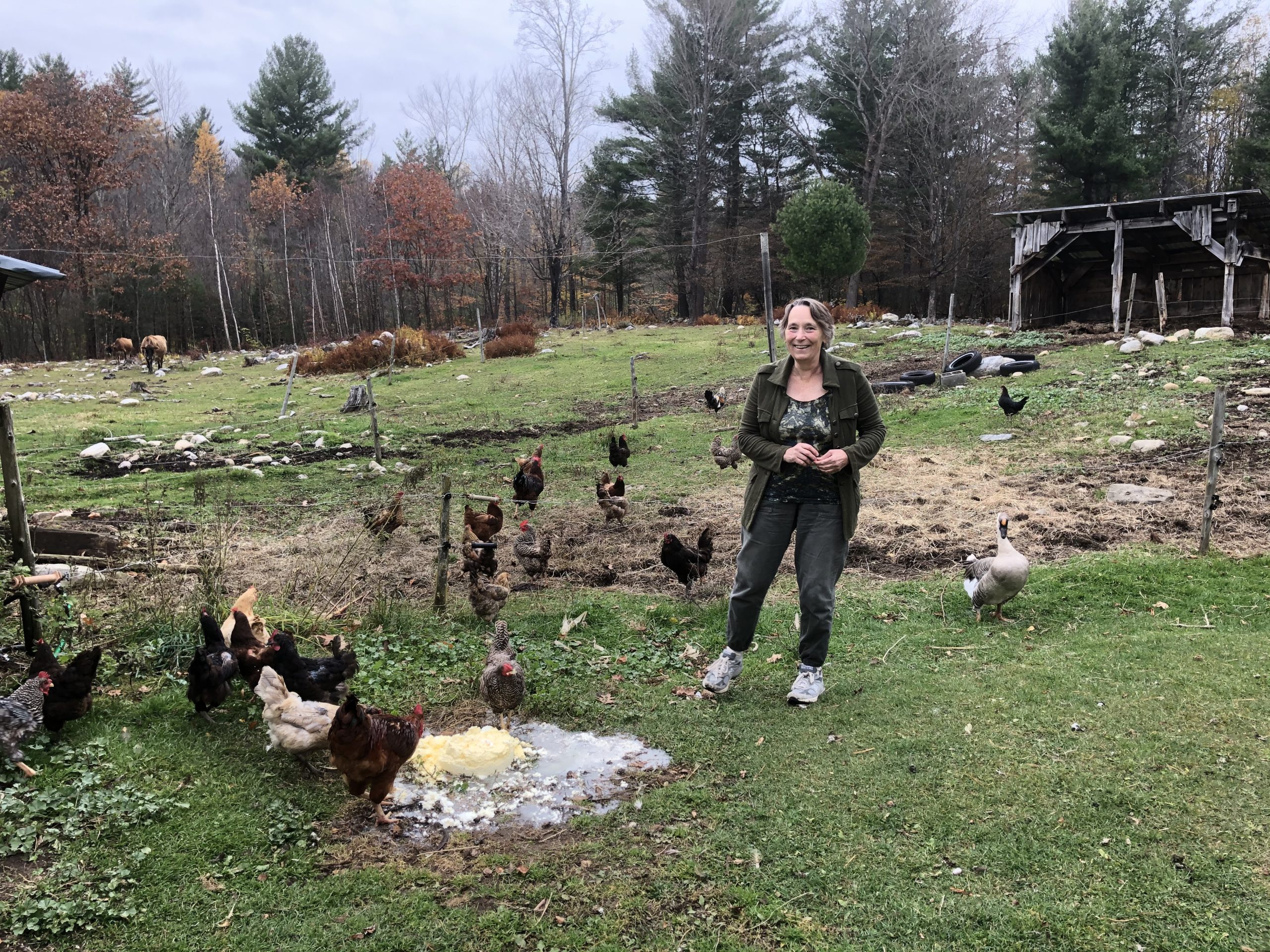
Smith lives off the electrical grid with her husband and some farm animals, including a slow-moving 36-year-old goose, and she cherishes the idea of energy independence.
“You know why the Amish don’t use electricity? It’s about dependence and independence,” she said recently as she worked in her home office. Her home is powered by solar and propane. “They use propane because they have a choice of providers, but they don’t want to be dependent on one electric company.”
Smith added that VCE isn’t a policy organization; it’s a group that reacts to issues that come up in communities. The issue most likely to garner Smith’s attention is any project that changes the landscape.
“I don’t know that I’ve ever talked about climate change or global warming,” said Smith. She feels her own experience living with a solar array that was installed in 1989 and 2008 gives her a good perspective now when policymakers talk about renewable energy.
“Cutting forest for solar is just antithetical to everything we should be doing,” Smith said. “I have been lambasted as being against renewable energy, which is absurd, but I am dismayed at how solar energy has been developed in Vermont. It’s been done in exactly the wrong way.”
Paul Burns, who has been executive director of VPIRG since 2001, is one of the people who sees Smith as an opponent of renewable energy.
“It’s hard to know how effective she has been, but I think it’s fair to say that she’s done her best to block clean energy solutions for Vermont over a number of years,” Burns said. “There is no serious disagreement over that fact.”
But VCE also ventures into the policy arena. A big target for the organization nowadays is the Transportation and Climate Initiative or TCI, a 12-state collaboration aimed at improving transportation, developing the clean energy economy and reducing carbon emissions from transportation.
The initiative includes a cap-and-invest system in which fuel suppliers would be required to buy carbon allowances through an auction system. The initiative was launched in December 2018 and a final proposal will be released this month. Member states, including Vermont, can then choose whether to participate in the final program.
Smith said the TCI is a burden foisted upon people who have no say. She attended a meeting about the initiative in Manchester in September to suggest alternatives, such as manufacturing hemp clotheslines.
“It’s a stealth carbon tax that will cost me money, and the state will redistribute the money,” she said. “Gov. (Phil) Scott can put this in place next year without anybody voting on it. Shouldn’t people have a say in how this is done?”

Blittersdorf opposes the TCI too, but for different reasons.
“Mine are technical reasons, and realistic reasons, compared to her worry about people paying a little bit more money,” Blittersdorf said. “Everything to do with reducing carbon is going to cost money somehow, because if it doesn’t cost money, it’s not going to change behavior.”
Sen. Andrew Perchlik, D-Washington, who founded Renewable Energy Vermont in 2001, said that Vermonters will have a say in the Transportation and Climate Initiative.
“Citizens of Vermont have a say through their representatives at the Statehouse, as for all the other taxes and fees and programs that the state runs,” said Perchlik, who also works as director of the Clean Energy Development Fund at the state Department of Public Service.
Perchlik said Smith’s idealism has thwarted change that would lead to improving the environment.
“She’s so forceful and uncompromising in her ideals,” said Perchlik, who discussed Smith in his capacity as a state senator, not a state employee.
“I like her,” Perchlik added. “She does have an important role. Real Vermonters feel like they have been helped by her, and she cares about the average person.
“But it is frustrating to work with her because she demands this kind of perfection that we’re not going to reach.”
In a VCE’s newsletter this year, Smith advised readers to avoid 5G devices and beware of 4G ones as well, and to oppose siting of these antennas in residential neighborhoods close to homes.
“I happen to be very good at helping people stop bad things,” she said. “If people would stop proposing bad things, we wouldn’t need to do that.”
