


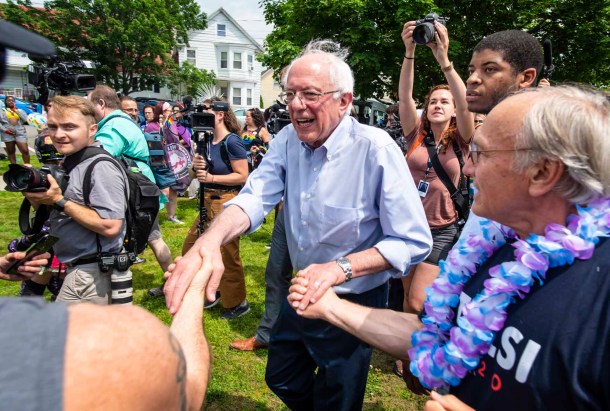
To Sen. Bernie Sanders, solving income inequality is simple.
But for some of his opponents, Sanders’ solution is too radical and won’t achieve what the senator seeks.
Sanders argues the country would be fairer if the playing field was more level. He wants big corporations to give employees better wages, billionaires to pay more taxes and Wall Street traders charged fees when they quickly flip commodities.
Under his plan, Sanders would impose a wealth tax on some of the richest households in the country. He would push for a financial transactions tax on Wall Street speculation. He’d also seek a levy on companies that pay their CEO a disproportionately higher salary than the average employee.
“Bernie’s plans seem to really be addressing the income inequality that has accrued since the mid-1970s,” said Stephanie Seguino, a professor of economics at the University of Vermont.
While there is little doubt Sanders’ tax plans, as designed, will reduce the wealth of the richest Americans and change corporate economic behavior, it is less clear if the tariffs will create enough revenue to fund social programs — including Medicare for All and affordable housing — that would distribute the wealth to middle and low-income families.
One expert thinks Sanders’ plans will fall short.
“He must have plans to raise revenue through other means because none of these three taxes will really make a big dent in the revenue he will need,” said Erzo Luttmer, a professor of economics at Dartmouth College and an expert on income redistribution.
Taxing the wealth of the wealthiest
Both Bill Gates, the founder of Microsoft, and Warren Buffett, Berkshire Hathaway CEO, have declared they and other billionaires need to pay more taxes. Recently, however, Gates has walked back some of his previous comments in favor of higher taxation after hearing what Sanders’ tax rates might be.
“I’ve paid more than anybody in taxes,” Gates recently said as he expressed his concern about potential hikes.
Buffett, in 2011, famously said he pays a lower tax rate than his employees, which led then-President Barack Obama to propose raising rates on people making more than $1 million. That plan stalled in Congress.
President Donald Trump himself even dabbled with a potential wealth tax.
In 1999, as Trump was deciding whether to launch a presidential bid as a member of the Reform Party, he proposed a one-time 14.25% tax rate on households with net worth above $10 million, claiming at the time it would eliminate the national debt, CNN reported.
“It is a win-win for the American people, an idea no conventional politician would have the guts to put forward,” Trump said at the time. His candidacy and his wealth tax plan were quick to fizzle out.
With Sanders’ proposed wealth tax, he would directly target the fortunes of the mega-rich, like Gates, Amazon owner Jeff Bezos, Facebook founder Mark Zuckerberg, Google founder Larry Page, conservative businessman Charles Koch.
Sanders is proposing a tiered system for the 180,000 wealthiest families in the country, with the tax rate brackets beginning at 1% on households with a net worth above $32 million. For unmarried individuals, all the tax brackets would be halved, meaning the tax would kick in at around $16 million.
Households with a net worth of $50 million to $250 million would have a 2% tax rate; a net worth between $250 million and $500 million at 3%; $500 million to $1 billion, 4%; $1 billion to $2.5 billion, 5%; $2.5 billion to $5 billion, 6%; $5 billion to $10 billion, 7%; and net worths over $10 billion capping off at an 8% tax rate per year.
Warren is pitching a much simpler plan.
She would levy a 2% tax on households with a net worth between $50 million and $1 billion, and a 6% tax on wealth above $1 billion.
Warren’s wealth tax plan has become a staple of her stump speeches, while she also makes clear that she is not opposed to capitalist economies nor billionaires.
Other candidates have also released plans to tax the wealthiest Americans, but none are as extreme as Sanders’ plan.
Pete Buttigieg, mayor of South Bend, Indiana, has proposed raising the top individual tax rate to 49.9%, up from 37% currently. New Jersey Sen. Cory Booker would repeal the Trump administration’s 2017 tax cut for the wealthiest households and return the estate tax to its 2009 levels, with a 45% rate and a $3.5 million exemption.
Emmanuel Saez and Gabriel Zucman, both professors of economics at the University of California Berkeley, who Sanders worked with on his plan, estimate his wealth tax would raise around $3.5 trillion over the next 10 year.
However, other economists think revenue figures will be drastically lower if enacted.
“People will find ways to avoid it and people are creative so I think it will be a wonderful time for tax lawyers and for organizations that are actively trying to oppose this,” Luttmer said.
While several European countries have dabbled with a wealth tax, many have gone by the wayside. Only four countries — Norway, Spain, Switzerland and Belgium — still have the tax on the books.
Iceland utilized an “emergency wealth tax” after the economic crash in 2008, that was in effect from 2010 until it sunsets in 2013. The Icelandic government taxed the top 2.2% of its population and raised enough — $590 million per year — to help the country rebound from the global recession.
Sweden did away with its wealth tax in 2007 after business people balked at the tax rates and moved away from the country along with their money, according to a Cato Institute report.
France’s wealth tax, which was in place between 1982 until it was abolished in 2017, was fraught with loopholes as people tried to skirt the tax rates. The rich in France lobbied for exemptions on wine and art collections where wealth could be hoarded.
Chris Edwards, director of tax policy studies at the CATO Institute, said he expects something similar if a wealth tax is enacted in the U.S.
“If they were ever to put such a tax in this country it seems to me an Achilles heel would be farmland,” Edwards said. “There is no way you would ever be able to impose it on farmland, just because the farm lobby is too powerful in the United States.”
Edwards says he would expect the super rich would first spend down much of their wealth into lobbying for such an exemption, before taking on debt and then procuring large amounts of the assets which have been made exempt — in an attempt to move into lower tax brackets.
“You would end up with this mess,” Edwards said.
But Saez and Zucman have argued that where Europe failed, the U.S. could succeed by implementing strict enforcement and cracking down on loopholes.
“Taxes are bound neither to fail nor to succeed: Governments can choose to make them work or allow them to fail, and European governments made wrong choices, letting tax avoidance fester,” the economists wrote Oct. 25 in the Washington Post.

The Sanders campaign says the wealth tax will not only raise enough revenue to fund his social programs but also cut down on their political influence the wealthy wield through campaign contributions.
However, Luttmer believes short term there may be more money flowing into the political system as wealthy people lobby for exemptions and loopholes to hold onto their assets.
“Ultimately you get rid of super rich people,” Luttmer said. “They might actually have more political influence in the short run as they try to spend down their wealth before it’s taxed away, but ultimately you will not have many people sitting on huge amounts of wealth.”
Wall Street speculation tax
While other candidates have toyed with proposals to increase taxes on the wealthy, the Vermont senator stands alone in the crowded Democratic field calling for banks to forgive student debt.
“The American people bailed out Wall Street. Now it is time for Wall Street to come to the aid of the middle class in this country,” he has repeatedly bellowed to large cheers in Iowa, South Carolina, New Hampshire and other early primary states.
Sanders’ campaign says the government can afford to pay off the $1.6 trillion in student debt by imposing a tax on Wall Street trading and speculation that would raise $2.4 trillion over the next 10 years.
This tariff would work by placing a 0.5% tax on stock trades – 50 cents on every $100 of stock – a 0.1% fee on bond trades — 10 cents on every $100 — and a 0.05% — five cents per $100 — fee on derivative trades.
The tax is designed to not punish long-term stock or bond investors, but instead discourage rapid flipping of stocks for quick, short-term profits. But, some question as it changes trading behavior whether the tax would raise as much as Sanders forecasts.
In 2016, the Brookings Institute, a centrist think tank, estimated a financial transactions tax could raise a maximum of $50 billion per year, or $500 billion over 10 years.
The United Kingdom, which has a similar tax of 0.5% on share trading, raised $4.5 billion in 2018. Economists estimate that, using this number as a model, the U.S. would be lucky to raise $25 billion per year from such a tax.
“People will hold onto stocks much longer and not partake in the kind of behavior that is being targeted in the tax,” Luttmer said. “So a lot trades that happen currently won’t happen and so the volume of trades goes way down.”
The U.S. had a financial transaction tax on sales and transfers of stock from 1914 to 1966, with varying rates as the economy rebounded from the Great Depression.
That tax on Wall Street speculation coincided with what Stephanie Seguino calls “the golden age of U.S. capitalism” in which the highest earners had a marginal tax rate around 70% — the current rate is around 37%.
During the time frame between 1945 and 1975, wages were increasing — even as the economy was growing. People were able to more easily fund their children’s education which led to a dramatic increase in college educated adults, according to Seguino.
“We had this virtuous cycle in which there was equity with growth that began to unravel in 1975 with globalization and a number of other political events,” Seguino said, referring to Vietnam, the oil embargo and high-inflation economy.
“I think it is important to recognize that we have done these things in the past and the impact on the economy has actually been very good from those policies,” she added.
Incentivizing companies to pay CEOs less and employees more
Sanders’ third tax proposal is called an “income inequality tax.” While the Vermont senator says it would raise an estimated $150 billion over the next 10 years to pay for his plan to eliminate existing medical debt, the campaign says that is a secondary aim.
“The goal of this income inequality tax is not just to raise more revenue. It is to send a message to corporate America,” the campaign says.
Sanders’ plan would apply to all private and publicly held corporations with annual revenue of more than $100 million and whose executives are making at least 50 times more than the median worker.
Those companies would have to pay an additional corporate tax rate of 0.5%. The rate could go as high as 5% more if executives are making more than 500 times as much as an average employee.

Sanders’ proposal allows corporations to avoid the tax hike if they choose to increase the annual median worker pay to $60,000 and reduce the annual salary for top executives to $3 million.
Peter Hans Matthews, professor of economics at Middlebury College, said the inequality tax evolved from an earlier Sanders proposal to tax large companies if their employees were on welfare. That was part of a push to get corporations to pay a $15 minimum wage.
“That was just a bad idea because some households qualify at different moments in their lives and different levels of income for those things,” Matthews said. “So you would be forcing companies to pick and hire certain kinds of workers.”
Matthews said single mothers could have been hurt, but his new proposal to limit the gap between the highest paid and the average paid could be much more effective.
“The policy strikes me as a very difficult one to implement but it strikes me as a fascinating one conceptually,” he said.
Luttmer said the harsh penalties will likely give corporations all the incentive they need to bring down the pay of the CEO but that it also could result in outsourcing lower paid jobs in an attempt to keep the average worker’s salary higher.
“They will get down the wealth. It will get down super high CEO pay, it will raise some revenue that the Sanders campaign can use to help lower and middle income people,” Luttmer said.
“It will bring up the bottom some, but the main thing is bringing down the top, he said. “And because these taxes are so high, there will be very high incentives to think of creative ways to avoid them,” he added.
