

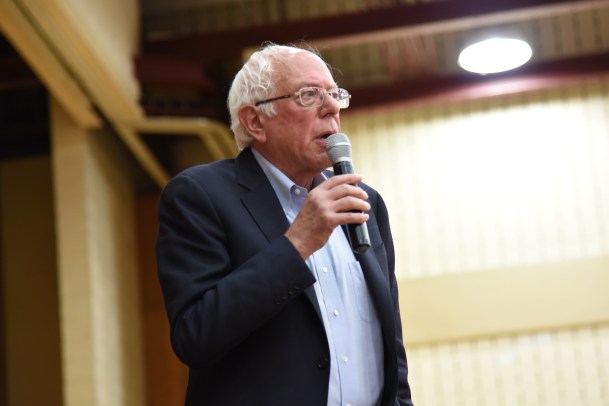
Sen. Bernie Sanders is looking to curb the wealth of the mega-rich by taxing millionaires and billionaires at a much higher rate and use that money to fund policy proposals that have become the bedrock of his campaign for president.
The Sanders campaign said the proposal to tax the wealthiest 180,000 households in the country would raise revenue to fund the Vermont senator’s affordable housing plan, universal child care and “help” to fund his “Medicare-for-all” plan.
With this proposal, Sanders is directly targeting the fortunes of Jeff Bezos, the owner of the online retail giant Amazon; Bill Gates, the founder of Microsoft; Mark Zuckerberg, who created Facebook; Warren Buffett, Berkshire Hathaway CEO; Larry Page, who started Google; the Koch brothers; and many more.
And some of those — including Buffett and Gates — have backed the idea of higher taxes on the super wealthy.
In an interview with the New York Times on Tuesday, Sanders said his proposal would reduce income inequality in the United States and that although there will always be people with more money than others, the proposal would address the divide.
“I don’t think that billionaires should exist,” Sanders said. “This proposal does not eliminate billionaires, but it eliminates a lot of the wealth that billionaires have, and I think that’s exactly what we should be doing.”
Under Sanders’ tax plan, he would levy a 1% tax on households with a net worth above $32 million — about $5,000 annually for those families — and then he increases the rate from there.
Households with a net worth of $50 million to $250 million would have a 2% tax rate; a net worth between $250 million and $500 million at 3%; $500 million to $1 billion, 4%; $1 billion to $2.5 billion, 5%; $2.5 billion to $5 billion, 6%; $5 billion to $10 billion, 7%; and net worths over $10 billion capping off at 8%.
For individuals who are not married, the brackets would be halved, meaning the tax would kick in beginning at around $16 million.
These tax rates could cut the accumulated wealth of billionaires in half over 15 years, significantly changing the power dynamic in the country, according to a letter written by two economists who Sanders consulted with about the plan.
Emmanuel Saez and Gabriel Zucman, both professors of economics at the University of California Berkeley, estimate the proposal would raise around $4 trillion over the next 10 years and be approximately 1.6 % of the country’s gross domestic product (GDP) per year, or $335 billion annually.
Peter Hans Matthews, professor of economics at Middlebury College, said he believes a major objective of this proposal is not necessarily only about increasing tax revenue but about more fundamentally changing political power dynamics in the U.S.

“This is also about the connection between huge concentrations of wealth and political power,” Matthews said. “Some of this is about leveling the playing field.”
While Saez and Zucman have argued that this type of tax structure would stop the rise of inequality and raise revenue for the country, not all economists are convinced Sanders’ proposal would result in the redistribution of wealth it seeks to create.
Erzo Luttmer, a professor of economics at Dartmouth College and an expert on income redistribution, said it depends on what the goal of the tax plan is, but that if it is to help low and middle income earners who are struggling, “there are more effective ways than this proposal.”
Luttmer added that the tax rate could disincentivize entrepreneurial enterprise while also incentivizing “lavish spending” by billionaires to escape certain tax brackets.

Luttmer did say Sanders’ proposal seems very effective at limiting the wealth at the very top of the scale.
However, with rates that could see as much as half of a household’s wealth taxed away in less than a decade, he said people may look to limit their wealth, which will in turn limit tax revenue and curb income redistribution.
“It’s kind of like killing the goose that lays the golden eggs,” Luttmer said. “There won’t be a sustained amount of golden eggs in the future.”
Sanders’ plan ends by making the pitch that the U.S. already has a wealth tax in the form of the property tax, which “disproportionately impacts working class families.”
But Luttmer says comparing Sanders’ net worth tax proposal to property taxes oversimplifies two very different tax policies that have little overlap.
“The analogy with property tax is a nice talking point on a stump speech, but it really doesn’t hold up,” he said.
Matthews argues that concerns over people spending more money is less troublesome than how the federal government will make sure the tax structure would be enforced.
“The bigger concern is enforcement and evasion. Most of the projections suppose the federal government is going to to do a pretty good job, but that’s a challenge,” Matthews said.
“The super wealthy have all sorts of ways to try to avoid that type of taxation,” he added.
Sanders does address tax evasion and enforcement in his plan, outlining how it would create a national wealth registry while also increasing funding for the Internal Revenue Service (IRS) and would require the tax division to perform an audit of 30% of wealth tax returns for those in the 1% tax rate bracket as well as a full investigation into all billionaires.
Sanders also would enhance international tax enforcement to dissuade American billionaires from taking their money abroad, including as of yet unspecified reforms to the Foreign Account Tax Compliance Act.
The Vermont senator has been advocating for a wealth tax for decades, and named it as an option to pay for his Medicare-for-all plan back in 2017.
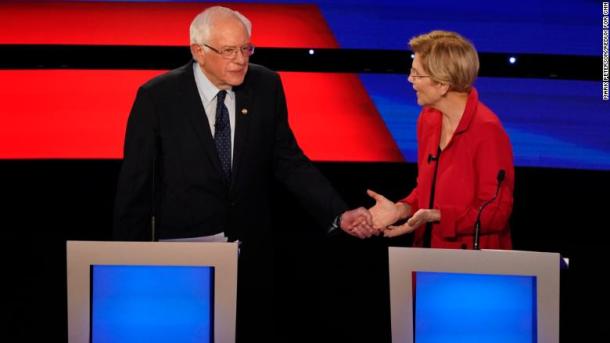
During the 2020 election cycle, however, it was Massachusetts Sen. Elizabeth Warren who was the first to announce a proposal to increase the tax burden for wealthy Americans.
Warren, who is surging ahead of Sanders in early primary states and nationally, released her plan back in January. It would levy a 2% tax on households with assets above $50 million and 3% for households worth more than $1 billion.
This wealth tax plan has become a staple of Warren’s speeches on the campaign trail, even as she has made it clear that she is not opposed to capitalist economies nor billionaires.
With this latest maneuver, Sanders is perceived by some political observers as moving to the left of Warren as both grapple for the support of the progressive wing of the Democratic Party. However, it would appear that Warren is not looking over her shoulder at Sanders, but rather look to overtake former Vice President Joe Biden.

