ST. JOHNSBURY — Older patients and fewer employees are putting a strain on Northeast Kingdom health care, according to industry professionals and officials.
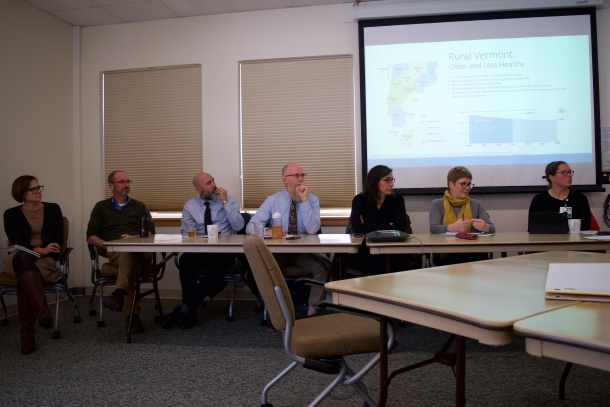
About 40 people, including six state legislators, filed into Northeastern Vermont Regional Hospital in St. Johnsbury Thursday afternoon for a forum held by the Rural Health Services Task Force.
Attendees focused on workforce, coordination and fiscal challenges to health services in rural Vermont, considering in particular the struggles of the Kingdom, the state’s most rural region.
“I feel like our system is not fully prepared for our demographic reality, and part of this strain is [that] the people we’re taking care of are older,” said Shawn Tester, chief executive officer of the St. Johnsbury hospital. “We’ve done a great job of keeping people alive longer, but then when they’re coming to us, they’re much more medically complex.”
The task force has held public meetings in anticipation of releasing a report in January. Most of the sessions have been in Montpelier.
The group is charged with identifying barriers to access in the state’s rural health care system, suggesting ways to overcome those obstacles and determining what would happen if rural hospitals closed.
“Rural hospitals really need certain lines of business to survive [and] oftentimes that revenue center is around a single person,” said Sen. Jane Kitchel, D-Caledonia.
At many hospitals, a single specialist can draw outsized patient traffic, Kitchel said. Reliance on one individual is inherently unstable, she said.
The CEO of Northeastern Vermont Regional Hospital described how the shrinking pool of health care professionals willing to work in rural areas is another financial threat.
“Financial stability is directly linked to workforce, and our workforce challenges are driving cost inflation in our system that we feel helpless to [rein in],” Tester said.
The St. Johnsbury hospital has 26 lines of business, only six of which make money. The rest, he said, run in the red.
In each of the Kingdom’s three counties, the annual average labor force declined in all but one year from 2014 to 2018, according to the state Department of Labor.
Caledonia County’s labor force lost 505 people over that period, data show. Orleans County’s decline was about the same, and in Essex County, the least populous in the region, 72 people dropped out of the labor force.

The state will have 3,900 nursing-related job vacancies by 2020, according to a survey last year. That will exacerbate the labor strain in rural areas. Some at the forum suggested that an interstate nursing compact could fill gaps in hiring.
Attendees discussed whether rural hospitals should move toward telemedicine — connecting patients to providers via video. That’s been a trend at several hospitals throughout the state in recent years.
Betty Keller, a former physician from St. Johnsbury, said telemedicine wouldn’t always work, especially in mental health-related cases.
“Where you need to have trust and rapport … they need a human being in front of them,” Keller said.
But at the same time, she questioned whether an area like the Kingdom could attract and keep psychiatrists.
The region’s lack of broadband would hamper telemedicine efforts, too, attendees said.
Tester, the Northeastern Vermont Regional Hospital CEO, also raised concerns about hospitals without bed space.
He said his hospital often has to keep patients longer than desired because the patients can’t get into specialist centers, like those at Dartmouth-Hitchcock Medical Center or University of Vermont Medical Center.
That also means Northeastern Vermont Regional has had to send patients as far as Springfield, Massachusetts — a nearly three-hour drive from St. Johnsbury — because local beds aren’t available.
“It’s a hardship on the families, who probably can’t afford to travel,” Tester said.