



Editor’s note: Mark Bushnell is a Vermont journalist and historian. He is the author of “Hidden History of Vermont” and “It Happened in Vermont.”
If Clarence Waldron ever wondered whether he was in trouble, the crowd must have removed any doubts. A throng of people — estimates range from 300 to 1,000 — swarmed around him at his workplace, demanding he defend what he had done, or rather not done, earlier that day. Waldron bravely met the crowd on the steps of the First Baptist Church of Windsor, where he was minister, and tried to explain. It wouldn’t be easy — not to this crowd, not in this era.
It was Oct. 21, 1917, and America was in a war frenzy. The country had joined the fighting in the Great War (as World War I was first known) six months earlier and bodies of dead American boys were returning home from battlefields overseas.
People were so concerned about the war that some feared the fighting would reach American shores. Some Vermonters around White River Junction armed themselves and took turns guarding railroad bridges against German saboteurs.
If any Vermont community was going to aggressively support the war, it would be Windsor. When fighting broke out in Europe in 1914, the local machine tool industry kicked into high gear to meet the orders that began flowing from the warring nations. As workers streamed into town to take jobs at the busy factories, Windsor’s population doubled.
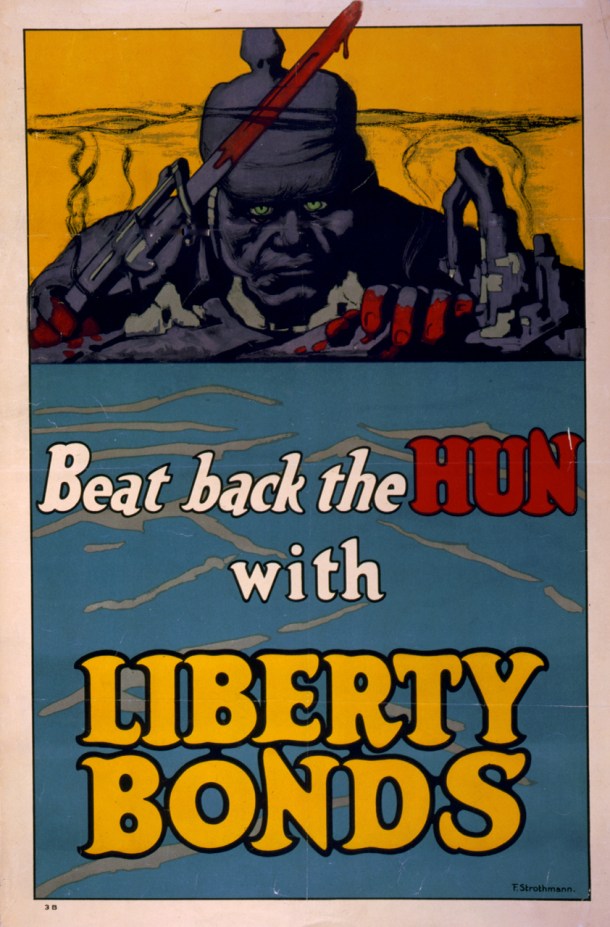
The day Waldron faced the crowd was the date that President Woodrow Wilson had declared “Liberty Loan Sunday,” when he expected the nation’s clergy to decorate their churches in red, white and blue and lead their congregations in singing “The Star-Spangled Banner.” The idea was to encourage congregants to buy Liberty Bonds to fund the war.
Across the country, clergy members complied. So too in Windsor, except at Waldron’s church, where that Sunday’s service was no different than ever. Word of Waldron’s decision spread quickly through town, and by evening the crowd had gathered outside his church.
His patriotism clearly questioned, Waldron responded by saying that he was “as loyal an American as ever walked in shoe leather.” His family was American through and through, he insisted, and could trace its roots to the Mayflower. Waldron said he supported his government and deplored the German Kaiser. His opposition to selling war bonds in church wasn’t political, but religious. He said that as a minister he found it inappropriate to discuss earthly matters in church, where the gospels were the only proper subject. He apparently didn’t mention it, but his religious beliefs had long ago made him a pacifist.
Under pressure from the crowd to prove his patriotism, Waldron, wrapped himself in the American flag and sang “The Star-Spangled Banner.” He was joined by his wife and some friends from his congregation.
Clarence Waldron seems an unlikely person to be considered a traitor. And his fight to defend his name might have been forgotten if not for the research of the late Gene Sessions, a historian who wrote about Waldron in the 1990s for the journal of the Vermont Historical Society.
Waldron, who followed his father into the ministry, had studied at an evangelical bible school with a Pentecostal bent and been ordained a Baptist minister before landing the job in Windsor in 1915. Emulating the flashy, charismatic style of famed evangelist Billy Sunday, Waldron soon drew new members to his congregation. In short order, Waldron had roughly tripled the number who attended his church each Sunday. He seemed more likely to be considered a pillar of the community than an enemy of the state.
But, Sessions noted, Waldron had made enemies in making converts. The minister rode a wave of Pentecostalism that was hitting Windsor at the time. Waldron noticed one street-corner Pentecostal preacher was especially good at drawing crowds by “healing the sick, casting out demons, and speaking in other languages as the Spirit gives utterance,” as the man advertised in a local newspaper.
Waldron decided to conduct similar services, and eventually local Pentecostals began attending his Baptist church. Waldron may have changed his style to attract churchgoers, but he didn’t change his beliefs; he shared Pentecostalism’s literal view of the Bible. But not everyone in his congregation did, so his decision split the congregation. Many longtime members objected to the presence of Pentecostals and their flamboyant displays of faith.
Several days after the dispute on the church steps, some members of Waldron’s congregation asked him to resign. The issue was the Pentecostals, though the war-bonds controversy may have lurked in the background. The minister refused to step down.
Next, the church’s organizing group, the Vermont Baptist State Convention, began pressuring Waldron to resign. In his defense, he said he would understand the move if he “were teaching Universalism, Spiritualism, Mormonism, Christian Science or any other ‘ism’ contrary to view and practice held by the church.” He argued that “Pentecostal truth” and “Baptist truth” were both “God’s unchanging truth.” He again refused to resign, saying Windsor was primed for “a real religious awakening.”
The board, unmoved, fired Waldron.

Denied a church, Waldron continued to conduct Pentecostal meetings at his home. If he thought his troubles were over, he was mistaken. Almost immediately, a federal grand jury in Brattleboro began investigating Waldron for alleged anti-war activities. On Dec. 21, the grand jury indicted him for violating the Espionage Act that Congress had passed in June, just two months after the United States entered the war. Despite the name, the act contained a section that had nothing to do with spying. The act called for prison terms of up to 20 years to “whoever, when the United States is at war, … shall willfully obstruct the recruiting or enlistment service of the U.S.”
Waldron was charged with violating the act based on the grand jury testimony of some parishioners. They accused him of making unpatriotic statements in church and in private, and of trying to dissuade young men from enlisting. He had allegedly told men in a Bible class that a true Christian wouldn’t fight in a war, and distributed a pamphlet that reiterated the argument. Furthermore, he had once been heard saying “to hell with patriotism.”
When he took the stand, Waldron acknowledged that he believed that Christians shouldn’t fight wars. After all, he noted, the Ten Commandments forbade killing. Ironically, he had distributed the pamphlet in hopes of calming tensions after the church-step controversy.
On the stand, Waldron also admitted making the comment about patriotism, but explained that he had made it before the United States entered the fighting. And the comment had been about the extreme German nationalism that had sparked the war. “If this is patriotism,” he had said, “to hell with patriotism.”
The jury, perhaps perceiving that a community religious dispute was a part of Waldron’s troubles, failed to reach a verdict. At a second trial, at which the judge barred any testimony related to the religious dispute, the jury convicted Waldron. The judge sentenced him to 15 years in prison. Advised by lawyers that an appeal was hopeless, he entered prison on April 1, 1918.
Waldron was hardly the only American tried under the Espionage Act. His, however, was the first major case involving someone being tried for religious beliefs. During the war, roughly 900 American were convicted under the Espionage Act.
Waldron was not the only Vermonter prosecuted or persecuted at the time for his beliefs. Sessions cited several examples: A Wilmington high school student refused to salute the flag and, along with his parents, was hounded out of town; Frazier Metzger, a one-time Progressive Party candidate for governor, was labeled a German spy by the U.S. State Department, based on a false rumor; a professor of German at the University of Vermont was bullied into resigning. And, in the most serious case, a worker at a dairy in the town of Holland, who perhaps not coincidentally was of German descent, was convicted of making “seditious statements” and sentenced to 15 years in federal prison.
Waldron never completed his sentence. A year after Waldron entered prison, with the war having ended months earlier, President Wilson pardoned him and many others convicted under the Espionage Act. Waldron found work leading a Pentecostal ministry and settled, with his wife and daughter, far from Vermont.
