

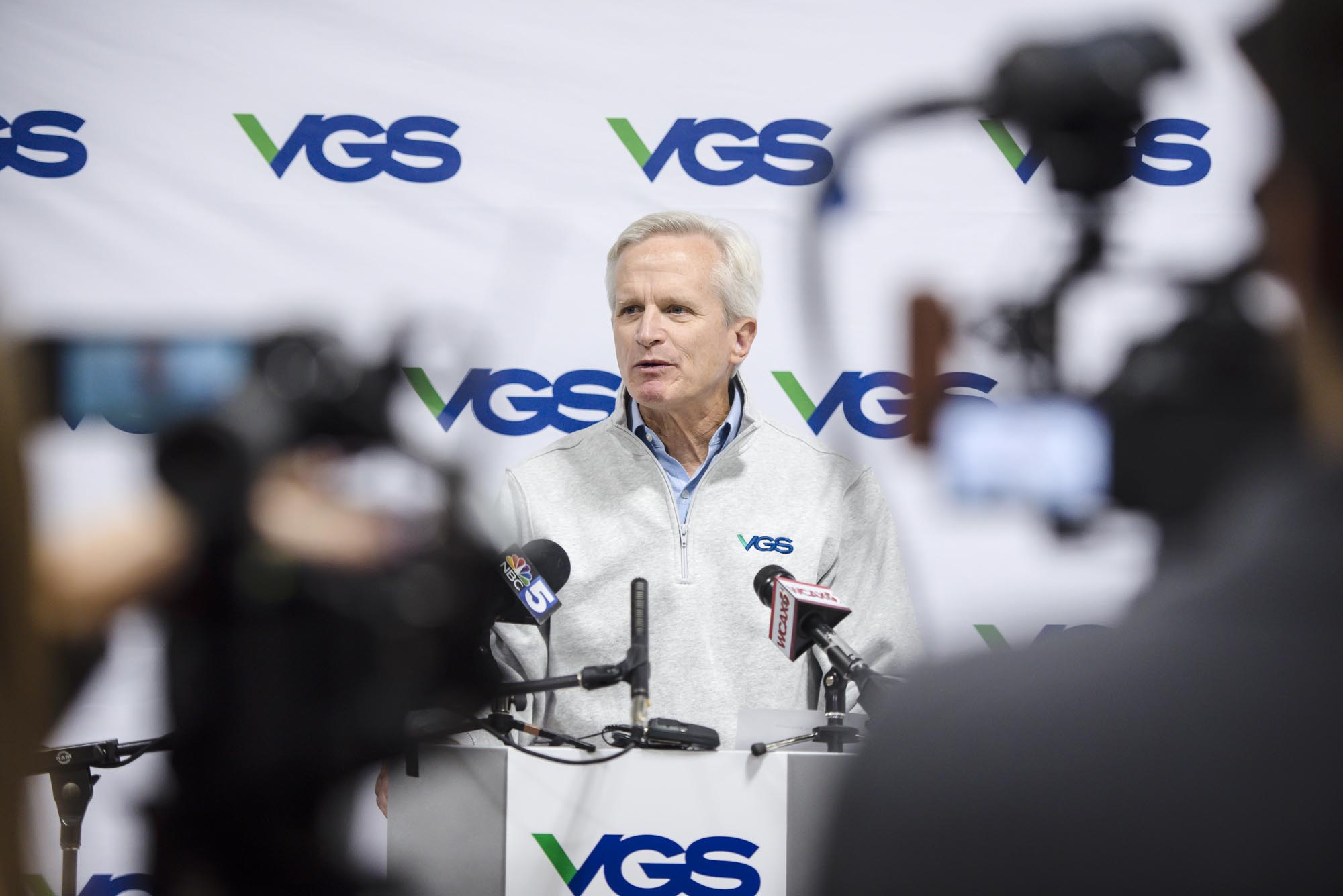
SOUTH BURLINGTON — Vermont Gas has unveiled plans to cut greenhouse gas emissions by 30% over the next 10 years and get to zero emissions by mid-century.
The state’s sole natural gas utility plans to achieve its ambitious reduction targets in part by selling less gas, utility CEO Don Rendall said at a press conference Thursday.
In a move indicating an intention to shift direction, the company redesigned its logo to simply state “VGS,” conspicuously removing the name of the fossil fuel it provides.
“These steps are the next phase in our ongoing transformation here at VGS from a traditional gas utility to a climate forward energy services company, reducing greenhouse gas emissions to zero while strengthening our commitment to safety, reliability and safety,” Rendall said.
The utility will reduce emissions by increasing home weatherization and customer access to so-called “renewable natural gas,” as well as partnering with other energy companies on projects like district heating.
In addition to selling heating fuel, Vermont Gas operates as one of the state’s three designated energy efficiency utilities. The utility plans to seek Public Utility Commission (PUC) approval to invest $20 million in its energy efficiency work to triple the number of customer homes weatherized, aiming to reach a total of 3,350 by 2025. Vermont Gas will even work with some customers to find “non-gas” heating alternatives, like advanced wood stoves and cold climate heat pumps.
Last year, the utility became the first in the United States to offer its customers the option to pay slightly more on their gas bills to go toward renewable natural gas, which currently comes from methane captured from a Quebec landfill. This summer, energy company Vanguard Renewables, Vermont Gas and others broke ground on a biodigester at the Goodrich Farm in Salisbury to provide renewable natural gas for Middlebury College.
As of this summer, Vermont Gas had 54 of its 50,000 customers enrolled in that program. By 2030, Vermont Gas plans to have renewable gas make up 20% of its supply by adding about 2% each year.
The utility will also partner with Burlington Electric Department and others to establish district heating systems in the Queen City and Middlebury. As part of its plan to become net zero by 2030, Burlington will capture waste heat from the McNeil Plant, piping it to large customers like the University of Vermont — a plan decades in the making. In Middlebury, Vermont Gas will pipe excess heat from an anaerobic digester to the Agri-Mark dairy processing plant.
Burlington Electric and Vermont Gas are also developing a “net zero” home pilot to serve as a customizable template for residents looking to shave their greenhouse gas emissions. And Vermont Gas is working with natural gas trucking company NG Advantage to offer its commercial customers the option to pay extra for renewable natural gas.
Peter Walke, deputy secretary of the Agency of Natural Resources, said Gov. Phil Scott’s administration was grateful to the utility for “for putting the weight of their operations behind this effort.”

Vermont has a goal of reducing greenhouse gas emissions 50% below 1990 levels by 2030. Emissions have increased in recent years, however, with the most recent data from 2015 showing emissions 16% higher than 1990 levels. Heating and transportation together account for almost 70% of those emissions.
“They’re a huge part of the energy distribution system and a huge part of the opportunities that exist in places where we need to make emissions reductions,” said Walke.
But Julie Macuga, extreme energy coordinator of 350.org, a nonprofit that fought against the utility’s Addison County pipeline, expressed skepticism about the utility’s emissions reductions plan. That pipeline is the subject of multiple ongoing PUC investigations.
“At the end of the day, they’re still selling fracked gas,” she said. “They call it a solution … but it’s certainly not commensurate with the scale of the problem.”
Rendall said the funds for this work will come from both the company and its customers. Vermont Gas estimates its emissions reductions efforts will add around $3 a month to residential heating bills in 2021, with similar annual increases that will level off in 2025.
The utility estimates the annual greenhouse gas emissions reduction in 2030 will be equivalent to taking 40,000 cars off the road.
