

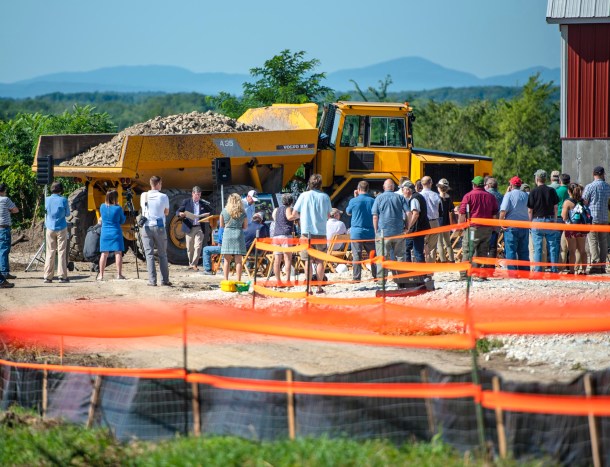
SALISBURY — Chase and Danielle Goodrich, operators of a 900 milking cow dairy in southern Addison County, had a decades long dream come true on Tuesday when construction began on a plant that will turn manure into natural gas.
Middlebury College reached out to the Goodrich family a decade ago about building an anaerobic digester to help the school become more energy self-sufficient.
David Provost, executive vice president for finance and administration, said the college plans to use 100% renewable energy by 2028. Methane from the digester will provide 40% of the energy needed to heat Middlebury College’s buildings, Provost said. An on-campus biomass plant will supply the rest.
“To create and develop a project that would produce energy for a college down the road on a Vermont farm and prevent phosphorus runoff into Lake Champlain — and would take food waste and cow waste and process it here on one of our four generation Vermont farms — is truly remarkable,” Provost said.

Chase Goodrich said he and his sister see the project as a way to diversify their family’s 2,400 acre farm.
“We wanted to move away from just adding more cows and more cows and getting bigger,” he said.
Vanguard Renewables, a Massachusetts-company that has built five biodigesters in Massachusetts, has financed the nearly $20 million system, which it will own and operate. The Goodrich Family Farm will receive an annual lease payment for the plant and free heat.
John Hanselman, CEO of Vanguard, said Vermont’s 2020 ban on food waste from landfills and a 20-year contract with Middlebury College made the project viable for the company. The system at Goodrich Family Farm will provide enough natural gas to heat the equivalent of 5,000 homes, he said.
“We think this will be the largest biodigester east of the Mississippi,” he said.
The biodigester system at the Goodrich Family Farm will take in around 100 tons of manure and 180 tons of food waste each day, which will “cook, if you will, in the world’s largest stew pots” for around 30 days, said Hanselman. The digesters will contain microorganisms that breakdown the waste in an oxygen poor environment, creating methane in the process.
The system will separate out solids, which the farm will use for bedding, from liquid fertilizer that will be injected into corn and hay fields. Electricity generated from that process will provide power for the farm and the digesters, said Hanselman in an interview.
“The thing with anaerobic digestion is, we’re really just figuring out all the other things we can do with it,” he said.

Don Rendall, president of Vermont Gas, said the utility is the first natural gas distribution company to offer renewable natural gas to its customers. Vermont Gas is building the 5-mile distribution line to connect the plant to its main Addison County pipeline, and will purchase 40,000 Mcf of the gas produced.
“We’re proud to have this project actually become a reality so we can have a locally sourced product for our customers,” said Rendall.
The digester will be the first in Vermont to produce natural gas from manure, but it is not the only on-farm digester in the state.
Foster Brothers Farm in Middlebury started producing electricity from an on-farm anaerobic digester in the 1980s.
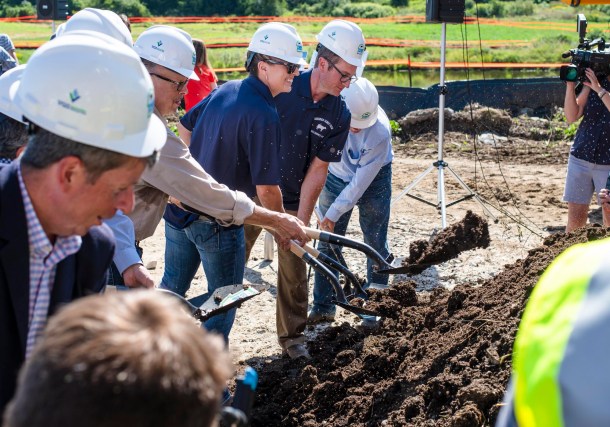
Danielle and Chase Goodrich, center, take part in a groundbreaking ceremony for an anaerobic digester at the Goodrich Family Farm in Salisbury on Tuesday, August 20, 2019. Photo by Glenn Russell/VTDigger Vermont Secretary of Agriculture Anson Tebbetts, center left, speaks at a groundbreaking ceremony for an anaerobic digester at the Goodrich Family Farm in Salisbury on Tuesday, August 20, 2019. Photo by Glenn Russell/VTDigger 
Don Rendell, President and CEO of Vermont Gas Systems, speaks at a groundbreaking ceremony for an anaerobic digester at the Goodrich Family Farm in Salisbury on Tuesday, August 20, 2019. Photo by Glenn Russell/VTDigger 
Construction has begun on an anaerobic digester at the Goodrich Family Farm in Salisbury. Seen on Tuesday, August 20, 2019. Photo by Glenn Russell/VTDigger 
Danielle Goodrich, second from left, looks on as Chase Goodrich speaks during a groundbreaking ceremony for an anaerobic digester at the Goodrich Family Farm in Salisbury. Seen on Tuesday, August 20, 2019. Photo by Glenn Russell/VTDigger
