


This story by Sarah Earle was published by the Valley News on Nov. 11.
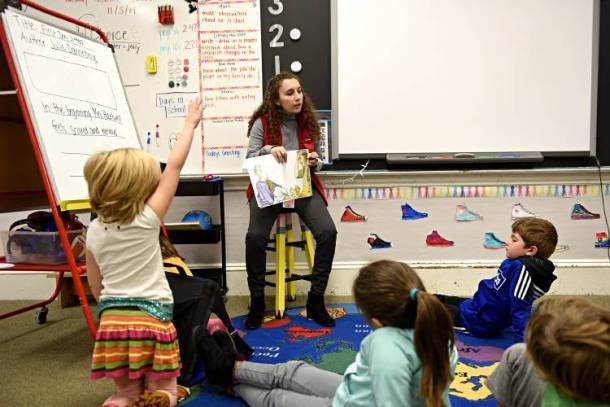
It was a blustery morning at Chelsea Public School, and first-year teacher Danielle Jesmonth had her work cut out for her keeping 6-year-olds focused on the words in front of them instead of on the flickering lights and the sounds of the wind making mischief outside.
Luckily, two months into the school year, she had implemented a system as close to clockwork as a first-grade classroom ever gets. After leading a reading lesson in which the students identified the problem and solution in a story about a rabbit who got separated from his magician, Jesmonth projected a graphic on the whiteboard that gave students their marching orders for the better part of an hour.
The screen was split into four quadrants: guided reading, independent reading, writing about reading and word work, with the students’ names divided among them. A timer in the middle counted down from 12 minutes and then reset itself, automatically shifting the groups to new quadrants. With just a bit of prompting from Jesmonth, the students found their designated spots and got to work at 12-minute intervals.
Lessons like these are now happening across all the elementary schools in the White River Valley Supervisory Union, as part of the new Raising Readers program. An ambitious attempt to address lagging test scores in the supervisory union’s schools, the program shows promise not just because of its structure and content, educators said, but because it’s getting everyone on the same page.
“This is the first initiative that we’ve done uniformly across this SU,” said Bruce Labs, school distruct superintendent. “We’ve spent a lot of time looking at the problem together and how we might go about solving it.”
Funded with $450,000 of Medicaid money and approximately $100,000 in donations, the Raising Readers program consists primarily of new reading materials in the supervisory union’s eight elementary schools and a one-year contract with literacy coach Aimee Toth, who is helping all elementary teachers adopt uniform, research-backed practices through embedded professional development.
The goal of Raising Readers is straightforward but far from simple: “Our kids are not doing well on reading and literacy, as well as math,” Labs said. “We want to get all our kids on grade level. That’s a pretty Herculean task.”
State test scores vary considerably across grade levels and schools in the district, but on average, elementary students in the SU score proficient or higher at considerably lower rates than the state average. About 44% of WRVSU fifth-graders, for example, scored proficient or higher on the 2017-18 Smarter Balanced English Language Arts Assessment, compared with 55% of fifth-graders statewide.
Research shows that students who struggle with reading usually struggle with other subjects as well, said Mary Ellen Simmons, WRVSU’s curriculum coordinator. Thus, as the SU grappled with raising scores across all subject matter, a strong investment in reading made the most sense.
To determine just what that investment should look like, school leaders turned to teachers. Last spring, they completed surveys, inventoried their materials, many of which hadn’t been updated in decades, and assessed their instructional practices, which they found differed widely.
Guided by a similar program that was implemented with great success in a school district in Washington state several years ago, teachers and administrators chose new classroom materials with themes and graphics designed to engage students and created common reading assessments and helped craft a common language for reading instruction.
Meanwhile, the supervisory union enlisted Toth to support their efforts in the classroom.
Though she’s been hired to raise test scores, Toth said her approach differs from teach-to-the-test methodologies that tend to steal the joy from reading.
“It’s really based on authenticity,” said Toth, who has conducted literacy coaching in Windsor Central Supervisory Union, Orange East Supervisory Union and Montpelier schools and served as principal of Roxbury Village (Vt.) School and Rumney (N.H.) Memorial Elementary School prior to coming to WRVSU. “It’s developing a passion for reading.”
That starts with selecting materials that appeal to today’s kids, Toth said. The look and feel of a book are important, as are the topic and writing style. The text also has to be demanding enough to ensure students are developing the skills they need, she said.
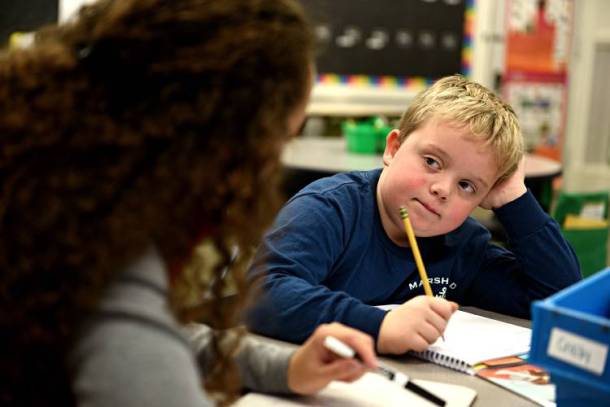
To comprehend demanding text, students need clear, effective guidance from teachers.
For example, at Sharon Elementary School, fifth-grade teacher Dulce O’Hare has been helping her students identify four parts of nonfiction text using the new materials. “We were able, over the course of days, to really dig into the text,” said O’Hare, who is in her sixth year of teaching at the school. “It sounds really high-falutin’, but they’re really just making sense of the book.”
O’Hare said the materials and coaching have helped her refine her practices, primarily because everything is clearly laid out for her. “Most of the time as a teacher, you are creating lessons from scratch,” she said. “This saves time, and I make sure that I’m getting all the parts and pieces. … The lessons kind of guide the teachers through introducing the text.”
Of course, the program isn’t a magic bullet. Some kids may not like reading no matter the approach.
Back in Jesmonth’s classroom, Cora Benson and Ira Corbett, both 6, were enjoying themselves.
“I really like reading. I’m pretty good at it,” Cora said.
“I’m working on a fourth-grade book right now,” Ira said. “It has surprisingly short chapters. I can read three or four chapters a night.”
But one first grader, asked if he liked reading, offered a flat “no.”
Another challenge in implementing the program is waiting for measurable results. Toth, who has been providing updates on Raising Readers to the WRVSU board, knows progress will be incremental. “I don’t believe systemic change can happen in a year,” she said. “Of course, I want to see (test) scores come up, but in most districts that’s a three-year process.”
Labs realizes the risk involved in spending money on a program that may not show improvement for a while. The Washington district that piloted the program about a decade ago got 95% of its students reading on grade level, but it took six or seven years, he said.
Part of the program’s success will hinge on parent buy-in, Labs said. To that end, the schools have begun publicizing Raising Readers with colorful banners and take-home materials designed to improve literacy at home. Over time, they hope to develop additional methods of getting parents involved.
The SU also is encouraging each of the schools to develop data teams to gather and analyze different data points that may help them track progress and identify areas in need of improvement in both the short and long term.
Raising test scores may take time, but Toth said she’s already seeing results in the classroom. “I’ve seen the language that kids are using around books shift just in the last month,” she said. “This is expanding their worldview. It’s tapping into the child’s innate curiosity.”
One first-grader in the district got so excited about the books he was reading that he started writing his own series about dinosaurs, Toth said. “It’s that kind of impact that’s so rewarding,” she said.
