

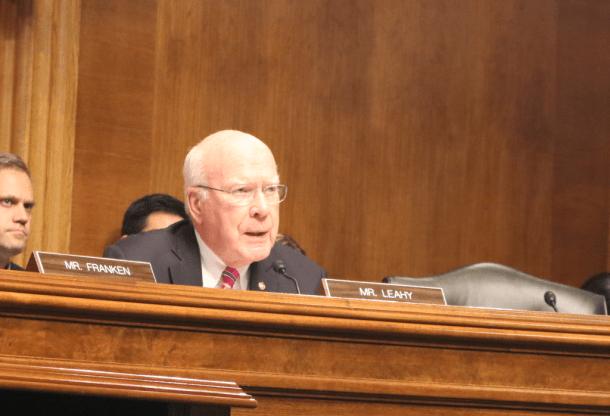
Sen. Patrick Leahy, D-Vt., criticized the National Security Agency for being opaque with members of the Senate Judiciary Committee about its bulk data collection program during a hearing Wednesday on the renewal of surveillance powers legislation.
The Trump administration is asking Congress to renew the agency’s controversial authority to collect bulk phone call data, despite suspending the program earlier this year.
The program has been in operation since former President George W. Bush’s administration began the “war on terror” in the wake of the Sept. 11, 2001, attacks, but only became widely known after Edward Snowden, an intelligence contractor who worked for the NSA, went public with an outline of the surveillance apparatus in 2013.
At a hearing on the reauthorization of the Freedom Act of 2015, which Leahy co-wrote with fellow committee member Republican Sen. Mike Lee of Utah, the Vermont senator pressed a top National Security Agency official for details on the efficacy of its “call detail records” (CDR) program. In 2018, more than 434 million phone records were collected by the federal government under the policy, according to Leahy’s office.
Susan Morgan, a senior official for the NSA, told the committee that though the agency had decided the value of the program “did not outweigh the cost” and had stopped using the bulk communication collection program, the agency hoped lawmakers would reauthorize the surveillance power.
“We could find ourselves in a situation where this particular tool in our toolbox, we would want to have the agility to use it should it be valuable moving forward,” Morgan said.
Leahy pressed Morgan about the use of the program, asking her how many times since 2015 the data collection program had been “materially significant in preventing a terrorist attack.”
Morgan responded that she could not answer the senator without divulging classified information about the program, and refused to give any details about how frequently data collected through the program has been used in an investigation.
In response, Leahy said the agency has no issue publicly discussing how other sections of the Patriot Act are instrumental in preventing terrorist attacks, but balks at releasing about the data collection program.
“If at some point in the future the technology is developed to allow for better data collection, that is appropriately limited — that follows the road, that is fair — well then come back to Congress, and let us revisit the question,” Leahy said in his opening statement at the hearing.
“Until that time there is no reason to to reauthorize the CDR program,” he said. “We’re going to be legislating in the dark.”
In an interview Wednesday evening, Leahy said the intelligence community is aware that the program by itself does not prevent terrorist attacks.
“The reason they didn’t give an answer is because they know the answer wouldn’t make them look good,” he said.
Committee Chair Sen. Lindsey Graham, R-S.C., said he plans to schedule a closed-door briefing with the NSA so the classified information could be reviewed.
Since 2013, Leahy has been trying to curb the federal government’s collection of bulk data on U.S. citizens. During former President Barack Obama’s second term, Leahy, then Senate Judiciary chair, held a number of oversight hearings on surveillance programs in an attempt to end the practice.
Leahy’s Freedom Act co-author, Lee was also unimpressed with intelligence community during the hearing, saying there should be monthly oversight briefings on the use of the data collection program moving forward if it is reauthorized.
“When you put this much power in the hands of the federal government, one has to worry,” Lee said.

