

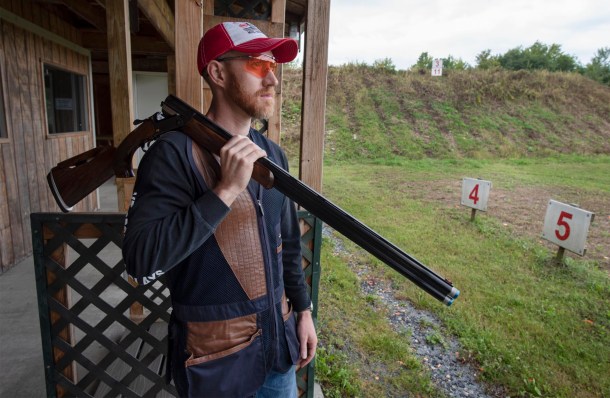
WILLISTON — The town’s only shooting range has been part of Williston history for 57 years. Shotgun blasts regularly echo around the Old Creamery Road property on Sundays and Wednesdays.
Selectboard Chair and state Democratic Rep. Terry Macaig said the issue of controlling noise from the North Country Sportsmen’s Club (NCSC) has been one of the central debates for Willistonians since he joined the board 18 years ago.
Now, the Selectboard and officials from the club have come to an agreement on a proposed amendment to the town’s noise control ordinance as it relates to the club, with a public hearing set for Nov. 19.
Macaig said “great compromise from where we started” was needed to reach the point of being able to move the amendment forward.
“It’ll be good to put this behind us,” NCSC President Bob Otty said following the Oct. 15 Selectboard meeting.
Operating hours for the club are set through a written agreement with the town, as required in the current noise control ordinance. The club has been at odds with the town since a 2017 Supreme Court ruling, which was prompted by two noise citations after the club had terminated the original agreement.
The amendment approved by a unanimous vote of the board last month sets the same regular operating hours. It allows for special events on any day of the week, with advanced notice to the town, and a limit of 20 each calendar year, but a rolling average of 16 a year over three years. In addition, four hunter safety courses would be allowed.
In 2004, the Williston Selectboard passed the town’s current noise ordinance, which Town Manager Rick McGuire said “had nothing to do with the gun club.” The ordinance requires a written agreement between the town and the club for operating hours.
That agreement was signed on May 2, 2007. Regular hours were set for Wednesdays and Sundays, with Saturdays for special events only. The club had to provide two days advance notice to the town for a special event, but it did not define a special event nor limit the number that could be held in a year.
On April 7, 2015, Otty sent an email to McGuire with “proposed terms for a new agreement” that would add Thursday shooting and increase the number of special events. Otty also wanted to make clear the club is entering into the agreement “voluntarily.” Lastly, Otty told McGuire the email would serve as a termination notice of the original agreement effective May 1, 2015.

McGuire replied to Otty on April 23, 2015, seeking to address the level of special events and define more clearly what those are. McGuire also asked to increase the amount of time a notification is required when hosting a special event.
No agreement was reached before May 1.
“We canceled that agreement on May 1. The next Sunday, the police came up and cited us,” Otty said. “The next Wednesday we were shooting, the police came up and cited us.”
The club appealed these citations to Superior Court.
When the court decision came back, Otty said he felt both sides thought the ruling “was a little ambiguous” and both sides appealed the decision.
McGuire agreed, saying “The Superior Court decision wasn’t all that clear to either side.”
The motion moved on to the Vermont Supreme Court.

The Supreme Court handed down its decision in 2017, saying the ordinance was “unenforceable” as it related to the club. According to state statutes cited in the decision, as long as the club did not increase its level of activity beyond historic levels, there is nothing the town could do. The court also advised the two parties to come to a voluntary agreement because “both sides face uncertainty” on regulating special events.
Previous iterations of the proposal set more restrictive limits on the number of events and when they could be held. Otty challenged these limits based on the high court’s ruling and records compiled as part of those proceedings, which show the club had hosted special events on weekdays in the early 2000s.
Macaig said there is a financial interest for the club to host special events, as the club will host events for corporate outings and parties. Yet, Williston Police officials said they receive very few noise complaints about the club, with only two in the last two years.
57 years of lead shot
The NCSC has been shooting for more than 50 years and the amount of lead in the area surrounding the club has drawn attention from a next-door neighbor and state environmental officials.
An assurance of discontinuance agreement is now in place between the club and the Department of Environmental Conservation. The agreement was reached after the club failed to submit required tests on time between 2008 and 2016. Should the club fail to comply with the DEC investigation and required tests, the club could be prosecuted for civil violations.
When the club was first created in 1962, records obtained by VTDigger show that for more than 20 years, members at the club shot facing east with a shot drop zone over the adjacent property and another nearby property.
“Written permission was obtained from the adjacent property’s landowner to use their property as a shot drop zone,” the AOD reads in part. In the late 1980s, the club made a change to reorient the shot drop zone to face north.
North of the club’s property is a wetland, and headwaters to a tributary for Williston’s Sucker Brook. While the soil and groundwater around the club and portions of the headwaters are contaminated, the Sucker Brook is clean.
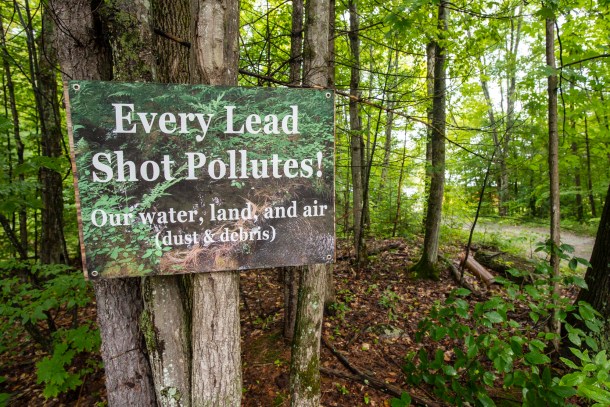
Mona Boutin lives on the property next to the club, where her family has been farming the small plot of land for five generations.
“We’d done some testing ourselves privately, getting water kits and tested the brook ourselves and came back at levels that are higher than considered safe and contacted the state,” Boutin said of tests she conducted in 2008.
“Sometimes the waterflow coming through it has lead and sometimes it doesn’t,” Boutin said, who uses a filter for cooking water.
Tami Wuestenberg, an environmental analyst with DEC, has been working with the club and Boutin to resolve the issue.

In September 2008, Wuestenberg took two water samples from the Boutins’ well and determined the lead levels were “significantly below” the state’s lowest safe level. The water was considered safe for drinking and to use for cooking.
“If we went out there and there was lead in the well, we would have put a treatment on their well,” Wuestenberg told VTDigger.
Otty, the club president, said: “We’ve been doing a number of things for a number of years” about the lead, including to redirect where members are discharging their shells. After a fill project was completed in 2014, shots are now fired facing west.
“The terrain before the fill would have essentially made it impossible to collect any lead,” Otty said. Over time, as the shot collects, Otty will hire a commercial company to scrape off the top few inches of soil and put it in a centrifuge with a little bit of water. This separates the shot from the soil, and the company keeps the lead as payment. Wuestenberg confirmed this method is an effective way to recollect lead.
“We’ve reduced the level of lead in that surface water by, I think, it’s over 95% at this point, through just the reorientation of the field,” Otty said
Wuestenberg said there are other options, like soil remediation. The problem with removing and replacing the soil in the area north of the club is that it would disrupt the entire ecosystem in the area.
However, “If we determine that the Boutin’s property has areas with soil contamination, I could see limited soil remediation,” she said.
Boutin had expressed some concerns there are no plans for the future.
“The idea that it’s ever going to get cleaned up is pretty much null,” she said.
Otty has repeatedly acknowledged the threat and detailed the changes made since becoming president of the club. Wuestenberg said he has been very cooperative.
“I appreciate [the Boutins] concerns,” Wuestenberg said. “I’ve asked them many times to contact their legislator about banning lead shot.”


