

BOSTON — The Vermont politician could still hear the applause sparked by his introduction when he began to extol the virtues of a government-run Medicare for All insurance plan.
“I believe health care should be a right and not a privilege,” he said.
Next came his oft-repeated words about the scourge of opioid addiction.
“It drives me crazy — this is a problem created by big pharma that profits big pharma to this day.”
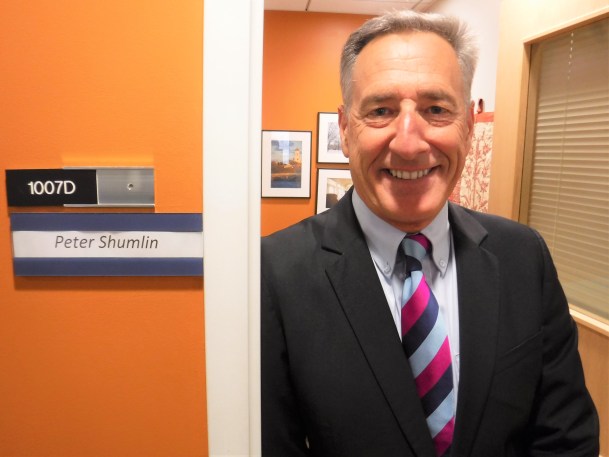
The audience here at Harvard University’s T.H. Chan School of Public Health has heard U.S. senator and presidential candidate Bernie Sanders campaign on such talking points for years. But on this recent autumn day, the speaker wasn’t the septuagenarian socialist but instead another Green Mountain Stater: former governor turned fall senior leadership fellow Peter Shumlin.
The 63-year-old Putney Democrat won his first gubernatorial election in 2010 after promising to support a publicly financed state health care plan, then signed a law a year later that called for the nation’s first single-payer system. As his administration crunched numbers, he explored other wellness issues, going so far as to dedicate his entire 2014 State-of-the-State address to fighting opioid abuse.
But Shumlin had to drop the single-payer proposal upon discovering it would practically double state government’s $5 billion annual budget, raise the income tax rate to nearly 10% and require an 11.5% payroll tax. The number of Vermont opioid-overdose deaths, for its part, went on to skyrocket from 63 the year of his State-of-the-State address to more than 100 each year since he left office in 2017.
As a slew of 2020 White House aspirants debate Medicare for All and drug treatment options, Shumlin is teaching a Harvard course on the same issues. The official title is “Health Policy and Leadership: Reforming America’s Broken Health Care System from Within.” But by recalling the state’s struggles to turn rhetoric into reality, the class more easily could be tagged “Lessons from Shumlin’s School of Hard Knocks.”
“Our experience in Vermont could and should be a guinea pig for the folks who are advocating for Medicare for All,” Shumlin said in a recent televised session. “This is what we learned, and it was a hard lesson: If you don’t find ways to fix our broken health care system, you can’t fix the broken payment system.”
‘The biggest failure of my political leadership’
Shumlin, a one-time local selectman and state legislator, launched his first campaign for governor in 2010, the same year Congress adopted the Affordable Care Act. What’s known as “Obamacare” is considered the biggest such reform measure since the 1965 introduction of the Medicare senior insurance program. But Shumlin believed his state could do even better.
“I don’t think it’s bragging to say that our administration took the deepest dive into how a state would move to a publicly financed system with cost controls — with finding ways to spend less for better outcomes — than probably any governor, yet, in America,” he said in one recent class.
Vermont appeared to be a promising testing ground, boasting some of the highest health and lowest uninsured numbers in the nation. But by the winter of 2014, after studying all the income and payroll tax options, Shumlin understood he couldn’t come up with a politically palatable funding formula.
“It was clear to me that the taxes required to replace health care premiums with a publicly financed plan that would best serve Vermont are, in a word, enormous,” he said in a speech five years ago. “The risk of economic shock is too high at this time to offer a plan I can responsibly support.”
Today, Shumlin calls that result “the biggest failure of my political leadership” — although he finds relief in the fact that, had the state moved from health care premiums to tax payments, President Donald Trump’s 2017 federal tax reform bill would have wreaked havoc by capping what used to be unlimited state and local tax deductions.

“The Trump tax bill would have really screwed us,” he says. “If we had gone to an up to 9.5% state income tax instead of premiums, all the sudden everybody would be screaming and hollering.”
Shumlin’s inability to deliver on a signature promise was one reason he chose not to seek re-election in 2016 after serving three terms. Now helping to head his family’s Putney Student Travel, he sees health care premiums rise annually by double digits.
“Business folks become used to that,” he says. “And what they do is they don’t give their employees raises that they should get. So I always say Trump got one thing right. The American people were frustrated with incomes that hadn’t changed in 10, 20 years. He understood that better than the Democrats, fair to say.”
Several 2020 presidential candidates hope their calls for Medicare for All will change that. They talk about the proposal’s elimination of premiums — although they don’t elaborate on (or even yet acknowledge, in the case of Massachusetts U.S. Sen. Elizabeth Warren) its need for new taxes.
“It’s so easy to scare people,” Shumlin says. “If you say to them, instead of that system you have with your employer, you’re going to get a tax bill in the mail, they say, ‘Wait a minute. I’m all for single payer, but I thought that meant free — are you telling me my taxes are going to go up and my employer is not going to have this burden anymore?’ You’ve pretty much got to say, ‘Yeah, that’s what we’re saying.’ So that’s a huge problem.”
Shumlin has watched recent presidential debates in which candidates are asked to simply raise a hand if they support a specific plan.
“You see 20 hands — some go halfway, some not at all, others all the way up and then they pull them back and the next day say, ‘I didn’t mean to raise my hand.’ That’s the depth of the discussion now. It’s frustrating to me that the debate is so superficial, and I see them making the same mistake I made. I should have talked about cost all of the time. I say to the Medicare for All folks, great idea, but you will not get a politician in Washington to vote to raise taxes as fast as the current premium-based system is requiring us.”
‘You’ve got to do two things simultaneously’
Shumlin says leaders first need to tackle diverging levels of care and costs.
“What I learned the hard way is you’ve got to do two things simultaneously: You’ve got to find a way to spend less money for better outcomes,” he says. “Our outcomes are worse than the countries that spend around us. We’re living not as long. We’re more obese. We tend to reward providers who keep you a little bit sick — not dead, because that doesn’t help — but a little bit sick, to keep billing a fee for service.”
Shumlin hopes the state’s new OneCare Vermont accountable care organization, created during his gubernatorial tenure to bring together a variety of insurance programs and health providers, will help to better monitor coordination and costs.
“We’ve got one of the only waivers in the country where you can take Medicaid, Medicare and private pay and put it in one capitated system,” he tells students. “You get paid for keeping someone healthy on a capitated payment instead of for the number of things we do to you. Suddenly, the providers want to know how your blood pressure is, how the jogging program is going, how your mental health is — all the things that lead to good health care outcomes.”
Launched in 2017, OneCare Vermont is set to present its proposed 2020 budget to the state Oct. 30. Government leaders already have a slew of questions about how and whether the new organization will work short- and long-term. The state auditor’s office, for example, has launched a full performance audit after determining OneCare Vermont “did not reliably monitor or accurately report” some of its initial community health investments.
“This isn’t going to be a smooth sail — you’re starting something entirely new and different,” Shumlin says. “You cannot move to a publicly financed system until and unless you simultaneously bend the cost curve. It doesn’t mean you have to spend less money on health care, it means that it has got to more closely match your GDP or income level. The question here is once they get this up and running, do they bend the cost curve and improve outcomes with this model? My guess is the answer is yes. But it takes three or four years to get data you can believe in.”
In the meantime, Shumlin is teaching about his administration’s struggles not only with single-payer insurance but also a host of topics related to well-being.
“I’m convinced that you can’t move to real health care reform until you have a system that makes people healthy as opposed to gives people lots and lots of unnecessary quantity of care,” he tells students, “yet having said that, it’s all interrelated.”
Shumlin was governor when the state passed a first-in-the-nation law in 2014 to label genetically modified organisms, only to see Congress preempt it by passing a weaker National Bioengineered Food Disclosure Standard.
“I said, ‘Listen, I’m not taking sides in the GMO debate whether it kills you, whether it’s good for you — all I’m saying is I want consumers to have the right to know,’” he recalls. “The American food industry flips out when you do that. And I kept saying to them, ‘What are you all afraid of?’”
Shumlin attended the 2015 United Nations Climate Change Conference in Paris, where nearly 200 nations reached a landmark accord to lower planet-warming greenhouse gas emissions. Two years later, Trump withdrew the United States from the agreement.
“Climate change is going to be the biggest challenge that current health care providers face,” the Vermonter says.
Closer to home, Shumlin knows drugs are hitting just as hard.
“When I dedicated my State-of-the-State address to the opiate crisis in Vermont, my staff flipped out,” he says. “‘Vermont, maple syrup, Ben & Jerry’s ice cream, farms, skiing, and you’re going to tell everybody we got a bunch of heroin and folks suffering from opiate disorder? Are you insane?’ I said, ‘No. My job as governor is to protect our quality of life, and this is the one thing that could drown us.”
‘There’s just so much to learn from’
Shumlin sums up his resulting speech in two sentences: “I said we’re going to reform our criminal justice system so that this is a disease and not a crime. Second, I said we can’t have waiting lines for treatment any more than we can have waiting lines for cancer or any other disease.”
The state has increased access to treatment and overdose-reversing drugs such as Narcan.
“Here’s the one thing we didn’t do: Solve the problem.”
Since Shumlin gave his 2014 address, the annual number of Vermont deaths from opiates has nearly doubled. He blames the increase on the fact many people using heroin first took prescription painkillers such as OxyContin. He questions why the U.S. Food and Drug Administration isn’t investigating drugmakers who erroneously claimed their products weren’t addictive.
“Bonnie and Clyde had nothing on these guys,” he has told students. “The Sackler family (founders of Purdue Pharma, the manufacturer of OxyContin) is going to pay some billions of dollars now, finally. Guess where most of that money is going to go? To big pharma.”
That’s because people need medications such as methadone to curb their addiction to other drugs.
“Most of the money from the crisis is going to go to the folks who created the crisis,” Shumlin says. “For God’s sake, why doesn’t some presidential candidate say, ‘You elect me president of the United States and I’m going to put an FDA in there that’s going to re-examine this.’”
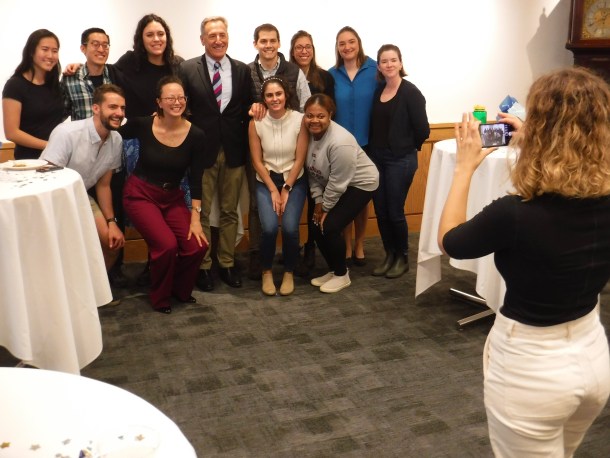
Shumlin is one of the few Democrats not running for the party’s 2020 White House nomination. Nonetheless, his words are sparking notice. Students and staff recently thanked him at a private lunch for, as his teaching assistant summed up, “the courage and candor to explain why things went wrong.”
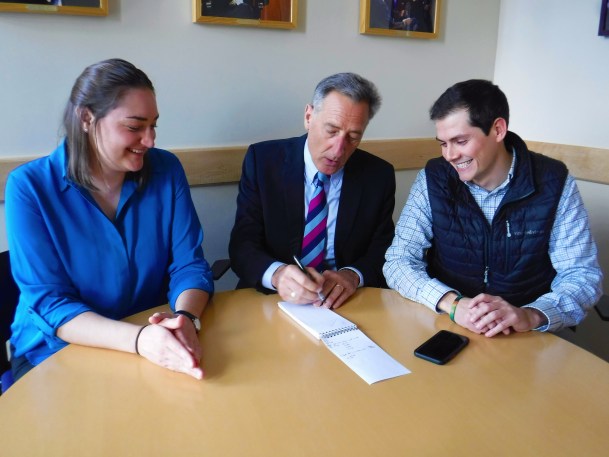
“There are a lot of academics here who have done excellent research, but he is unique in the sense that the school doesn’t have many politicians or practical people,” says Carolyn Payne, a 29-year-old graduate student with a medical degree from the University of Vermont. “There’s just so much to learn from. As the next generation of leaders, we’ll hopefully be able to implement a better system.”
“His willingness to be here sends a really good message to public health students,” adds Jacob Petrini, a 25-year-old classmate who grew up in Proctor. “You can’t think just about the science, you need to think about the policy level and how do you institutionalize some of these changes.”
Shumlin sees his course less about sharing the past and more about shaping the future.
“Why does politics matter?” he told students in one session. “It matters to you, because the policies that we make about what food we eat, about whether or not you can have access to insurance as a right and not a privilege, about whether we get off coal and oil and move to renewables, all those issues are going to come right to the door of health care providers.”
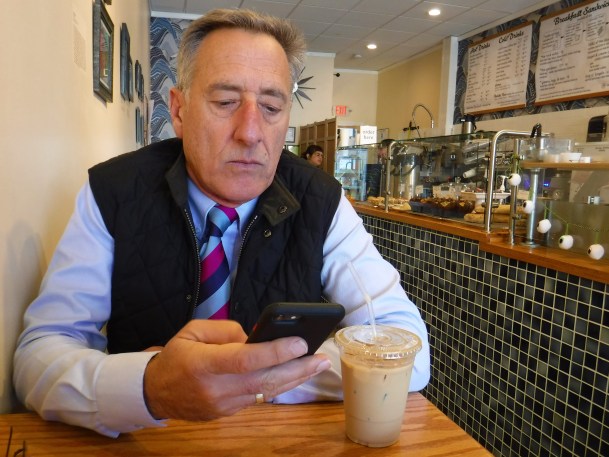
Shumlin went on to give everyone a pint of maple syrup. As for himself, he held up his new favorite Boston iced latte before declaring, “It’s mostly whole milk right out of the cow from Vermont.” But such politicking aside, don’t look for him to seek higher office anytime soon.
“The best job in government — aside from being president of the United States, where you have a lot of ability to make change — is being a governor,” he says. “Our feeling is generally that we don’t want to sit around in Washington. I would jump out of a window in frustration. I bless those who dare spend a lifetime in Congress. I just couldn’t do it.”


