


State environmental regulators say the $1 million aeration system installed this summer to curb noxious cyanobacteria blooms on Lake Carmi is doing what it’s supposed to — when it’s running properly.
Cyanobacteria feeds on phosphorus, a mineral that is found in manure, commercial fertilizer, human waste and soil.
The Scott administration has touted the aeration system as an effective way to reduce phosphorus in the Franklin County lake. But the cleanup of Carmi, which is surrounded by farms and summer camps, has a long way to go. Beaches were closed for two weeks at the end of the summer.
Camp owners say the aeration technology isn’t doing enough to stem the cyanobacteria blooms, which are toxic to humans and animals. Residents want a moratorium on manure spreading.
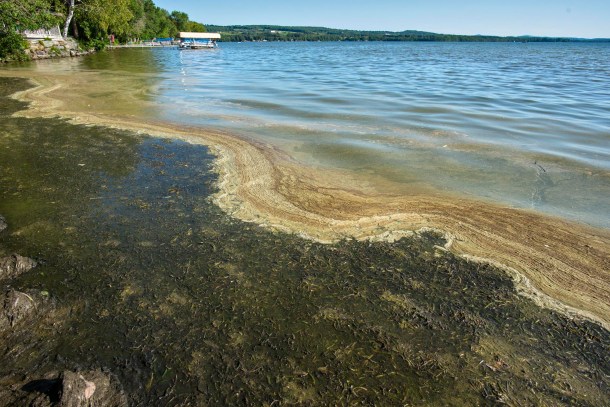
The blooms on Lake Carmi have been particularly bad over the past few years, in part because of a build up of phosphorus pollution from decades of agricultural runoff. The phosphorus, which accumulates in sediment at the bottom of the lake, is released when the lake loses oxygen. Those releases then feed cyanobacteria blooms that have spread over the lake.
After the lake was closed to recreation for several months in 2017, lawmakers passed a bill requiring the state Agency of Natural Resources to develop a “crisis response plan” for Lake Carmi. The crisis plan sets a target phosphorus concentration for the lake at 22 parts per billion — a level that should allow residents and visitors to swim and boat on the lake.
The plan is part of an ongoing effort to improve water quality in the Carmi watershed by reducing phosphorus from nearby farms, dirt roads, eroded stream banks and camp septic systems.
[Listen to the Deeper Dig podcast on the new technology in Lake Carmi.]
The aeration system is a novel solution that the Scott administration has said will reduce the accumulation of phosphorus in the sediment of the lake and curtail cyanobacteria blooms.
The state Department of Environmental Conservation paid Michigan-based EverBlue Lakes to install an aeration system this summer to prevent in-lake phosphorus from being released.
The aeration system shoots compressed air out of 80 ceramic diffusers spread across the bottom of the lake to continuously mix more oxygen into the water. The goal is to keep the deeper part of the lake oxygenated so that phosphorus stays bound to sediment at the bottom of the lake — rather than acting as food for blooms.
“Overall, the aeration system accomplished what we hoped to accomplish when it was fully operating,” said Mark Mitchell, environmental scientist with the Department of Environmental Conservation’s lakes and ponds program. “But we need to sort of tweak the system.”
The system was not turned on until late June, which was later than ideal as the lower part of the lake had already started to become oxygen depleted, he said. And then the air compressors overheated, shutting the system down for the first week of July, which is around the same time algal blooms started.
A wet spring and early summer followed by hot weather created “basically the perfect recipe for blooms starting a bit earlier than normal,” Mitchell said. There were also some storms later in the summer that sent phosphorus into the lake, fueling blooms.
Mitchell said that while he is still analyzing water quality data from later in the season, initial data indicate the aeration system was continuously mixing the lake as intended when it was fully running. Next year, the DEC hopes to turn the system on earlier to limit the early season in-lake phosphorus release that happened this summer, said Mitchell.

Pete Benevento, president of the Lake Carmi Campers Association, said that while he and other lakeside property owners would like to see as few blooms as possible, they also knew that the aeration system would not immediately clean up the lake.
“You’re not going to have Caribbean water, if you will — things take time,” he said.
The pollution has had an impact on tourism. Lake Carmi State Park had the lowest number of visitors this season since 1987, said Rob Peterson, northwest regional park manager for the state’s Department of Forests, Parks and Recreation. But beach closures were down slightly from last year, with the park having 30 days with at least one beach closed due to a cyanobacteria bloom compared to 35 days last year.
“Overall it’s challenging because the blooms come and they go without warning with a shift of wind or lack of wind and it poses a challenge for us to accurately stay on top of it,” he said.
Peterson said his staff monitors blooms several times a day. This year, blooms forced the closure of beaches at the state park from Aug. 24 to Sept. 14.
Moratorium on manure proposed
Lake Carmi property owners, while optimistic about the aerator, are concerned that not enough is being done to stop farm runoff from entering the lake. At a state clean water budget board meeting Tuesday afternoon, they called on agency heads to make Carmi a test case for Lake Champlain water quality problems.
“One of the things I look at is a moratorium … on spreading (manure), you can use Lake Carmi as an example,” said Franklin resident Rob Cormier.
Ryan Patch, deputy director of water quality for the Agency of Agriculture, said in an interview Tuesday that farmers in the Carmi watershed are allowed to spread manure on fields if they follow requirements like stream setbacks and a ban on spreading on snow. Farmers in the Carmi watershed have been going “above and beyond” required practices with 72% of farms cover cropping and many not tilling fields, he added.
“There’s a strong emphasis and ownership on the part of the farmers to do what they can,” he said.
Julie Moore, secretary of the state Agency of Natural Resources, said the board had received hundreds of comments on a plan to spend more than $30 million on clean up. Tuesday, the board approved allocating $700,000 more to agricultural water quality efforts in response to one of the main concerns in comments — that not enough money is being used to limit farm runoff.
Multiple meeting attendees from near Lake Carmi and along Lake Champlain in Addison County, some holding pictures of green water or manure in water, called for the Agency of Agriculture, Food and Markets to no longer regulate farms. The Agency of Natural Resources has authority over point-source pollution, which is anything directly running off into a stream, lake or other body of water, while the Agency of Agriculture has authority over other agricultural water quality violations.
Environmental advocates want ANR to regulate farms — not the Ag Agency, which is compromised by its dual role as a booster and enforcer for the dairy industry.
“One of my pet peeves is that the Agency of Agriculture, which promotes agriculture and … part of the mission is marketing, is also in charge of enforcement,” said John Barrows, former president of the Franklin Watershed Committee. “That should be separate.”
Agriculture Secretary Anson Tebbetts detailed at the meeting how farm inspections and referrals to the Attorney General’s Office had been ramping up since the state’s landmark clean water law was enacted in 2015. For example, the agency completed 379 inspections in 2016; 505 in 2017; and 652 in 2018.
“I think you’re seeing the trend here that as the program starts to build up there is much, much more scrutiny on farmers,” he said.
