

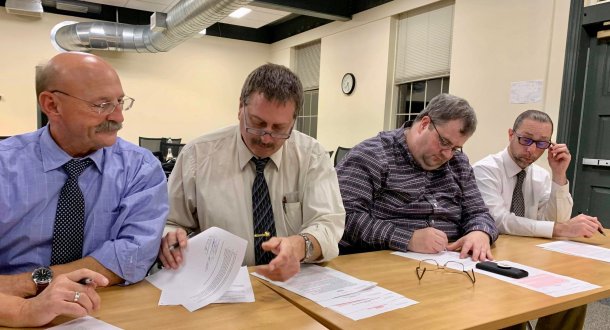
The Scott administration and the Vermont State Employees’ Association have reached a tentative deal on a two-year contract covering the lion’s share of executive branch employees.
The three bargaining units included in the contract are the supervisory, corrections, and non-management units, which involve basically all rank-and-file state employees as well as their managers. In total, it covers about 6,000 employees.
Details of the agreement will not be made public until employees vote to accept the deal. If ratified, the contract would begin July 1, 2020.
Doug Gibson, the communications director for the union, said the VSEA had not yet set a date for the ratification vote, but would soon be scheduling information sessions to answer employee questions about the proposed contract.
“Our rank and file bargaining team members have been meeting for a long time now, they’ve reached a decision, and they’re taking that decision to the membership now,” Gibson said.
Bargaining started in August and concluded with the help of a mediator.
Vermont Human Resources Commissioner Beth Fastiggi said she was “very appreciative of the bargaining teams and their good-faith bargaining efforts.”
The union and the state have had contentious negotiations in the previous two rounds. The current two-year contract went to mediation in 2018 after the union objected to the imposition of the contract by the Vermont Labor Relations Board.
Compounding disagreements about pay and health benefits, the neutral status of one of the members of the panel, Karen O’Neill, was questioned. The board is made up of two representatives from the union, two from the administration and two who are neutral.
Opponents of O’Neill questioned her qualifications to serve as one of the two neutral members of the board, citing her background working with two Vermont utilities and a Burlington law firm that has opposed unions in cases. The Senate ultimately refused to confirm O’Neill’s appointment.
In 2016, after months of negotiations with the Shumlin administration, the contract went before the labor board, which sided with the union. The stalemate was about cost-of-living and step raises.
