


The Vermont State Employees Association and the state agreed Thursday go to mediation to resolve a protracted battle over the terms of the next contract for thousands of public employees.
The two sides came to the agreement at a hearing before the Vermont Labor Relations Board. The union, which represents most state employees, asked the board to reconsider a March decision to impose the Scott administration’s proposal in the negotiations over the next biennial state employee contract.
The agreement to move the case to mediation is the latest development in a months-long fracas involving questions about the legitimacy of an appointee to the board, who was involved with the state contract decision but later failed to win requisite Senate confirmation to the panel.
Because of the tangled appointment process, the appeal came before only two members of the board Thursday.
“This is a very unprecedented situation that the Labor Board and all of us find ourselves in,” board member Richard Park said at the start of the meeting.
The board came down on the administration’s side in a 2-1 decision in March on the state employees’ contract for the next two years.
Shortly after the decision, the union raised concerns about the legitimacy of one of the members of the panel, Karen O’Neill, who sided with the administration.
Opponents of O’Neill questioned her qualifications to serve as one of the two neutral members of the board, citing her background working with two Vermont utilities and a Burlington law firm that has opposed unions in cases.
Ultimately, in May, the Senate refused to confirm O’Neill as a neutral member of the panel.

The board is comprised of two members each from union, management and neutral backgrounds. The other members of the total six-member board had recused themselves from the state workers’ contract decision. The board has raised concerns about the selection process for new members in the wake of the issues.
Only two members of the panel were on hand for Thursday’s meeting, which Park opened by soliciting input from both sides on how to proceed with the “highly unusual situation.”
The meeting began with a discussion of how the panel should proceed with the case, given that only two members of the board — who had come down on different sides in the initial decision — were present.
The union took the position that the hearing could proceed with two members of the board, but a third would need to be briefed in order to issues a decision.
Lawyers for the state said they were “content” with the current panel of two, and believed that they constituted a quorum. They said they viewed O’Neill as a legitimate member of the panel when the initial ruling on the dispute was issued in March, and emphasized that they believe the decision at that time was final.
Ultimately, after hours of discussion and a lunch break, both sides agreed to attempt to resolve the issue in mediation.
The two sides will seek an external mediator that they both agree to. They anticipate moving forward with mediation in the next month or so.
Park refused to comment on the situation after the hearing, citing a practice of not weighing in while cases are open.
VSEA’s attorney Al Gordon O’Connell said he felt the board recognized the seriousness of the situation.
“There are some significant legal issues that are pending,” O’Connell said.
He said taking the case to mediation is a reasonable way to address the complex situation. Mediation will allow the two sides more flexibility in their negotiations, whereas a board decision on last best offer is more rigid.
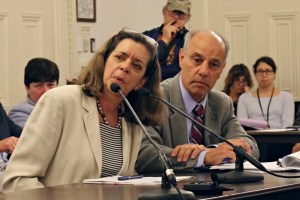
“I think it’s apparent that the best way through this would be to come to a negotiated resolution,” O’Connell said.
Legislation has already been signed into law setting the terms of the state employees’ contract. However, O’Connell said he did not view that as a disadvantage in the mediation process.
“We think the options are there,” he said.
Joseph McNeil, an attorney for the state, noted that both sides showed interest in resolving the issue swiftly, but added that there was no money left on the table for negotiations.
“We would just emphasize that the appropriation has occurred and to the extent that there was surplus money it’s been allocated,” McNeil said. “The Legislature has done what it’s done.”
However, he said the administration is willing to come to the table.
“We agreed to it, so we’ll proceed with it in good faith and we’re hopeful that it will resolve the matter,” McNeil said.
Arguing their cases
Both the union and the state had an opportunity to make their arguments about the VSEA’s appeal.
Over the course of two hours, the union and the state made their arguments about the appeal to reconsider the case.
“The government has decided that people are widgets,” O’Connell said, arguing that the administration focused on dollar figures rather than on the needs of employees to support their families.
The board’s decision took into consideration the state’s ability to afford the contract terms proposed by the VSEA, which O’Connell asserted was a deviation from precedent. O’Connell charged it is up to the Legislature to decide whether or not to fully fund the contract, not the board.
The state’s team urged the board not to take up the union’s request to revisit the March decision.
McNeil said the state believed that the board had the authority to decline to accept the case. They viewed the March decision as final. That decision went to the Legislature, which approved the contract in the Pay Act. Scott signed the bill in May.
“The Legislature is hardly a potted plant in this action,” McNeil said. “It is the ultimate arbitrator, and that ultimate arbitrator has spoken.”
One of the key disagreements was on wage increases for employees under the contract.
The union had proposed a 2 percent annual wage increase. They say the administration’s proposal increases wages only by 1.35 percent annually.
The state has argued that their proposal is a total increase of 2.33 percent, including all factors. A key difference is how each side counts regular “step” increases.
The two sides also disagree how to take into consideration the surplus revenue the state netted in recent months, terms pertaining to employees’ health care plans and more.

