


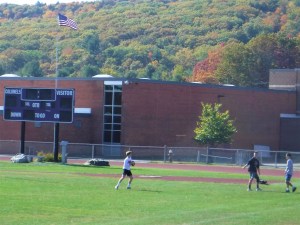
BRATTLEBORO — Residents in the first town in the state to ban single-use plastic shopping bags are asking why Brattleboro Union High School leaders are pushing to replace their football field with a $1 million synthetic surface.
“For a town like Brattleboro that did away with plastic bags, this is not environmentally friendly at all,” Dummerston resident Jody Normandeau said at the most recent Windham Southeast School District Board meeting.
“I am a mother and grandmother of athletes. I understand the need for new fields, but I think there are other ways of getting them,” she added.
School officials announced a plan just before summer vacation to swap grass planted in 1965 for artificial turf. The upgrade, which would solve problems with maintaining the grass and give athletes a more durable place to practice and play sports, has been under consideration since 2002.
But the recent request has taken many residents by surprise. Most locals learned about the proposal from a newspaper story published two days before the school’s last district meeting. A new Act 46-mandated board has since taken over governance of the district.
Only 67 of the old district’s nearly 15,000 registered voters attended the June 12 meeting in which a loan of up to $750,000 for “necessary capital improvements to the recreational field” was approved. The motion didn’t specify a natural or artificial surface, but synthetic turf proponents believe the voter-approved language supports their choice.
Many residents of Brattleboro and the surrounding union high school towns of Dummerston, Guilford and Putney didn’t grasp the change until a crowd of 200 attended the first meeting under the new Act 46-mandated board two weeks later.
Since that time, the new board announced it would withhold a decision until it could host a fall public hearing, which drew a capacity crowd and more than two dozen speakers Wednesday night.
But that hasn’t stopped synthetic field supporters from trying to push their plan forward. Earlier this month, the Windham Southeast School District’s Finance Committee drew ire when it tried to review a call for artificial turf bids before the full board debated other options.
“I think it’s coming through the backdoor,” Normandeau told the committee. “There are a lot of people who don’t know it’s on the agenda.”
“I feel this is undermining the democratic process,” added Henry Zacchini, a social studies teacher at the high school. “I think it’s getting a fox in the henhouse before a decision is made.”
School officials contend that teams can play on grass for only “few hundred hours” a year before the ground breaks down. A synthetic surface, they hope, will allow a field now dedicated to football to also host boys’ and girls’ soccer, lacrosse and field hockey.
But many residents are asking if money would be better spent on reseeding the current field or buying nearby farmland to add more practice space.
Brattleboro resident Timothy Maciel, an instigator of the town’s plastic bag ban, played a video at Wednesday’s meeting that showed how the nearby city of Springfield, Massachussettes, is growing organic grass at its municipal Forest Park.
“When it’s managed properly, it’s very resilient and used for multiple sports,” said fellow resident Marilyn Chiarello, founding director of the Edible Brattleboro community gardens.
Grass fields have their own environmental drawbacks, requiring regular watering and mowing (related emissions are slowly declining with improvements in mowers). But grass fields, like trees, take carbon out of the atmosphere. Offsetting the carbon produced by a standard-sized turf field over 10 years would require planting 1,861 trees, according to a study by Canada’s Athena Institute.
Brattleboro student-athletes were split on the grass versus turf debate. Senior Gus Williams, captain of the boys’ soccer and lacrosse teams, voiced support for synthetic turf. Classmate Amelia Glickman, a member of the girls’ soccer and lacrosse teams, expressed reservations.
“This is a contested issue,” Glickman said. “Not every student athlete prefers that surface, and our environment is in question.’
In the past, school officials have said almost all its football competitors — including Burlington and Rutland — have artificial turf. But Brattleboro, which last won a state football title in 1973, dropped to the smaller-school Division II this fall after winning only one game last season. (Since the division change, Brattleboro has won all seven games so far.)
The School Board could decide what options to explore as soon as its next meeting, set for Nov. 6 at 6 p.m. at Brattleboro’s Windham Regional Career Center. Many residents with concerns about the process hope members will vote to pursue all options.
“This shouldn’t be us vs. them,” Brattleboro resident Dick DeGray told the board. “This is about having all the information.”
At June 12 meeting, the unmerged school board approved a loan of up to $750,000 for “necessary capital improvements to the recreational field.”

A larger crowd challenged that decision at a meeting of the merged board on June 25, leading members to hit pause on the proposal.

Correction: This article originally omitted the word “million” from the headline.
