

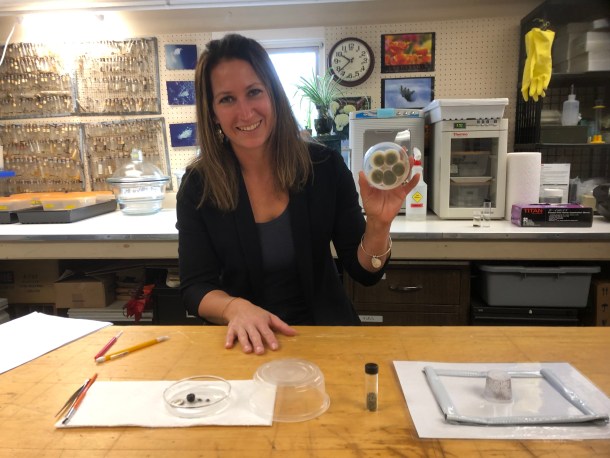
When Cheryl Sullivan started studying a fungi that could manage populations of moose-killing ticks, she knew she’d hit a research sweet spot. If there are two things people like to see, she thought, they’re killing ticks and doing it in an eco-friendly way.
“There’s a huge demand from the public for that,” Sullivan said.
Winter ticks have been the primary cause of the 70% death rate observed in moose calves in northern New England from 2014 to 2016. The fungus that Sullivan is working with in the lab can kill 37% to 100% of the tick larvae it comes in contact with, depending on the dose and application method.
Sullivan, a Ph.D. student at UVM, is working with two faculty members to figure out how exactly to make that fungi work in the real world to keep the tick-moose balance in check.
At her lab, just minutes away from UVM’s campus, she works with more than 30,000 tick larvae and hundreds of kinds of fungi.
Sullivan first got hooked on the project while walking in the woods, finding herself continually brushing off ticks. It especially bothered her because she could remember a time not too long ago when that just wasn’t the case.
“As a kid, you’d be outside and never have to worry about that — checking for ticks,” she said. “Now, you can’t even walk off the beaten path or play in your backyard and not pick up ticks. It seems like they’re there all the time.”
Several other scientists at her lab had been working with insect-killing fungi to tackle a variety of pests, and Sullivan wanted to see if she could take some of those existing fungi products and put them to use to stop the spread of ticks in the woods of northern New England.
But it wasn’t the Lyme-spreading black-legged tick that she was most interested in. Instead, she wanted to focus her research on the winter tick that had been causing so many problems for the area’s moose populations.
Sullivan suspected that spreading a granular form of the fungi that looks like small, rice-shaped chunks throughout the areas most densely populated with moose could put a serious dent in the ticks’ spread, and perhaps provide some relief for the region’s vulnerable moose population.
Unlike the black-legged ticks, which move from species to species throughout their life cycles, the winter ticks have a much more narrow focus. They are a one-host species, typically living on large ungulates like elk, moose or deer.
A female tick can attach to a moose as a larvae, stay on the animal until it matures into an adult, mate while still on the moose, and then ultimately detach to lay eggs on the ground, starting the life cycle anew.
But the ticks don’t attach to hosts one-by-one. While on the ground, they stay in clumps of hundreds or thousands. That’s why dead moose are discovered with an average of 47,000 ticks attached to them. The parasites cause the moose to become anemic, and ultimately susceptible to a number of threats — especially if the moose is still a calf. The moose don’t stand a chance against the thousands of parasites once they take hold.
But, that hasn’t always been the case. In fact, the species used to have a natural deterrent: winter.
With longer, colder winters, it’s more likely that when adult ticks detach from their host, they’ll land on ice or snow, dying before they have a chance to lay eggs. But when the weather warms, they can instead land on dirt and plants, which also allows them a longer period in which to look for a host in the fall.
“It’s kind of a double whammy in the context of climate change,” Sullivan said, “because now it’s allowing ticks to get a little bit of the upper hand on things.”
Sullivan said the fungi won’t be a cure-all for the ticks. But she said it could be an important tool in the pest-management toolbox, along with programs that focus on the habitats or the hosts, rather than on the ticks themselves.
“This really is nature’s battle,” Sullivan said. “We’re just hoping that we can give nature a little bit of an added boost to help it get the upper hand against winter ticks at a time where the climate is changing.”
