


Rev. Canon Ronald Spann knew his stepdaughter had a gift for human connection at a young age.
During a family trip to a historically black congregation in Galveston, Texas, his stepdaughter — Rev. Dr. Shannon MacVean-Brown, then 10 or 11 years old — sat at the feet of the matriarchs of the church, entranced by their stories. At the end of the visit, MacVean-Brown approached each of the elderly women and handed them portraits she had drawn of them as a parting gift.
“We had no idea she knew how to do portrait pictures. And the precocious quality of them were just amazing,” Spann said. “It was something about being engaged, reaching across a generational gap. … And now we’re looking back at her capacity to relate to others different than herself. It was just there, in a little kid.”
MacVean-Brown will put this innate interest in human connection to the test in a new community — as bishop of Vermont’s Episcopal Diocese.
An experienced Episcopal pastor, MacVean-Brown was elected May 18 and she’ll be consecrated into the position Saturday, replacing Bishop Rt. Rev. Thomas Ely, who served 18 years.
MacVean-Brown, 52, is the first African American bishop of the Episcopal Diocese in Vermont, and the first African American woman to serve as a bishop leading a diocese in New England. Mary Adelia McLeod was the first woman elected bishop to Vermont’s Episcopal Diocese in 1993.
On Friday, she talked with reporters about how she plans to build community among the 45 Episcopal congregations in Vermont she’ll oversee.
MacVean-Brown grew up in a family built by the Episcopal faith. Her stepfather was a pastor at the Messiah Episcopal Church on the east side of Detroit where he met MacVean-Brown’s mother, Jackie Spann.
In a way, MacVean-Brown’s initial interest in faith brought her parents together. Jackie put four-year-old MacVean-Brown in daycare at the church, and one day MacVean-Brown asked her mother if they could go to a service.
So they went, and Jackie kept coming back, Ronald said, eventually strengthening her ties to the church. They eventually developed a friendship, he said, which turned into a love, and then marriage. Ronald and Jackie married when MacVean-Brown was nine.
From then on, MacVean-Brown’s life continued to intertwine with the Episcopal faith. Jackie founded a church-based school called the Messiah Learning Center, where MacVean-Brown attended classes.
“Her new normal was that you live in the church and go into the world,” Ronald said. “Whereas most people talk about living in the world and going to church. It was just the other way around for her.”
And while MacVean-Brown is very attached to the Episcopal faith, she’s also felt excluded. Women were not allowed to serve as pastors in the Episcopal Church until 1976. Even though more than 40 years have passed, MacVean-Brown said she is often the only woman in a room full of church leaders. She most recently served as an interim rector at the St. Thomas Episcopal Church in Franklin, Indiana — a city with a population that is about 95 percent white — where she said she was usually the only black person around.
“God didn’t give me the experiences I had to just ignore them,” MacVean-Brown said.
So she began to reflect on something she called “a ministry of otherness.” She turned her personal feelings of isolation into teachable lessons for other Christians who were asking themselves how to include others in their lives who were different from them.
“Those experiences that I’ve had,” MacVean-Brown said, “have informed how to make others feel welcome.”
Rev. Rebecca Nickel, a close friend, said she has witnessed MacVean-Brown’s capacity for connection and welcoming firsthand, specifically through racial differences.
“She’s an African American woman from Detroit. So that has a whole … shape in forming her as a leader,” Nickel said. “Bringing that to a church that is 90 percent white is important. We have a lot to learn from our African-American and multicultural people in the church, and she’s there to help teach us.”
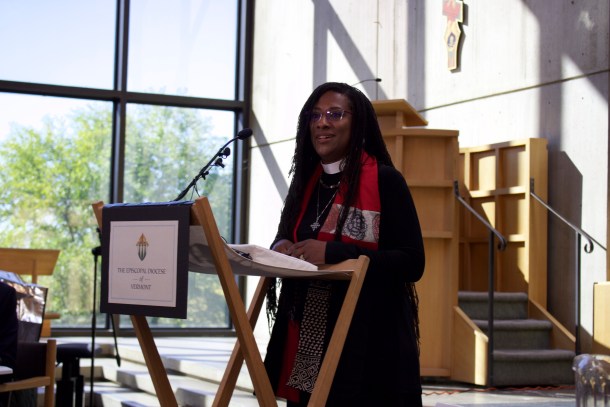
MacVean-Brown’s identity has also driven her commitment to activism. She was involved in faith organizations in Indiana that fight for economic and racial justice. She said she doesn’t know how to be a Christian without also being an activist.
“I think about what Jesus did during his time here on earth, and he spent his time with marginalized people,” MacVean-Brown said. “And that’s part of what we’re supposed to be doing today. Because there continue to be people who are forgotten and lost.”
Now, MacVean-Brown is moving from one majority white community to the next. Vermont has the second largest population of white people in the country, second only to Maine. That fact doesn’t intimidate her.
“Vermont, to me, there was no hesitation,” MacVean-Brown said. “Maybe I should have some trepidation, but I don’t.”
Her stepfather questioned the move to a far less diverse area than her hometown of Detroit.
“All our friends are saying, ‘She’s going where? And how many people look like her?’” Ronald said.
Despite those worries, Ronald said MacVean-Brown has the ability to approach Vermont’s past, and present, conflicts with racism.
“Vermont has some unfinished business,” Ronald said. “The very first bishop of Vermont was a man who wrote a book in 1861 defending the institution of slavery.”
The first bishop was John Henry Hopkins, and his contentious pamphlet was “The Bible View of Slavery.” In it, Hopkins criticized abolitionists and asserted that scripture did not support the end of slavery. Ronald said MacVean-Brown’s presence should serve as a reminder to Vermonters that while progress has been made, there is a deep history of racism in the state.

