

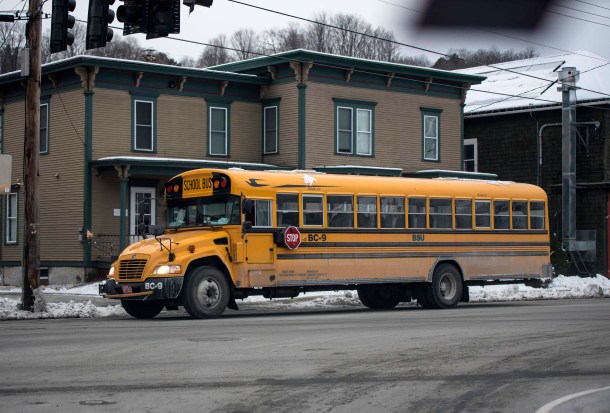
A tight labor market is making the perennial headache of finding school bus drivers even more difficult across Vermont.
“Just about every school district is looking for drivers,” said Todd Parah, the director of athletics, facilities and transportation at Green Mountain Union High School.
Vermont is no outlier. The shortage is country-wide. Media outlets across the U.S. have reported stories of students squatting in the aisle on overcrowded busses, schools postponing sports games, and, in one case, a district cancelling school altogether because it couldn’t get its students to class.
Chris Kemper, a spokesperson for First Student, a national bus company that contracts with a few Vermont districts, said it’s generally difficult right now to hire for any position that requires a commercial driver’s license.
“The crux of it is the labor market. Our unemployment rate is the lowest it’s been in decades,” he said.
Superintendents and transportation managers report dramatically increasing wages, or asking other support staff, like custodians or paraprofessionals, to get their commercial driver’s license. Still, some districts are still cancelling or consolidating routes when they come up short.
“We’re able to manage it right now, but the kids are on the bus a little longer, and the busses are full, and that can always be challenging,” said Jacquelyne Wilson, the superintendent of the Bennington-Rutland Supervisory Union.
The supervisory union, which covers about 450 square-miles, once offered door-to-door service. But Wilson says those days are long gone.
“Sometimes parents have to drive their kids a mile or two to get their kid to that spot,” she said.
The Bennington-Rutland Supervisory Union has also started requiring new custodians to get their commercial driver’s license. Wilson said it’s a way to build in-house capacity instead of trying to recruit new people in such a shallow labor pool, but also a plus for employees, who can go from part-time to full-time status. The supervisory union, which currently also pays beginning drivers $20 an hour, is also considering re-opening its union contract to increase wages.
Parah, at Green Mountain Union High, said his district increased wages for beginning drivers from $14 to $22 an hour over a three year period in an attempt to recruit more aggressively. He agreed finding people with a commercial driver’s license is generally difficult. Plow truck and long-haul drivers are also in short supply.
But he said the problem is compounded for school bus drivers, who also have to be drug tested and pass a background check to work for the district. And it doesn’t help that traditional bus driving gigs only pay for a few hours in the morning and a few in the afternoon.
Like in the Bennington-Rutland Supervisory Union, existing employees at the high school have started getting behind the wheel. Two teachers and one para-educator at Green Mountain have their commercial driver’s license and now drive the bus. Parah also says the school often contacts nearby districts to see if they can share transportation when they’re headed to the same sports game.
“It makes you use more creative ways of bussing,” he said.
