

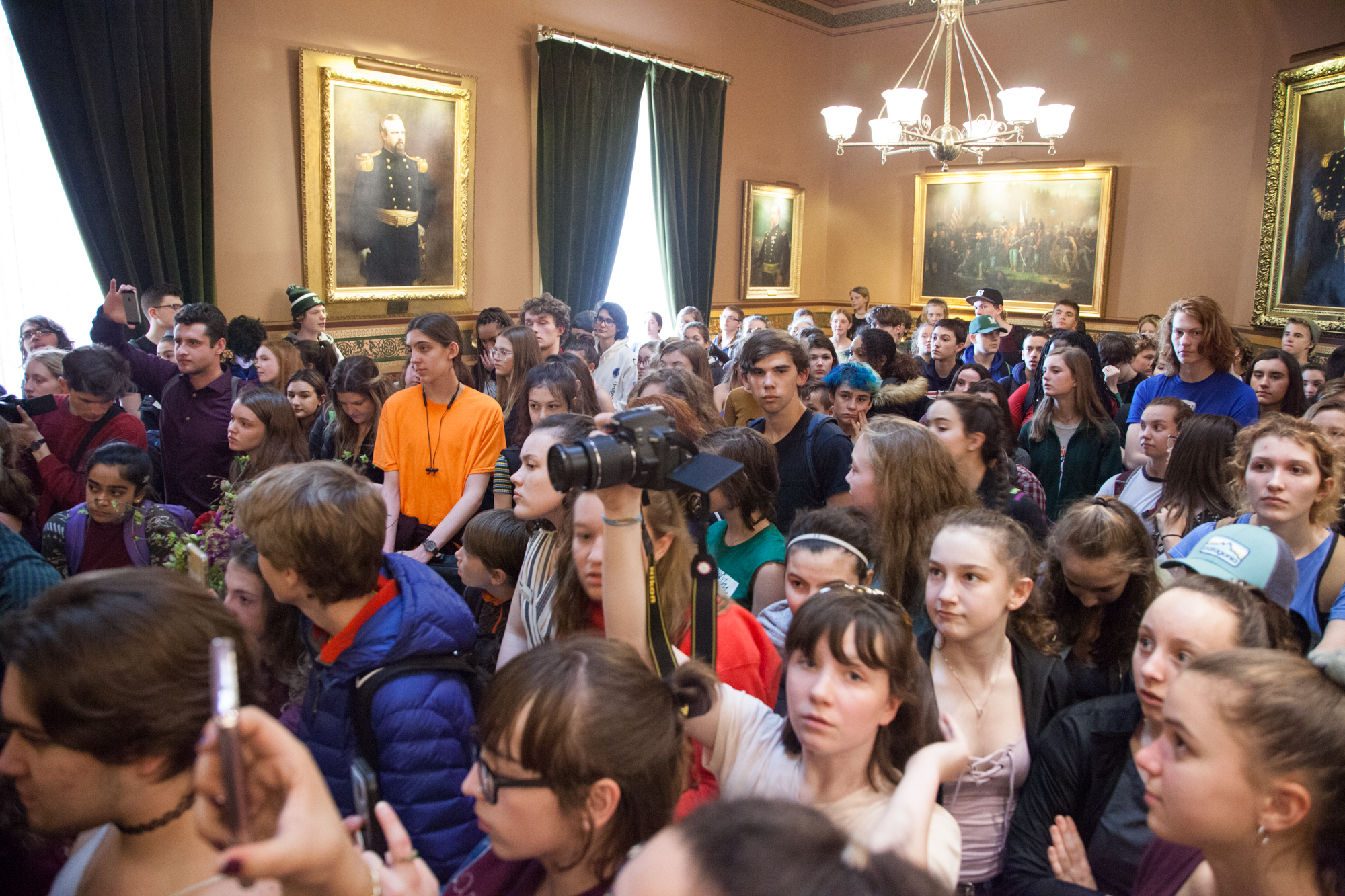
Woodstock Union High School senior Erica Kurash was one of a group of students who organized a climate strike last March, where students left campus to protest government inaction on climate change.
But they ran into a problem.
They couldn’t simply leave campus. In order to express their rebellion, they first had to get their parents’ permission to leave school grounds. Otherwise, they would be given in-school suspensions.
As this Friday’s global climate strike approaches, Vermont school administrators are grappling with how to best use the power of protest for educational purposes, while balancing safety and liability concerns. A number of strikes have been scheduled across Vermont, and Gen Z organizers have been central to the movement, both internationally and locally. And while the action has gained global momentum in large part through the initiative of young people, they can still be restrained by local school policies.
Garon Smail, principal of Woodstock Union High School, explained that school administrators are obligated to keep students safe. That can easily be ensured on campus, he said, but when students leave school grounds it opens up the potential for liability.
“People have entrusted their kids to be at school, so I can’t just say ‘Hey, you can leave campus,’” Smail said. “That’s just not safe and acceptable to do.”
The in-school suspension punishment wasn’t aimed at students to keep them from protesting, Smail said, it was instituted because school policies were broken. Which is partly why Smail and student organizers came up with a different plan for this Friday’s strike — instead of leaving campus, students will be participating in workshops centered around climate change held during a two-hour delay before regularly scheduled class time starts.
Kurash said the alternative plan, which was proposed by students, addresses both safety concerns and engagement issues she witnessed at the March strike. She felt students may have used the strike to ditch school, not to engage with critical environmental issues.
“With the strike in March,” Kurash said, “people were walking out, but they didn’t know what they were supporting.”
In the past, state officials have directed schools not to support student walkouts. Former Education Secretary Rebecca Holcombe sent a memo to school administrators in February 2018 discouraging a student walkout protesting gun violence, citing safety concerns and the exclusion of differing opinions.
Gov. Phil Scott has not issued any directives to administrators about how to approach Friday’s strike. Rebecca Kelley, Scott’s communications director, said the governor did not direct Holcombe’s previous guidance, nor did he know about it before it was issued, and that it does not reflect his views. Holcombe is now running as a democratic candidate for governor.
Kelley also said Education Secretary Dan French is not actively providing guidance to administrators but is available if needed. She said French believes administrators are “well-positioned to manage these types of decisions at the local level and in the best interests of their students.”
Jeff Francis, executive director of the Vermont Superintendents Association, also said he wouldn’t be issuing guidance for administrators and that their local policies should guide their approach to Friday’s strike.
The Montpelier-Roxbury school district won’t be penalizing students for taking part in the strike, Superintendent Libby Bonesteel said, as long as they follow proper procedures for leaving school. Middle school students need a parent’s permission to leave, she said, while high schoolers who are old enough can sign themselves out.
“There is significant concern around student safety. Once they leave our campus we can’t track them,” Bonesteel said. “But as an American, I’m proud of them for taking a stance.”
The Burlington School District is also instituting similar guidance. As long as students are given permission by parents to strike, their absences will be excused.
The Essex school district is also allowing students to participate in the strike if they get parent permission to leave school grounds, Superintendent Beth Cobb said. But Grace Hsiang, a senior at Essex High School, said she was disappointed to learn that her school district won’t be supporting the strike more explicitly. Without a parent’s permission, students will get an “unverified absence” counted against them.
“I’m extremely disappointed,” Hsiang said. “As a school that says they support climate action, that they would so quickly deny this opportunity for students to take a stand on it, that seems conflicting with their message as a school. I’m not happy about it.”
Cobb said restrictions are needed in order to avoid liability concerns.
“I don’t feel right about just letting students walk out of the building,” Cobb said. “We’re just not supporting it or taking part in it as a district.”
Others are taking their students right to the strike’s front lines. Jacquie Werner-Gavrin, director of the independent Red Cedar School in Bristol, is bringing all of her interested middle school students, who have parental permission, to the climate strike rally in Burlington. Werner-Gavrin said the rally will provide an educational experience for students she didn’t want them to miss.
“The leadership role that young people are taking right now around the climate crisis movement is really heartening to us,” Werner-Gavrin said. “And we thought for them to be in the presence of an action like this would be an illuminating educational experience for them.
