


The Supreme Court has handed down a major win for government transparency advocates, deciding that inspecting public records is not the same as copying them, and therefore is not subject charges for the staff time required to respond to such requests.
The justices were split 3-2 in their decision on Reed Doyle v. Burlington Police Department, with Chief Justice Paul Reiber writing the majority decision. The decision reverses a trial court decision, which found in favor of the police department.
Reiber — joined by Justices Marilyn Skoglund and Brian Burgess — argues that there is clear legislative intent in the Public Records Act to differentiate copying records from inspecting them, and that rules around charging for staff time are exclusively related to “copies,” which the requester can physically take away.
The “plain language” of relevant statutes, he writes, “separates requests to copy from requests to inspect, and the section only authorizes charges for staff time associated with requests for copies – not requests to inspect.”
The chief justice seems to sympathize with the fact that state agencies will therefore go uncompensated for the staff time required to create a redacted version of these records, but he says it’s the job of the court to interpret laws, not impose its policy preferences.
“Accordingly, we conclude that state agencies may not charge for staff time spent responding to request to inspect public records pursuant to the PRA. We hold the trial court erred in denying plaintiff’s motion for partial judgement on the pleading,” Reiber writes.
Lawyers with the ACLU of Vermont, along with private attorney Anthony Iarrapino, represented Doyle in the case. He was seeking access to police body camera footage “of alleged use-of-force and threats by Burlington police against children of color in 2017.”
Doyle was denied the ability to view the footage unless he paid hundreds of dollars to the Burlington Police Department.
Jay Diaz, an ACLU staff attorney, said the high court’s decision is a “major ruling” that will ensure state agencies more closely comply with the public records law in the future.
“It has been all too common that public entities resist public records requests by placing enormous monetary cost at the feet of requesters,” Diaz said Friday.
“This makes sure there is no pay wall to holding government accountable and that’s really what the Public Records Act is all about,” he added.
Secretary of State James Condos, who in January filed an amicus brief with the Vermont Supreme Court in support of the ACLU, said Friday he has long believed that inspection of government records should be free of charge and that the public should have to pay a fee if there is a request for a physical copy.

“This is an issue that has popped up from time to time on the difference between inspection and copying,” Condos said. “I think it is important to remember that all government records are public records and are owned by the public.”
Some have argued that this decision could open up state and municipal agencies to excessive requests that would put an undue strain on government entities.
Condos said that while he empathizes with the argument, he is unconcerned that large backlogs of requests will begin to be common in Vermont.
“If you manage your records properly in the first place it shouldn’t be as difficult as they are making it out to be,” he said.
Anthony Iarrapino, a lawyer who worked with the ACLU on the case, said he too has heard state agencies complain about “boogie-men” records requests, but that in reality they are very rare.
“I think the Legislature struck the right balance on this policy. I hope they will stick to their guns when inevitably some constituency or bureaucracy come crying saying open government is just too expensive for Vermont,” he said.
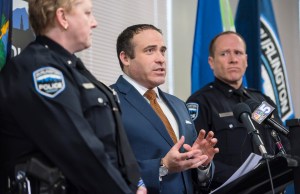
The Burlington Police Department declined to comment on the Supreme Court’s decision. With Police Chief Brandon del Pozo on leave, Jon Murad, deputy chief of operations, referred VTDigger to City Attorney Eileen Blackwood.
Blackwood said the city was disappointed in the Supreme Court decision.
“When someone requests documents that include information that has to be redacted then we have to go through the process,” she said. “We still have to redact and basically still have to make a copy, which we believe the law says the requester should pay for.”
Associate Justice Harold Eaton wrote the dissent to the Supreme Court decision, joined by Karen Carroll. He sided with Burlington police, arguing that the fundamental issue was whether public records requests required staff time.
“A public agency’s lawfully required duties in responding to record requests, not the working of the particular request, should determine whether the agency is authorized to charge for staff time,” he wrote.
Eaton said records requests either required government agencies to make a redacted a copy or it didn’t, but could simultaneously require a new copy and not carry the associated charges required when making that copy.
“It has to be one of the other. The answer can not be that no reimbursement for staff time is available because the request did not seek a personal copy of the record,” he wrote.
Doyle was walking his dog near Burlington’s Roosevelt Park on June 17, 2017, when he saw police officers in a confrontation with a group of youths. One had been arrested for disorderly conduct before Doyle arrived, and others were arguing with police about the arrest.
Doyle says he heard the officers threaten to use pepper spray on the group. He also says he saw an officer push a boy, who already was backing away with his hands up. When the boy protested being pushed, he, too, was arrested for disorderly conduct.
Doyle approached the police officers immediately, and afterward filed a complaint claiming excessive use of force.
The Vermont Journalism Trust, the parent organization of VTDigger, filed an amicus brief in the case siding with Doyle and the ACLU.
Kit Norton and Aidan Quigley contributed reporting.
