




The Department of Public Service is recommending that the potential risks and benefits of a Green Mountain Power proposal to add more home energy storage systems across the state be investigated before it moves forward.
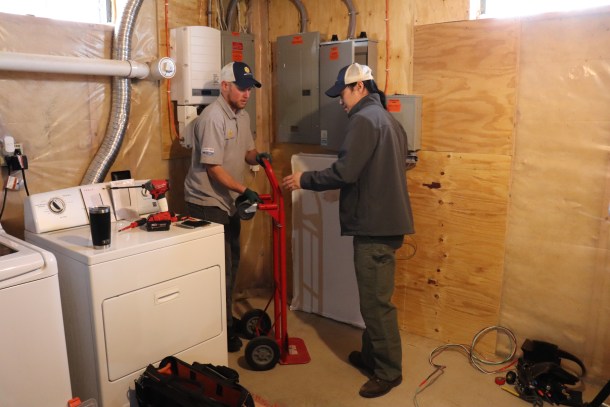
The GMP program installs Tesla Powerwall batteries in homes of its customers, some of whom generate power with solar panels and others who charge them from the power grid. The batteries act like a generator, providing backup power that seamlessly switches on when the grid experiences outages. But it also allows GMP to borrow some of that power during peak power-use times, like the hottest days of the summer, to lower its costs for all customers.
Green Mountain Power says so far, the 2,000 homes that it’s set up with Powerwalls have already earned back the money that was invested in purchasing the systems, plus saved their customers half a million dollars.
It says with the program in full force, it could save its customers $2 million annually.
But the initial costs of the batteries aren’t cheap — and the Department of Public of Service expressed concerns that the GMP offerings may be placing a “disproportionate share of financial risk” on non-participating ratepayers.
In each home enrolled in the program, GMP installs two Powerwalls. That comes with a $13,000 price tag per residence, not including the costs of supporting hardware and installation.
The filing by the Department of Public Service essentially asks that those numbers be checked out, to make sure that the savings are as good as they seem — because if they aren’t, it will be the company’s ratepayers that will have to bear the cost.
“We just want to go through the process and investigate and verify that the benefits are actually there for all ratepayers,” said Jim Porter, director of public advocacy for the department.
GMP spokeswoman Kristen Kelly said the investigation is something that GMP expected and welcomed. She noted that several previous iterations of the Powerwall programs have been looked at by the state and allowed to proceed.
“We’re happy to share information about it, and then ideally be able to offer these systems to more customers,” she said.
Kelly said that the measure is not only a cost-saving mechanism, but also a way to help save energy.
“During a heat wave, the dirtiest sources of power are being used that would not normally be used,” Kelly said. “These systems store clean energy, and reduce carbon in the process.”
GMP currently is seeking approval for a separate pilot project, called the “energy bundle innovation,” that would pair solar panel installation with battery storage. GMP customers can either enroll directly with the utility, which will use Tesla solar and Powerwall batteries, or buy solar and a battery system through a third party.
Department attorney Dan Burke said in a case filing that said the department “remains concerned” that the utility is making investments into one technology largely from a single manufacturer when energy storage systems will likely continue to improve in coming years.
The department added that it does see value in pilots that explore non-net metering options for residential solar, which utilities have increasingly started to say is becoming too costly. Utilities are also required under Vermont’s renewable energy standard to reduce customer fossil fuel use through “energy transformation projects,” like battery storage and electric vehicle incentives.
Burke said that the Tesla Powerwall review by the PUC should provide “meaningful guidance” on whether the utility can include future energy storage programs as part of its rate base.
Kelly said GMP has also worked with “BYOD” or “bring your own device” programs, where customers can buy a home energy storage system from another company, and then share some of their stored power with GMP in exchange for savings.
She said those other batteries aren’t part of the current proposal, because using just Powerwalls turned out to be the only way to get numbers to work out in this scenario.
However, she said Powerwalls have been in high demand from their customers, so GMP would be happy to see more people be able to use them.
“They deliver great benefits to customers that receive that backup power during storms, and it also generates savings, and helps lower the cost for all customers,” she said. “People really want them.”

