

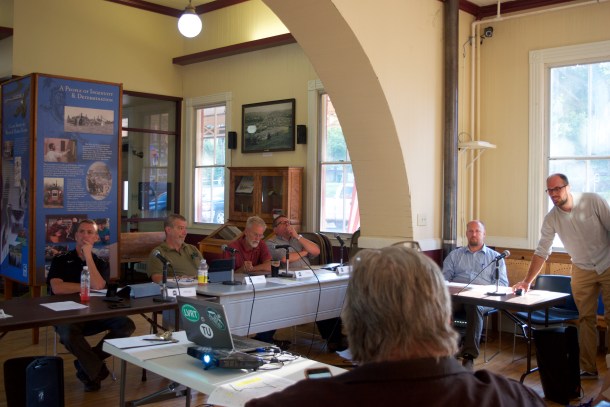
ST. JOHNSBURY — Selectboard members want more details before they’ll vote to ask citizens on Town Meeting Day whether St. Johnsbury should join a proposed communications union district in Caledonia County.
“Prior to this coming back to the board, would you do a little homework for us, please?” Selectman Jeffrey Moore asked Lyndonville entrepreneur Evan Carlson and Rep. Scott Campbell, D-St. Johnsbury, after their presentation about the district to the board Monday.
Moore asked the pair for more information about the current internet service from private companies in the region, such as Consolidated Communications, “to understand more wholly where we are in St. Johnsbury.”
Carlson and Campbell made their case to town officials that St. Johnsbury and other communities would benefit from joining a communications union district — and that the Selectboard should add a question about joining the proposed district to the Town Meeting Day ballot for March.
A communications union district is a type of governmental body created in 2015 that allows municipalities to join together to provide broadband internet service. Legislation lets a district obtain municipal bonds for the task, and a few exist elsewhere in the state.
“The important part about a CUD, and about towns joining a CUD, is that it eliminates the exposure of taxpayers to financial risk,” Campbell said. “The risk is all taken by the municipality, which is the communications union district. It’s just like a school district, or a waste district, or a water district.”
Carlson and others — such as Katherine Sims, director of the Northeast Kingdom Collaborative — have been pushing this summer to bring communications union districts to the Northeast Kingdom so more people can access broadband internet. Representatives from a working group behind the effort have been visiting local boards to win their support.
Broadband refers to a high-speed connection that is always on and faster than dial-up. To qualify as broadband, a fixed service needs a download speed of 25 megabits per second and an upload speed of 3 megabits per second, according to the Federal Communications Commission.
But the Kingdom’s counties — Caledonia, Essex and Orleans — have some of the lowest availability of 25-and-3 coverage in Vermont.
That’s caused challenges for businesses and beyond.
Campbell explained that the district would be eligible for state grants to fund feasibility studies and business plans. He said the working group behind the proposed district had already received “up to $80,000” for those efforts.
The district could also receive a startup loan from the Vermont Economic Development Authority through a mechanism created in this year’s broadband bill, Scott said.
The two advocates said taxpayers wouldn’t be footing the bill for the district, now or in the future.
“The entity is sustained through actual subscriptions to the service,” Carlson said, adding later, “This is actually direct dollars from the consumer, the end user for that service.”
Carlson told board members that the district plans to use fiber cables for its internet service and argued that it could provide better connections to people for the same price offered by private companies — or even at cheaper rates.
Still, officials put off a decision.
“I think Jeff brought up a couple of good questions, too, about what happens if one town decides to opt out, or the CUD goes belly up, or whatever happens,” Chair Kevin Oddy said, referring to Moore. “I’d like some answers to those questions, too.”
