

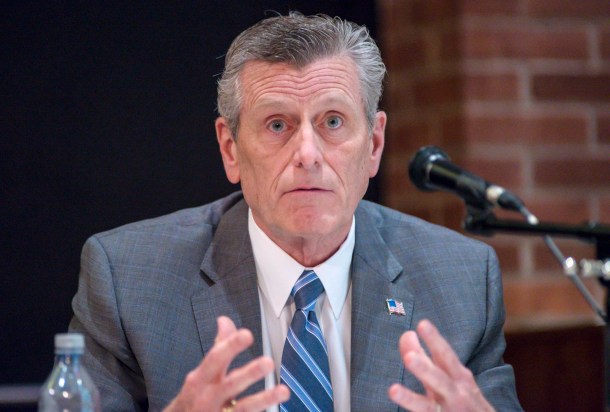
The interim CEO of the financially strapped Springfield Hospital says its financial structure is unsustainable and its survival will be “virtually impossible” unless it merges with other hospitals in its region.
Michael Halstead, the interim CEO of Springfield Hospital, which filed for bankruptcy in June as it tries to restructure about $20 million in debt, presented its proposed budget Wednesday to the Green Mountain Care Board.
The hospital is in merger talks with Mt. Ascutney Hospital in Windsor, and the Valley Regional Hospital in Claremont, New Hampshire, with the support of Dartmouth Hitchcock Medical Center, which is already affiliated with the other two organizations.
In an interview after the hearing, Halstead said that unless the three small rural hospitals combine under one umbrella, it will be difficult for Springfield Hospital to stay afloat.
He said that there would be “an awful lot of administrative costs taken out of the system if the three hospitals could function as one.”
“I think that’s what it’s going to have to be because otherwise, without that, we’re all protecting our own balance sheets, and that’s not going to work,” he said.
After months of financial strain, Springfield Hospital is expecting to lose $6.5 million by the close of the fiscal year, and in a proposed budget for next year, still projects a loss of about $1 million.
Although the hospital’s patient volume is increasing, it is still down from what it was in fiscal year 2018.
That year, the hospital saw an average of about 16 inpatient visitors per day and seven psychiatric patients. In fiscal year 2020, Springfield expects about 12 inpatient and six psychiatric cases per day. Outpatient cases are also projected to be low next year: down from 449,000 in 2018 to 408,000 in 2020.
Halstead said the hospital only has enough cash on hand to operate for 10 days and is “living pretty much on the edge.”
Speaking to the Green Mountain Care Board, the panel that regulates health care spending in Vermont and is in the process of reviewing Vermont hospitals’ proposed budgets, Springfield officials also detailed their efforts to cut costs next year by $10 million.
The hospital closed its birthing center this year, and started contracting out its anaesthesiology services — yielding about $2 million in savings.
The largest source of savings stem from the reorganization of its emergency room, where it expects to cut $3.3 million in costs next year.
The hospital now has staffed doctors in the emergency room at all hours of the day, and doesn’t rely as heavily on physician assistants. Doctors are able to provide care to patients more efficiently than physician assistants, which the hospital expects will help save resources in the ER.

Mt. Ascutney Hospital in Windsor also estimated it would see about $400,000 in losses by the end of the year.
It has faced many of the same struggles Springfield and other rural hospitals in Vermont have in recent years, including an aging population and difficulty retaining a robust workforce.
If the care board approves the Mt. Ascutney budget, which includes increasing the revenue it takes in from patients by 7.2%, it will be able to see a positive margin in 2020, officials said.
The hospital has asked the board to increase the average rate it charges patients for medical service by 3.2% in order to staff primary care doctors and serve an influx of New Hampshire residents and former Springfield Hospital patients.
Mt. Ascutney has seen a 25% increase in patient revenue from the area surrounding Springfield Hospital and 13% from New Hampshire patients.
“This is just what’s happening within the region organically based on the ebb and flow of available services,” said David Sanville, Mt. Ascutney Hospital’s chief financial officer.
Kevin Mullin, the chair of the Green Mountain Care Board, said that a merger between Springfield, Mt. Ascutney and Valley Regional hospitals could be a good approach to stabilizing the medical centers.
“If there was [some way] that you could take those three entities and make it work with one leadership team then maybe the operations are viable,” Mullin said.
“I don’t know how you don’t lose everything at the Springfield Hospital location without doing something creatively at this point,” he added.
“Maybe if they had come forward a year and half or two years ago when it should have been addressed, it would be different,” he said.
