

Editor’s note: Mark Bushnell is a Vermont journalist and historian. He is the author of “Hidden History of Vermont” and “It Happened in Vermont.”
Day after day, John Lincklaen sat astride his horse, making his way through a Vermont few of us today would recognize. He was seeing a sort of proto-Vermont, one in which the state’s main thoroughfares were no more than muddy lanes and where many towns were just springing up. Along the way, he met Vermonters who saw the financial possibilities in offering lodgings to travelers but who thought that maple sugaring would never succeed here. And he even met the governor, one of the founders of the new state, a man who could barely write.
This was hardly a vacation. It was a business trip, a long, arduous journey into a newly settled region with many inconveniences to endure and few comforts to enjoy.
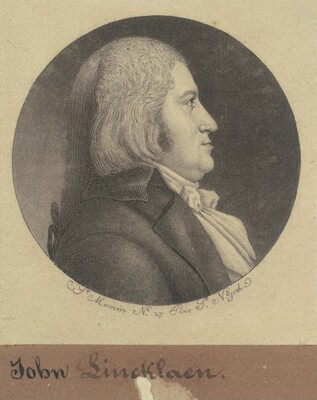
But Lincklaen was glad to get the assignment, and we today are lucky he did. Lincklaen, a Dutchman, was a 23-year-old at the time of his trek through the little-known territory of Vermont. It was early fall in 1791. Vermont had been a state for barely six months. As agent for the Holland Land Company, Lincklaen was scouting for trade opportunities.
His handwritten journal was published a century later by his granddaughter and today provides a rare glimpse into the early days after Vermont statehood.
As an outsider, Lincklaen found much worthy of note. Arriving from long-settled Europe, he was particularly curious about the nomadic lives of many Americans on the frontier. “(I)t is usually the case with Americans, beginning quite poor they buy a few acres in a new country for almost nothing,” he wrote. “(W)hen after 8 or 10 years of rugged toil they have augmented the worth of their lands, they find themselves with a numerous family, & their little territory, however valuable it may be, does not suffice to support them.” So they sell their land and use the money to buy a larger parcel in a less-settled area, “where the lands are cheaper, three times the quantity, enough to maintain & establish around them a dozen children.”
Even as Lincklaen was imagining these large settler families, much of Vermont was still sparsely settled. He reported the population as 85,708. For the Vermont leg of his journey (he was also visiting New York and Pennsylvania), he started at Bennington and traveled north roughly along the route of current-day Route 7. Biting off the trip in small chunks, usually fewer than 10 miles a day, Lincklaen and his traveling companion, a fellow Dutchman named Gerrit Boon, passed through Arlington, Manchester, Dorset and Rutland, and then on to Middlebury. He declared that the route had been along “tolerable good roads,” much better than the stretch between Middlebury and Burlington, which he described as “mud to the horses’ belly.” (Does that mean that anything short of “mud to the horses’ belly” constituted “tolerable good” in those days?)
Heading north from Middlebury, a bad decision or perhaps bad advice, made matters worse. “(T)here are two roads to Vergennes (and) we were so unlucky through the stupidity of other people as to take the worst,” he wrote.
Reaching Otter Creek, they found no pontoon bridge to cross. After searching for two hours, they found a boat to cross the creek while their horses swam. On the other side, they had to rely on the hospitality of locals. “Night coming on,” he wrote, “we had to pass the night in a poor log house, happily we found kind people there who gave us of their best.”
The next day was a Sunday. State law prohibited people from traveling on the Sabbath. But they risked it anyhow, reaching the tavern home of a Colonel Keys in Burlington Bay by afternoon.
The road was not without hazards. Boon’s horse had taken a fall into a hole, and Boon was injured. Having breakfasted in Vergennes (“a new settlement”), they decided to rest in Charlotte so that Boon could treat a cut he suffered in the fall.
To Lincklaen’s eye, the growing community of Burlington held promise. Though the settlement was new, he said, “people begin to live at their ease.” In other words, people were no longer struggling to get their most basic needs met.
Lincklaen was impressed with Keys and his establishment. “He is obliged to keep tavern by the situation of the place, is truly amiable, has been well educated & has many attainments,” he wrote. “We are very comfortable at his house, & very glad to spend some days here to refresh ourselves & recover from the fatigues & the bad roads we have just come through.”
Vermont had evenhandedness built into its basic structure, Lincklaen believed. “There are no great land holders as in the Southern States,” he wrote. “The legislature has always believed it was its policy to grant only a small number of acres to any one person, for the greater preservation of equality, & preventing too great individual influence.” The downside to this policy, he suggested, was that it made land expensive, as much as 10 to 20 dollars per acre.
But then he mentioned a pair of landowners who had gotten their land before Vermont became a state and thus controlled massive tracts. “Genl Allen,” by which Lincklaen meant Ira Allen, held 120,000 acres—historians now put the figure at perhaps 200,000; and Gov. Thomas Chittenden held 30,000 to 40,000.
Burlington-area farmers were relatively prosperous, Lincklaen noted, raising wheat, corn and cattle, which they traded north to British-controlled Canada, receiving European products in return. But the British, still smarting from the loss of the Colonies, prevented the importation of manufactured goods. Further evidence of the hard feelings was the presence of small British military posts on Lake Champlain, on North Hero in Vermont and Point Au Feu on the New York side.
Lincklaen saw promise in the state’s abundant maple trees, “but the people do not seem to me to be persuaded of the advantage they might gain from this tree.” Dutch investors were looking at maple sugar made by free farmers as an alternative to sugar cane grown and harvested in the Caribbean by slaves.

Still, Lincklaen was optimistic that a consolidated maple operation could turn a profit, particularly if canals were built on either end of Lake Champlain, to help open the New York and Montreal markets (as they eventually were).
From Burlington, Lincklaen and Boon headed east toward Windsor. They picked up their pace and Lincklaen wrote little about this long stretch of the journey.
Maple faced several obstacles, Lincklaen conceded. The state’s soils were so light, he claimed, that even “the least wind uproots” the trees, “an inconvenience for which a remedy should be sought.” Heavy snows made collecting sap difficult, Vermonters told Lincklaen. And there was no local market, or at least not a large enough one, and it cost too much to ship the sugar to more populated areas.
But he did comment at length about their visit, at the start of this section, with an interesting character, Gov. Chittenden. Lincklaen was struck by Chittenden’s lack of pretense.
“He received us without ceremony, in the country fashion,” Lincklaen wrote. “He is a man of about 60 years, destitute of all education, but possessing good sense, & a sound judgment… (He) was not ashamed to say that when he placed himself at the head of those who wished a separation from the State of New York, he scarcely knew how to write.”
The state owed its existence in part to this simple farmer, Lincklaen noted. During their visit, Chittenden explained the history of the Revolution and his role in it. Sadly, Lincklaen doesn’t provide a transcript of Chittenden’s version of events.
Visiting with the governor at his home in the foothills of the Green Mountains, Lincklaen seems to have savored this interesting interlude during his business trip.
“(H)e still retains the inquisitive character of his compatriots, & overwhelms one with questions to which one can scarcely reply,” Lincklaen observed. “…His house & way of living have nothing to distinguish them from those of any private individual but he offers heartily a glass of Grog, potatoes, & bacon to anyone who wishes to come see him.”
What an unlikely leader to have helped create this unlikely state, Lincklaen must have thought.

