

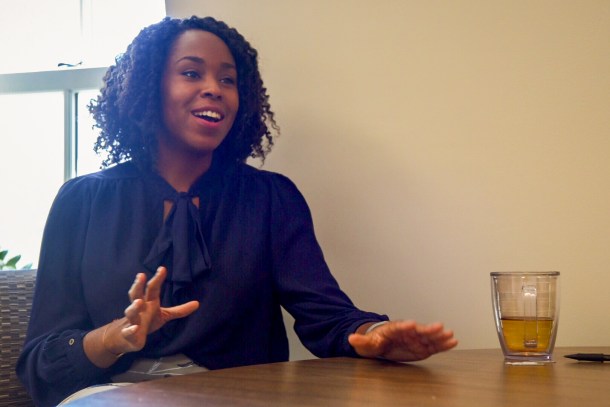
Xusana Davis couldn’t take getting stuck in a tunnel during another commute.
The 30-year-old had already decided to leave New York City for Vermont when she saw the job posting for the state’s first executive director of racial equity. So, “on a whim,” she applied.
Now, in a new cabinet-level role created by legislation last year, Davis will work with the new five-member Racial Equity Advisory Panel to identify and address systemic racism in Vermont.
Davis previously served as an official in the New York City Department of Health and Mental Hygiene, where she gathered data on the connection between secure housing and people’s physical and mental health. Previously, as the director of New York City Council’s Black, Latino, Asian Caucus, she had assisted policymakers in the largest municipal minority caucus in the country.
Davis has now been on the job for about a month. On Thursday, VTDigger sat down with her to discuss how she ended up in Vermont, her vision for the position and what her definition of success is. This conversation has been edited for length and clarity.
VTDigger: Why did you decide on Vermont? You’ve said in an interview with VPR that you had been planning to move to Vermont before you got this job. What made you decide to move here?
Xusana Davis: I lived in New York state my whole life. I lived in New York City the last decade or so, and I love it — I love everything it has to offer. But I decided I wanted to live in a place that values individual liberties and civil liberties a little bit more and was still close to my home state and socially felt welcoming. So Vermont it was.
I had Vermont on my radar for a while and then I was following the news about the passage of the legislation that created this role. When I saw the job was available, I — on a whim — said ‘well, let me take a chance and apply.’ And Vermont took a chance on me.
VTD: How would you describe your role as succinctly as possible for Vermonters to understand what it is you will be doing?
XD: I am here to help you as Vermonters, as my fellow Vermonters, to get farther, do more and be our best. I am not here to create problems where they don’t exist or to single handedly fix problems where they do exist. I’m here to help the rest of Vermont to ask the right questions so we can implement the right policies so that we can do the right things for one another.
VTD: Being in the position for just a short time, how would you define success for yourself in this position moving forward?
XD: When you all don’t need me anymore. Truly my goal is to put myself out of business. And it’s hard, we don’t know what it looks like on the other side because in this country I don’t think we’ve ever truly achieved 100%, 360-degree equity along all the fronts in which it is necessary. So it’s new, it’s uncharted territory for a lot of people here and I don’t know if a bell will ring and confetti will drop when we do hit success. But what I genuinely hope for is that there’s less of a need for roles like mine because equity, not just racial equity, is built into everything that we do.
VTD: Is there anything that you have noticed since you moved here that has really stood out to you, in terms of first impressions and interactions that may inform the work you will be doing?
XD: When I was apartment hunting, one of the places I was looking at, a neighbor across the street had a huge Confederate flag hanging outside his home and sort of stared me down as I walked up the driveway. But then three streets over there are pride flags galore, and people who appear to be going out of their way to be making eye contact with me and smile.
I see Vermont as a place that is excited for a demographic change. My experience, just as a visitor in the last few years, has been one where I always feel very noticed. In Vermont, in New Hampshire, in these spaces, every time I walk into a Shaw’s, there are children who stare, things like that. When kids do it, I don’t really mind. When adults do it, it’s a little more unusual. It’s definitely a place where I am noticed and I know that I am noticed. But I think people in Vermont have really gone out of their way to be welcoming and inviting.
One thing I’ve learned is that in the same way this state sees a lot of socioeconomic disparity — a lot of differences in everything from education level to where people come from — there is also a big difference in people’s social outlooks. And by and large most of the people I have met here have done a really great job of expressing their support for the work and making themselves available to collaborate and help in any way they can.
VTD: In a state that is so overwhelmingly white — 94% white according to the 2015 Census — what does racial equity look like for the state as an employer and looking at a pool of candidates which, by the numbers, will be mostly white people?
XD: That is a question that you will get one million different answers depending on who you ask. I believe that racial equity means that if you are afforded a particular opportunity, if you are experiencing a particular hardship in life, if there is something working to your disadvantage, it’s not going to be because of your race.
That is what racial equity is to me: that your race or your ethnicity is not going to be the determining factor in your life outcomes.
And it’s hard because for the last nine centuries that has almost exclusively been the case, but we as a society, as a state, as a nation, have been working hard for many years to turn that tide. It’s difficult work and it’s not going to happen overnight because we didn’t get here overnight. But what’s important is that one, everybody participates and two, that people do so in a way that is honest and open-minded.
VTD: There have been discussions in the Legislature about revitalizing Vermont’s economy. How do you see your role interacting with that goal and attempting to attract more people to the state?
XD: I think a lot of times people from outside the state don’t see themselves living here. They don’t see themselves as being welcome or being part of Vermont society. So if we as a state can demonstrate to our friends in other states or in other countries that Vermont is and will continue to be a destination for people of varied interests, various walks of life, then it will help us to recruit and retain talent, and recruit and retain neighbors.
One of the ways that we can help to improve that and help to have a vibrant and robust economy is to make sure we have a vibrant and robust state. It means that if we ensure that our physical infrastructure and our service infrastructure and our social infrastructure are equitable for all people, then more people will see themselves here.
VTD: Looking at the recent reports in the media about hate group activity being on the rise in Vermont, and the case of white supremacist Max Misch harassing former Bennington Rep. Kiah Morris, where do you see the work you’re doing interact with what is happening here?
XD: The legislation that created this position was spurred, if not advanced, in response to those kinds of incidents. However, those weren’t the first times we saw this action in the state and sadly it will not be the last.
The work that I’m doing is not intended to cure, or fix or dismantle anything. It is intended to illuminate our blindspots and to help us understand where we are as a state, what are our shortcomings and areas of opportunity. If there is an incident of a hate crime or harassment along those lines, how do our municipalities and the state as a whole handle the law enforcement aspect of that?
So the work I’m here doing is one link in a long chain of what has been (happening) in this state. That needs to be done so we don’t have more incidents like what happened with Rep. Morris and many other people who go unnamed and unreported but who also experience extreme violence or otherwise biased treatment.
VTD: Have any current or former state employees reached out to you and explained experiences they have had or told you about incidents they thought you should be aware of?
XD: I have not yet received any complaints or reports or whispers from current or former employees about their experiences. I’m someone who believes very strongly that government is supposed to be accessible to people so I understand that there are mechanisms like the Human Rights Commission and other agencies whose job it is to receive those kinds of complaints and inquiries. But I also want Vermonters to feel comfortable approaching me or discussing these kinds of things with me as well, because one of the things that a lot of marginalized people will tell you is that just because there technically exists a reporting structure doesn’t mean that it is always one where people feel comfortable utilizing it.
So while I haven’t yet been contacted by anybody around those lines, my operators are standing by, so to speak. I hope we don’t have many of those but if they do exist and they are out there then they should disclosed and they should be known about so we have more data and more information on which we can act.
VTD: Will you be working with lawmakers here?
XD: I hope to. There is the Racial Equity Advisory Panel that has appointees from the Legislature. Separately from that, the legislators are the ones on the ground in their districts. They understand the needs of their communities and we can’t accomplish progress in equity if we aren’t working with every stakeholder and every person on the ground.
This is one of the things that is so important to me: to expand the conversation so that every Vermonter feels comfortable being able to have discussions around race.
We have a saying where my family is from, “Más sabe el diablo por viejo que por diablo,” which translates to, “the devil knows more by virtue of being old than he does by being the devil.” What that means is that you don’t have to be a scholar on critical race theory, you don’t have to have been an advocate in this work for 20 years. All you have to do is be a person who can identify inequity and call it out.
