

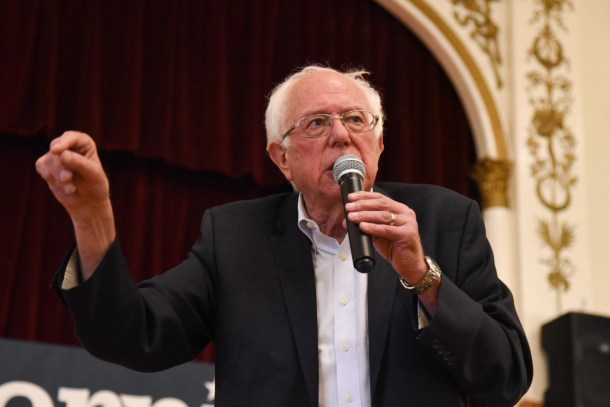
[S]en. Bernie Sanders softened his attack on the Washington Post Tuesday, backing away somewhat from his claim the day before that the newspaper’s negative coverage of his campaign stems from his criticism of Amazon, because both are owned by billionaire Jeff Bezos.
In an interview with CNN, Sanders sought to clarify his earlier remarks by saying he doesn’t think Bezos is actually influencing the Post’s coverage, as he originally implied.
“I think my criticism of the corporate media is not that they are anti-Bernie, that they wake up, you know, in the morning and say, ‘What could we do to hurt Bernie Sanders?’ — that’s not the case, that Jeff Bezos gets on the phone to the Washington Post,” Sanders said. “There is a framework of what we can discuss and what we cannot discuss, and that’s a serious problem.”
On Monday, Sanders took a shot at the Post in two separate town hall events in New Hampshire. At an event in Wolfeboro, Sanders asked a crowd “Anybody here know how much Amazon paid in taxes last year?”
To that, one audience member shouted out, “Nothing!”
“See, I talk about that all of the time,” Sanders said. “And then I wonder why The Washington Post — which is owned by Jeff Bezos, who owns Amazon — doesn’t write particularly good articles about me. I don’t know why. But I guess maybe there’s a connection. Maybe we helped raise the minimum wage at Amazon to 15 bucks an hour as well.”
The company raised its minimum wage last year after a number of critics, including Sanders, called on Amazon to pay workers a “living wage.” Sanders has also spoken extensively about how Amazon should pay more federal income tax, in response to a June article in the Wall Street Journal that questioned whether the company paid taxes last year.
Dan Kennedy, a professor of journalism at Northeastern University, said the reality is that there’s no evidence the Post has done anything to soften coverage around Bezos’ interests.
“I would say Bernie has a leg to stand on to the extent that he has picked up on the fact that Jeff Bezos is the founder and chief executive of Amazon,” he said, “and that potentially there could be some conflict of interest in how the Washington Post covers Amazon.”
Kennedy said Bezos actually has an “unusually hands-off approach” in the way he runs the Post.
“Not only is there no evidence he’s interfered in news coverage,” Kennedy said, “he really hasn’t touched the editorial pages, either.”
Marty Baron, executive editor of the Post, put out a statement in response to Sanders’ comments, saying that Bezos has no role in the paper’s coverage.

“Sen. Sanders is a member of a large club of politicians — of every ideology — who complain about their coverage,” Baron wrote. “Contrary to the conspiracy theory the senator seems to favor, Jeff Bezos allows our newsroom to operate with full independence, as our reporters and editors can attest.”
Jay Rosen, a media critic at NYU, agreed, saying he thought it was a “dumb comment” by Sanders.
“I doubt very much that Jeff Bezos is trying to influence Washington Post coverage of Bernie Sanders,” Rosen said. “If he tried to do that, we would probably know about it.”
He said this kind of comment probably stems from Sanders being more confrontational than other candidates.
“And the people running his campaign think they have a reason to be,” Rosen said. “They think this is a necessary move from them.”
Kennedy noted that this kind of comment from Sanders is well within the political norm. He said nearly every presidential candidate in recent memory can find some news coverage to complain about.
A favorite example, he recalled, was with Richard Nixon’s vice president, Spiro Agnew, who liked to call the press “nattering nabobs of negativism.”
“You kind of see the media criticism devolving, though,” Kennedy said. “He used three words that Trump probably doesn’t know.”
Both Kennedy and Rosen emphasized that although left-leaning voters have a greater trust in mainstream media than do right-leaning voters, there has been a rising anger among liberals in media coverage.
“Even though I don’t think Bernie Sanders is right,” Kennedy said, “I think the sort of thing he’s saying is within the bounds of what we expect a politician to say. That makes him very different from the things we hear from President Trump about ‘enemies of the people’ and ‘fake news.’”
